

The border region is depicted in Nguyễn Tấn Tuấn's colorful photographs, featuring Bà Đen mountain, Dầu Tiếng lake, and rubber forests shedding their leaves...

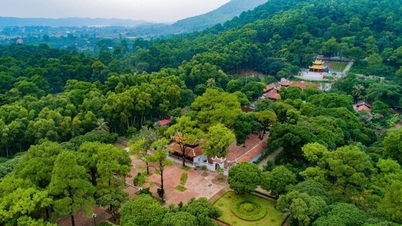
Mount Ba Den is one of the most famous spiritual tourist destinations. Visitors ascend the mountain by cable car to visit historical sites and ancient temples such as Linh Son Tien Thach Tu, Hang Pagoda, and Dien Ba, and hear the legend of Linh Son Thanh Mau, also known as Ba Den, who is worshipped in a stone cave.
The Ba Den Mountain cable car opened in early 2020. It has two lines: the Van Son line takes visitors from the foot of the mountain to the summit, and the Chua Hang line connects the foot of the mountain to Ba Den Pagoda. With an area of 10,959 m2, the cable car station has been recognized by the Guinness World Records as the world's largest cable car station. A round-trip cable car ticket to the summit of Ba Den Mountain costs 100,000 VND for visitors taller than 1.4m and is half price for children between 1m and 1.4m tall.


The solar panels, which generate electricity, are mounted on concrete pillars 6-8 meters high at the solar power plant located in the semi-submerged area of Dau Tieng Lake.


Besides landscape photography, the author also documented the daily life and activities in other craft villages in Tay Ninh.
The conical hat is an integral part of Vietnamese life. Within the province, there are hat-making areas such as the craft village in Ninh Son ward, Tay Ninh city, and the conical hat-making hamlet in An Hoa ward, Trang Bang town.
The photo shows an elderly woman in a traditional Vietnamese dress sitting and weaving conical hats in Ninh Son ward. "The old woman with the kind face carefully arranging each palm leaf onto the frame for sewing impressed me," said Tuan.

Drying chili peppers in Trang Bang. The dried chili peppers are then processed into chili salt, a specialty of Tay Ninh province.

Large pieces of colored and uncolored potato starch are dried in Long Thanh hamlet, Truong Tay commune, Hoa Thanh town. After drying, the starch is put into a machine and finely shredded into small strands.

The woman dries incense sticks on long shelves in Long Tan neighborhood, Long Thanh Bac ward, Hoa Thanh commune. Tay Ninh incense sticks are yellow or brown and are not coiled into bundles.

The craft of firing cups for collecting rubber latex in Phuoc Vinh commune, Chau Thanh district. After filling the molds with fine clay, the cups are dried thoroughly in the sun and removed from the molds (photo) before being placed in the kiln.
Tay Ninh has 12 different traditional craft groups: from making rice paper, chili salt, rattan and bamboo products, incense making, household carpentry, conical hat making, blacksmithing, tailoring to brick production, mechanics, cassava processing and agricultural, forestry and aquatic product processing.
Nguyen Tan Tuan - Huynh Phuong
Source
![[Photo] Prime Minister Pham Minh Chinh attends the Conference on the Implementation of Tasks for 2026 of the Industry and Trade Sector](/_next/image?url=https%3A%2F%2Fvphoto.vietnam.vn%2Fthumb%2F1200x675%2Fvietnam%2Fresource%2FIMAGE%2F2025%2F12%2F19%2F1766159500458_ndo_br_shared31-jpg.webp&w=3840&q=75)










































































Comment (0)