


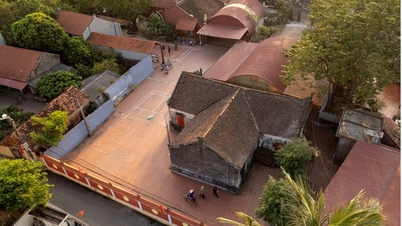
A corner of Ke Ry village
According to historical records, Le Van Huu was born in 1230 in Ke Ry village. From a young age, he was known as a handsome, intelligent, and exceptionally gifted boy. At the age of 18, he passed the imperial examinations and was appointed to a position in the Academy of Sciences. Later, King Tran Thai Tong entrusted him with the important task of compiling the Dai Viet History Chronicle. This was the first national history book, consisting of 30 volumes recording the events of the country from Emperor Vu to Queen Ly Chieu Hoang. His research was praised by King Tran Thai Tong, laying the foundation for Vietnamese national history.
To commemorate his contributions, the local people built a temple on a beautiful plot of land in the commune. However, due to serious deterioration of the monument, the temple has recently been rebuilt in a more spacious and impressive manner. Along with the temple, the historian's tomb has also been renovated within a large, harmonious, and airy compound. Right in front of the monument is a crescent-shaped lake, a triple-arched gate, and notably, an ancient stone stele recording his life and career.
Besides Le Van Huu, Ke Ry also produced many other highly accomplished scholars, such as the top scholar Dao Tieu (1275 examination), Le Quat (1345 examination), and eight other doctors: Le Van Chung, Le Gioc, Le Giac, Tran Van Thien, Le Ba Khang, Le Bien, Vu Kiem, and Tran Le Hieu. Many held important positions in the imperial court and had a significant influence on society, such as Tran Boc Xa Tuong Cong, Huu Bat Dai Hanh Khien Dao Tieu, Huu Bat Dai Hanh Khien Le Quat, historian Le Van Huu, and Kinh Doan Thang Long Le Gioc.
In Kẻ Rỵ, besides the Lê Văn Hưu Temple, a national historical and cultural relic, there is also Hương Nghiêm Pagoda, built by Lê Lương – the 8th-generation ancestor of Lê Văn Hưu – in the early 10th century. This pagoda boasts majestic Buddha statues, stone steles, and bronze bells. It is an ancient pagoda of significant architectural value, preserved by the local people. Alongside it is the Nguyễn family ancestral hall – dedicated to Nguyễn Mộng Tuân, a scholar of the Canh Thìn examination (1400), Trung Thư Lệnh, Tả Nạp Ngôn, Thượng Khinh Xa Đô Úy, and Vinh Lộc Đại Phu – which was recognized as a historical and cultural relic in 2001.
Besides ancient relics, the Ke Ry area also preserves the revolutionary imprints of the government and people of Thanh Hoa during the period of resistance against the destructive war waged by the American imperialists (1964-1972).
This is the underground working and command center of the Standing Committee of the Thanh Hoa Provincial Administrative Committee. The bunker was built in Phu Ly Nam village (now village 4) with an area of nearly 100 square meters, in a Y-shaped design, half above and half below ground, with one entrance facing south and two exits facing north. The bunker was solidly constructed, with a flat concrete foundation providing stability, serving as a shelter and workspace for approximately 5 to 6 people. In 2007, it was recognized as a provincial-level historical relic.
The ancient village of Kẻ Rỵ does not stand alone but always goes hand in hand with the village of Chè (Trà Đông village), forming the famous pair of names "Kẻ Rỵ - Kẻ Chè". While the village of Chè is renowned for its traditional bronze casting craft - a national intangible cultural heritage with artisans possessing golden hands, Kẻ Rỵ is a land of literature and scriptures.
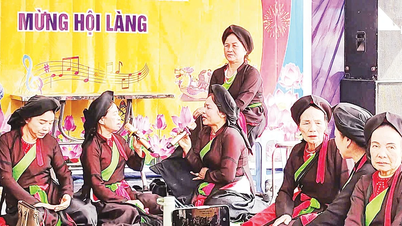
The vitality of the ancient village of Kẻ Rỵ is also reflected in its traditional festival, which is deeply rooted in the cultural identity of the old Cửu Chân region. The Kẻ Rỵ - Kẻ Chè traditional festival is not only an occasion for the people to remember their ancestors, but also a space to showcase the unique intangible cultural values of the locality.
Returning to Kẻ Rỵ today, walking along the wide, clean, paved village roads, one not only sees the couplet: "The renowned scholars of Kẻ Rỵ / The brilliance famous in Chè Đông land," but also hears the resounding sound of bronze casting, further understanding the cultural values being preserved by the people here.
Text and photos: Khac Cong
(This article uses source material from the book "Inscriptions on Huong Nghiem Pagoda" and the book "Ke Ry - Ke Che").
Source: https://baothanhhoa.vn/ve-lang-co-ke-ry-283189.htm





















































Comment (0)