

With the surge in demand for carbon credits following COP26, Vietnam has many opportunities to develop this market, creating high-quality carbon credits for sale regionally and globally.
 |
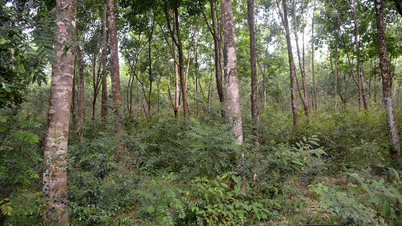
| Developing a carbon market offers numerous macro and micro benefits, both short-term and long-term, at national and international levels. (Source: Unsplash) |
A carbon credit is a certificate representing the right to emit one ton of carbon dioxide (CO2) or other greenhouse gas equivalent to one ton of CO2 (symbolized as CO2e). One ton of CO2e is considered one carbon credit. This is the unit of exchange in the carbon market or carbon credit market. Carbon credits, or carbon quotas, are considered a type of permit allowing the holder to emit a certain amount of CO2.
An inevitable need - a global trend
The carbon credit market originated from the United Nations Kyoto Protocol on climate change, adopted in 1997, and is specifically regulated in Article Six of the 2015 Paris Agreement. Accordingly, developed countries are obligated to reduce greenhouse gas emissions, either by directly reducing emissions themselves or by purchasing emission reduction certificates from other countries.
From there, a new type of commodity emerged worldwide : certificates for reducing/absorbing greenhouse gas emissions. The buying and selling of carbon led to the formation of a carbon market or carbon credit market.
Following the Kyoto Protocol, carbon markets have flourished in European, American, and Asian countries. There are two main types of carbon markets. One is the mandatory carbon market, where carbon trading is based on commitments made by countries under the United Nations Framework Convention on Climate Change (UNFCCC) to achieve greenhouse gas reduction targets. This market is mandatory and primarily caters to projects under the Clean Development Mechanism (CDM), the Sustainable Development Mechanism (SDM), or joint implementation (JI).
Secondly, voluntary carbon markets are based on bilateral or multilateral agreements between organizations, companies, or countries. Credit buyers participate in transactions on a voluntary basis, complying with environmental, social, and corporate governance (ESG) policies to reduce their carbon footprint.
Currently, 58 countries worldwide have developed carbon markets, and 27 countries apply carbon taxes, with some countries applying both. These countries have established carbon credit exchanges and have many transactions, generating significant revenue and setting a trend for countries that have not yet joined the market.
Most notably, Europe has the EU Emissions Trading System (EU ETS). From October 2023, the EU imposed a carbon tax on six high-risk imported goods: iron and steel, cement, fertilizers, aluminum, electricity, and hydrogen. These sectors account for 94% of the EU's industrial emissions. Importers must report the emissions in their imported goods; if these emissions exceed EU standards, they must purchase "carbon credits" at the current EU carbon price.
Japan has the Japan Carbon Credit Trading Scheme (J-Credits), which launched on October 11, 2023, on the Tokyo Stock Exchange (TSE). Currently, 188 Japanese companies and organizations participate in trading carbon credits validated by the government through the use of renewable energy and forest management. The US has the California Cap-and-Trade Program; China has the China National Emissions Trading Scheme… A number of Asian countries have launched carbon credit trading platforms, including Singapore (May 2021), Malaysia (September 2022), Indonesia (September 2022)…
Bloomberg, a new energy finance company, forecasts that the size of the global carbon offsetting market could skyrocket to $1 trillion by 2050, from around $2 billion currently, if countries expand the use of carbon credits.
In reality, the development of carbon markets has yielded, and will continue to yield, numerous macro and micro benefits, both short-term and long-term, at the national and international levels. This helps generate new income for emission reduction projects and activities, such as reforestation, forest protection, and renewable energy development, contributing to climate change mitigation – one of the world's biggest challenges. Carbon markets create economic incentives and encourage businesses to invest in cleaner and more efficient technologies, transitioning to renewable energy sources and lower-emission production methods.
In other words, the carbon market is a mechanism for generating resources to promote greenhouse gas emission reduction and the transition to a carbon-neutral economy. Of course, the carbon credit market will only be truly effective and beneficial if it is applied consistently, widely, and fairly on a global scale.
 |
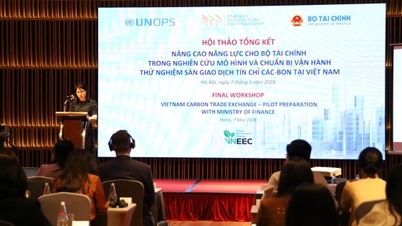
| Carbon credit market: For a greener life |
Vietnam's strong progress
Vietnam has always considered climate change to be the biggest challenge requiring a global approach, and has consistently and diligently implemented its commitments to reduce greenhouse gas emissions, viewing this as both a responsibility and an opportunity for Vietnam to transition to a suitable development model in the future.
In implementing the Paris Agreement, Vietnam has been obligated to reduce greenhouse gas emissions since 2021 under its Nationally Determined Contribution (NDC). Specifically, it must implement measures to reduce greenhouse gas emissions towards achieving net-zero emissions by 2050, reducing methane emissions by 30% by 2030, gradually phasing out coal-fired power generation between 2030 and 2040, and protecting forests as committed at COP26.
The carbon credit market that Vietnam currently aims to develop is mandatory. Accordingly, businesses subject to greenhouse gas emission controls, if they emit more than the set quota, can purchase additional carbon credits on the mandatory market, or a small portion from the voluntary market, to offset the excess.
Conversely, the voluntary carbon credit market has been operating for some time, but is currently primarily driven by forestry (forests), due to historical factors in the global effort to reduce greenhouse gas emissions. Furthermore, with the surge in demand for carbon credits following COP26, Vietnam has significant opportunities to develop its carbon market. Vietnam can generate high-quality carbon credits and sell them regionally and globally.
Essentially, scientists generally agree that Vietnam has great potential as a source of carbon credits. In 2023, in the forestry sector, Vietnam became the first country in the region to successfully sell 10.3 million forest carbon credits (10.3 million tons of CO2) through the World Bank (WB) at a price of 5 USD/ton, generating 51.5 million USD (approximately 1,200 billion VND).
Vietnam will continue to transfer 5.15 million forest carbon credits (equivalent to 5.15 million tons of CO₂) to LEAF/Emergent in 11 provinces in the South Central and Central Highlands regions during the period 2022-2026, at a minimum price of 10 USD/ton. These are positive signs in Vietnam's carbon credit commercialization efforts.
Currently, Vietnam is developing a draft plan for "Developing a Carbon Market in Vietnam" based on Government Decree No. 06/2022/ND-CP regulating greenhouse gas emission reduction and ozone layer protection. From 2028, Vietnam will operate an official carbon credit exchange with domestic connections and exchanges with regional and global markets.
In an interview with the World and Vietnam Newspaper, Dr. Samuel Buertey, Acting Deputy Head of the Accounting and Law Department, Faculty of Business, RMIT University Vietnam, stated that to achieve the project's objectives, especially the official operation of the carbon credit exchange by 2028, the carbon credit market in Vietnam needs to be developed in accordance with the country's practical conditions and development orientation, international commitments to greenhouse gas emission reduction, and global carbon credit market development trends.
The carbon credit market needs to maximize the resources of domestic economic sectors in participating in greenhouse gas emission reduction activities; harmonize the interests of entities in the carbon credit market, and increase national competitiveness towards low-carbon economic development and green growth linked to sustainable development.
For businesses, understanding information and preparing thoroughly to participate in the market by improving the capacity for greenhouse gas inventory, measurement, reporting, and assessment of greenhouse gas emissions at the sectoral and enterprise levels; and calculating emission reduction scenarios are urgent tasks that require a roadmap tailored to their specific needs.
In particular, according to Dr. Samuel Buertey, in the medium and long term, Vietnam should consider linking with other carbon markets in the region and globally to increase market transparency and meet international requirements.
In summary, with careful and sound measures, the carbon credit market in Vietnam needs to be developed in accordance with the practical conditions and development orientation of the country, with commitments to greenhouse gas emission reduction and development trends.
Source: https://baoquocte.vn/thi-truong-tin-chi-carbon-vi-cuoc-song-xanh-hon-286154.html





































































































Comment (0)