

A child's physical characteristics are determined by multiple pairs of genes from both parents, with more attractive children possibly inheriting recessive genes.
Many people believe that children should resemble their parents in appearance. However, not a few children have different appearances. Sometimes, parents are beautiful, but their children are not attractive. Conversely, parents may have average or less attractive looks, but their children are strikingly more beautiful.
According to Pharmacist Do Ba Tung, Head of the Microbiology Department at Le Van Thinh Hospital (Ho Chi Minh City), there are two types of genes: dominant and recessive. Dominant genes are usually expressed, while recessive genes are not. This means that parents carry recessive genes but they do not manifest in physical characteristics such as hair color, skin color, or body shape. Children who are born with different appearances from their parents (either significantly less attractive or more beautiful) inherit recessive genes from their parents. These recessive genes can determine whether a child's appearance is more attractive or less attractive.
"For example, if both parents have naturally straight hair (gene expression) but their child has curly hair, or if both parents have dark brown eyes but their child has light brown eyes, it's because the child inherited recessive genes that determine these characteristics," said Master Tùng.
A recessive gene in current parents can also appear as a dominant gene in previous generations or in relatives within the same family line. This explains why some children are born not resembling their parents but instead resembling relatives, for example, grandparents, uncles, aunts, etc., because the children inherit this gene.
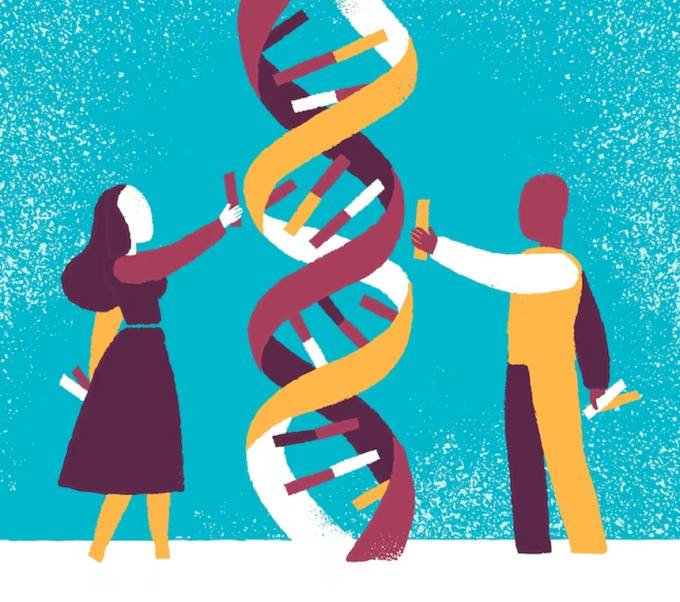
Illustration of genes from the father and mother. Photo: Freepik
Humans have 46 chromosomes, divided into 23 pairs. Of these, 22 pairs are autosomes (autosomal chromosomes) and the remaining pair, X and Y, are sex chromosomes. Autosomes determine height, hair color, skin color, and growth rate. Sex chromosomes, on the other hand, determine an individual's sex. Humans are born with 44 pairs of autosomes from their parents.
Chromosomes are the genetic material in cells, but genes contain the genetic information that determines physical characteristics. Each chromosome carries a different number of genes; some chromosomes carry up to 800-900 genes, like the X chromosome, while others carry a much smaller number, only a few dozen, like the Y chromosome (60-72 genes).
According to Master's degree holder Do Ba Tung, genetic characteristics such as height, hair color, skin color, physique, IQ, personality, and behavior are determined by many pairs of genes.
For example, if both parents have genes for black-brown hair color, their current hair color is brown. A child has a 50% chance of having brown hair (like their parents) if one parent contributes the black hair gene and the other contributes the brown hair gene. A child has a 25% chance of having brown hair (like their parents) if both parents contribute the brown hair gene. A child has a 25% chance of having black hair (unlike their parents) if both parents contribute the black hair gene.
Even siblings can inherit different gene pairs from their parents, resulting in different appearances or some other distinguishing characteristics. Besides genetic factors, a person's physique, height, personality, and intelligence are also influenced by non-genetic factors such as the environment. Therefore, some children grow up with features very different from their parents.
Mai Cat
Source link



































































































Comment (0)