

According to experts, a low minimum pension is necessary to ensure the principle of contribution-benefit is upheld, encourage long-term participation, provide high pensions, and keep the social insurance fund secure.
According to current regulations, the minimum pension for workers participating in compulsory social insurance is equal to the base salary. Currently, this is 1.49 million VND per month and will increase to 1.8 million VND on July 1st (the date of the base salary adjustment). Those receiving lower pensions will have their pensions raised to the minimum level. However, even after adjustment, this amount is still lower than the average monthly income of those classified as poor in cities (2 million VND) and higher than in rural areas (1.5 million VND).
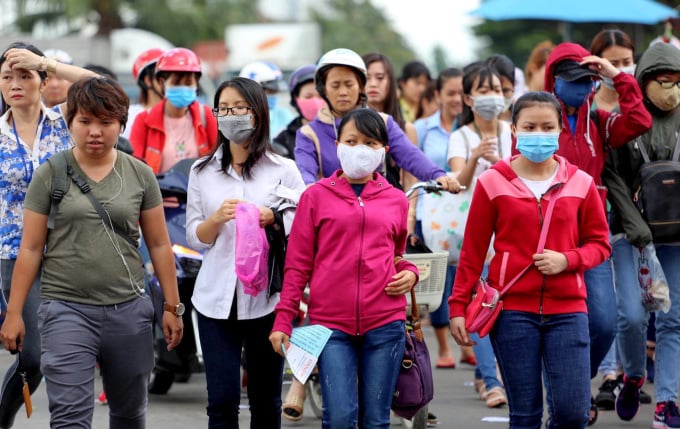
Workers at Pou Yuen company, Binh Tan district, after work hours, 2021. Photo: Quynh Tran
During consultations on the draft amendments to the Social Insurance Law held in Ho Chi Minh City, representatives from factories and grassroots trade unions expressed a desire to raise the minimum pension threshold. The reason is that in large cities, the 2-3 million VND retirement allowance poses significant difficulties for the elderly. The minimum pension threshold should be based on the regional minimum wage at the time of receiving the pension; for example, in Ho Chi Minh City, the applicable minimum wage is 4.68 million VND. This would reassure workers by guaranteeing a stable income upon retirement and reduce the need for lump-sum social insurance withdrawals.
Ms. Pham Thi Hong Yen, Chairwoman of the Trade Union of Intel Products Vietnam Co., Ltd. in the High-Tech Park (Thu Duc City), stated that the law clearly stipulates the minimum wage as the lowest amount paid to those performing simple tasks under normal conditions. This is to ensure a minimum standard of living for them and their families, in line with socio -economic development conditions. However, currently, some people receive less than the regional minimum wage upon retirement.
"This is one of the reasons why it's difficult to retain workers within the social insurance system. Therefore, when proposing amendments to the Social Insurance Law , it's necessary to calculate a minimum wage that is equal to the regional minimum wage so that workers can feel secure staying within the social safety net," Ms. Yen said.
Mr. Nguyen Dang Tien, former Deputy Director of the Ho Chi Minh City Social Insurance Department, stated that the current minimum pension level only applies to specific cases with short insurance contribution periods and low contribution levels. For example, contract kindergarten teachers in some localities before 1999 received only a few hundred thousand dong per month upon retirement. This group needs to have their pension raised to the basic salary level to ensure their retirement income is not below the poverty line.
However, for workers participating in social insurance based on the regional minimum wage, the retirement floor is ineffective. The reason is that the regional minimum wage is usually 2-3 times higher than the base wage. The monthly salary contribution rate to the retirement and death benefit fund for businesses and employees is 22%, but the lowest benefit rate is already 45%, double the contribution rate.
For example, the minimum wage used as the basis for social insurance contributions for employees is 4.68 million VND. Each month, both the employee and the employer contribute only about 1.1 million VND to the fund. With a benefit rate of 45%, the pension would be over 2.1 million VND. This amount is higher than the base salary of 1.49 million VND, which is naturally not subsidized.
"It's higher than the minimum wage, but it's not enough to live on," Mr. Tien said, adding that while workers' desire to raise the minimum wage for additional compensation is legitimate, it would disrupt the contribution-benefit principle of the policy and create an imbalance in the fund.
Professor Giang Thanh Long, a senior lecturer at the National Economics University, believes that there are two important factors in calculating pension benefits: the length of time contributing to the fund, which determines the benefit rate. Those who contribute for 20 years receive 45%, and this increases to 75% if they contribute for 30-35 years. The policy always encourages long-term contributions to receive a higher benefit. The second factor is the salary used as the basis for contributions. The closer the contribution level is to income, the higher the average pension received.
According to Mr. Long, if workers want to establish a minimum pension that ensures a livable income, they must revisit the constituent elements. For example, if they want the pension floor of 4.68 million VND to be equal to the current minimum wage in Ho Chi Minh City, the regulations would need to mandate that the salary for insurance contributions must not be lower than 10.4 million VND per month, with a minimum contribution period of 20 years and a benefit rate of 45%.
"If a high minimum pension is set without accompanying conditions, it will cause many negative consequences," Mr. Long said. The biggest risk is that workers and businesses will keep their contributions as low as possible because "they'll always get reimbursed." Workers will continuously receive lump-sum benefits because they don't need to accumulate contributions for a long time to reach the maximum benefit level. When the reimbursement is too large, the social insurance fund will become unbalanced, and the budget will not be able to bear the burden.
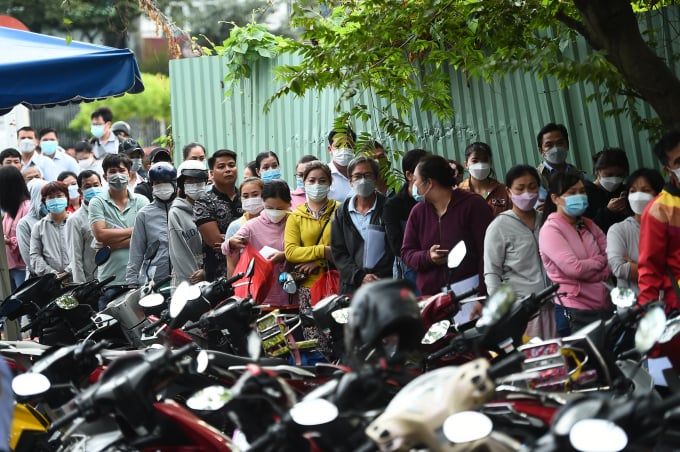
People withdrawing their Social Insurance contributions at the Thu Duc City Social Insurance office in December 2022. Photo: Thanh Tung.
Professor Long stated that the state budget only supports vulnerable or high-risk groups during transitional periods. For example, those whose jobs or circumstances require short-term or low contributions receive low pension benefits, far below international living standards. To provide support, pensions are periodically adjusted upwards based on the consumer price index and economic growth.
According to experts, pension policies based on the principle of contribution and benefit encourage long-term participation and high contributions to receive the best possible pension. This not only safeguards the fund but also ensures fairness among participants. Experience from other countries shows that the minimum pension floor should not be too high. For example, in Thailand, the minimum pension is equal to the social pension paid from the budget, currently 800 baht (approximately 550,000 VND). Those receiving pensions below this level will have their pensions raised to match this amount; those receiving higher amounts will not be compensated.
Mr. Nguyen Dang Tien argued that while it's impossible to raise the minimum pension level significantly, policies need to be adjusted to prevent workers' pensions from remaining too low. One technical solution is to recalculate the social insurance inflation adjustment factor. Theoretically, this factor helps create a balance between the monetary value at the time of pension payment and the time of contribution. The factor is calculated based on the average annual consumer price index published by the General Statistics Office.
According to a former leader of the Ho Chi Minh City Social Insurance agency, the contribution-benefit calculation for pensions is correct, but it is necessary to consider whether the inflation adjustment is appropriate. For example, a person retiring in 2023 had a social insurance contribution salary of 200,000 VND in 1996. The inflation adjustment factor calculated by the Ministry of Labor, Invalids and Social Affairs for that year was 4.09. Thus, the salary used to determine pension benefits would be 818,000 VND (200,000 VND x 4.09).
"After 27 years, such adjustments are really insufficient to ensure a decent standard of living. Therefore, the government needs to recalculate them to make them more appropriate," Mr. Tien suggested.
Le Tuyet
Source link



























![[Video] Sunset at Lap An Lagoon – Where the sun sets over the fishing nets](https://vphoto.vietnam.vn/thumb/340x192/vietnam/resource/IMAGE/2026/05/31/1780192137701_beach-landscape-sea-water-nature-grass-745871-pxhere-com.jpeg)








![[Image] A brilliant symphony and explosive power in the skies of Da Nang.](https://vphoto.vietnam.vn/thumb/1200x675/vietnam/resource/IMAGE/2026/05/31/1780196945787_anh-man-hinh-2026-05-31-luc-10-08-51.png)




































































Comment (0)