The Ministry of Health advises people to continue implementing preventive measures as guided and to regularly update information from official sources.
Chikungunya is not a new infection. It has been around since the 1950s, with outbreaks becoming more common in tropical regions in recent decades.
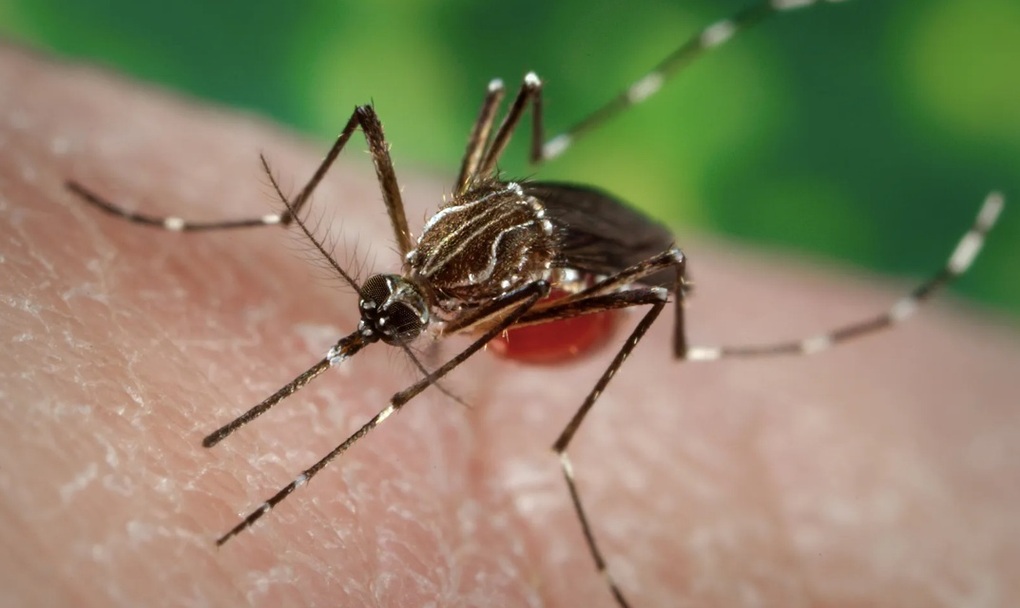
Chikungunya disease is transmitted through the Aedes mosquito (the same type of mosquito that transmits dengue fever) (Photo: Cdn).
Chikungunya is an infectious disease caused by the Chikungunya virus (CHIKV). The disease is not transmitted directly from person to person but is mediated by Aedes mosquitoes (the same type of mosquito that transmits dengue fever). These mosquitoes primarily bite during the day and may peak their activity in the early morning and late afternoon.
In Vietnam, Aedes mosquitoes are currently in their peak season, with high densities in many localities, coinciding with the summer months when many tourists travel to and from Vietnam. This poses a significant risk of Chikungunya entering Vietnam and spreading rapidly within the population.
Symptoms of the disease usually appear 3 to 7 days after being bitten by a mosquito. Characteristic symptoms include a fever above 39°C, bilateral and symmetrical polyarthritis, which can be severe and debilitating. Other symptoms may include headache, muscle pain, arthritis, conjunctivitis, nausea, vomiting, or a maculopapular rash.
Although the disease is rarely fatal, its symptoms can become severe and disabling, such as cranial nerve paralysis and meningitis. Most people will get better within a week, but joint pain can last for months.
Earlier, on July 22, the WHO issued a warning about the rapid spread of Chikungunya, with major outbreaks reported on Indian Ocean islands such as La Réunion and Mayotte.
These outbreaks have now spread to several areas of Africa, South Asia, and Europe. Guangdong Province (China) has also recorded the largest Chikungunya outbreak ever in the region.
What can be done to prevent Chikungunya?
To prevent the disease, the Department of Disease Prevention recommends that people in households and residential areas should strictly follow these guidelines:
- Cover all water containers tightly to prevent mosquitoes from laying eggs.
- Weekly, implement measures to eliminate mosquito larvae by releasing fish into large water containers; washing and cleaning medium and small water containers, turning over empty containers; changing the water in flower vases; adding salt, oil, or larvicidal chemicals to water bowls placed under cupboard legs.
- Weekly removal of waste materials and natural water pockets where mosquitoes can lay eggs, such as bottles, broken glass, coconut shells, broken pottery, old tires, bamboo hollows, leaf sheaths, etc.
- Sleep under a mosquito net and wear long clothing to protect against mosquito bites, even during the day.
- Actively cooperate with the health sector in chemical spraying campaigns to prevent and control epidemics.
- If you have a fever, go immediately to a medical facility for examination and treatment advice; do not self-treat at home.
Source: https://dantri.com.vn/suc-khoe/viet-nam-chua-ghi-nhan-ca-mac-benh-chikungunya-20250824204809037.htm





![[Photo] General Secretary and President To Lam presides over a meeting with the Central Organizing Committee.](https://vphoto.vietnam.vn/thumb/1200x675/vietnam/resource/IMAGE/2026/06/03/1780482764658_a1-bnd-4741-3342-jpg.webp)
![[Photo] Secretary of the National Assembly Party Committee, Chairman of the National Assembly presides over the meeting of the Standing Committee and Executive Committee of the National Assembly Party Committee.](https://vphoto.vietnam.vn/thumb/1200x675/vietnam/resource/IMAGE/2026/06/03/1780480353201_ndo_br_bnd-2585-jpg.webp)













































![[Video] Sunset at Lap An Lagoon – Where the sun sets over the fishing nets](https://vphoto.vietnam.vn/thumb/1200x675/vietnam/resource/IMAGE/2026/05/31/1780192137701_beach-landscape-sea-water-nature-grass-745871-pxhere-com.jpeg)




























Comment (0)