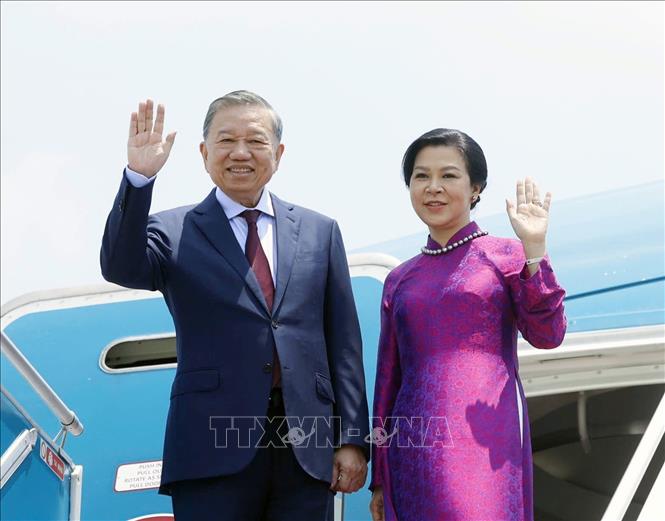
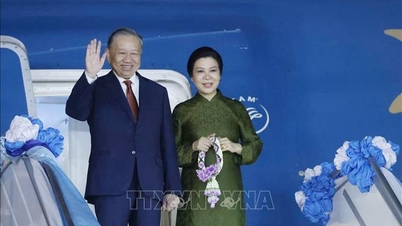
General Secretary and President To Lam and his wife. Photo: Thong Nhat/TTXVN
In this context, the invitation of General Secretary and President To Lam to deliver the keynote address at the Dialogue is considered a significant milestone, reflecting Vietnam's increasingly prominent role and position in regional and international affairs.
A test of resilience
Speaking to a Vietnam News Agency (VNA) reporter in Singapore, Dr. Mohamed Effendy B Abdul Hamid, senior lecturer in Southeast Asian Studies at the National University of Singapore (NUS), commented that this year's Shangri-La Dialogue is taking place at a time of "profound geopolitical significance."
According to this expert, the world is witnessing unprecedented upheavals in recent years, increasing regional instability and security concerns for many countries. Member states of the Association of Southeast Asian Nations (ASEAN) are no longer immune to the impacts of conflicts in the Middle East or Europe. Consequences such as supply chain disruptions, inflationary pressures, energy instability, and the risk of declining growth have caused distant conflicts to directly affect Southeast Asia.
Dr. Mohamed Effendy argues that this will spur deeper discussions on ASEAN's economic self-reliance, raising debates regarding the increasing militarization and defense spending trends in the region.
According to the published agenda, this year's Shangri-La Dialogue focuses on a range of pressing issues such as the US strategy in the Indo-Pacific, Asian maritime security, trans-regional threats, regional tension management, new security partnerships and China's role in the region, as well as the resilience of the defense industry and new models of security cooperation in an increasingly fragmented world.
One topic expected to be widely discussed is ASEAN's central role in the context of increasing strategic competition among major powers. Vietnam, Singapore, and other ASEAN countries all aspire to maintain internal unity and uphold ASEAN's central role in the reshaping regional structure.
However, according to experts, this will be a significant challenge as the region is increasingly affected by US-China competition, maritime security hotspots, and changes in global supply chains and technology.
From “participating party” to “influential party”
Many experts believe that the invitation to General Secretary and President To Lam to deliver the keynote address demonstrates the growing international interest in Vietnam's role. Dr. Mohamed Effendy stated that this is "a very important development," reflecting Vietnam's emergence as a key player in regional and global affairs, particularly in the areas of supply chains, maritime security, and regional diplomacy.
According to the Doctor, the fact that Vietnam's highest-ranking leader was invited to speak also shows that the international community appreciates Vietnam's stability and wants to hear about Vietnam's approach to current geopolitical challenges.
He emphasized that the international community is watching how Vietnam navigates a complex geopolitical environment, while also seeking inspiration from Vietnam's unique approach to unprecedented challenges.
Sharing this view, Professor Vu Minh Khuong from the Lee Kuan Yew School of Public Policy (Singapore) commented that Vietnam's presence and prominent role at this year's Shangri-La Dialogue is "a special milestone".
According to him, the event is taking place against the backdrop of a world undergoing major upheavals and the international community struggling to find effective global solutions. Therefore, the world expects leaders with strategic vision, practical understanding, and the ability to propose new approaches.
Professor Vu Minh Khuong noted that Vietnam is emerging as a "comprehensive model," not only because of its resilient history and the success of its Doi Moi (Renovation) process, but also because of its vision to develop into a technologically advanced nation in the coming decades. International attention to Vietnam also stems from key aspects of its foreign policy in recent times.
Firstly, Vietnam consistently adheres to a policy of peace and cooperation. Vietnam has always clearly demonstrated its commitment to promoting peace, cooperation, and mutual development, while also showing its ability to "turn enemies into friends," resolving differences to foster long-term cooperation.
Secondly, there is the proactive and flexible approach in foreign relations. The professor cited recent high-level diplomatic activities with the US and China, demonstrating that Vietnam maintains a high degree of proactiveness in managing its foreign relations.
Thirdly, there is the ability to maintain strategic balance in the context of increasingly complex geopolitical competition. Professor Vu Minh Khuong assessed that Vietnam is becoming "a shining example" in maintaining harmonious relations with major powers, thereby ensuring national interests while contributing to regional stability.
He argued that Vietnam is currently pursuing not only its own development goals but also acting as a "bridge" to promote understanding between major powers, including the US and China. Professor Vu Minh Khuong stated: "From these solid steps, Vietnam is increasingly asserting its position as an important component in the global ecosystem."
Meanwhile, international media outlets suggest that partners are viewing Vietnam not only as a dynamic economy but also as a factor shaping the structure of cooperation and strategic balance in the region.
Sputnik (Russia) quoted international security experts as saying that the invitation of General Secretary and President To Lam to deliver the keynote speech shows Vietnam's increasing proactive role in the regional security structure. Vietnam is now seen not merely as a "participant," but as an actor playing a shaping role (arbitrator, mediator) with a "dynamic balancing" approach, not taking sides and relying on international law.

Vietnamese Ambassador to Singapore Tran Phuoc Anh answers questions from a VNA reporter. Photo: Tat Dat/VNA.
According to Vietnamese Ambassador to Singapore Tran Phuoc Anh, assuming an important role at the Shangri-La Dialogue reflects Vietnam's increasingly high standing and prestige on the international stage. The Ambassador stated that the world now wants to hear Vietnam's voice, views, and approaches to regional and global security and defense issues.
This is also an opportunity for Vietnam to convey its message about its independent, self-reliant, diversified, and multilateral foreign policy; affirming that Vietnam is a reliable friend, partner, and responsible member of the international community. At the same time, it is also an opportunity for Vietnam to share its vision and approach to regional issues, especially maintaining peace, stability, and cooperation in Southeast Asia and the Asia-Pacific.
Against this backdrop, observers believe that the speech by General Secretary and President To Lam at the Shangri-La Dialogue will attract special attention from the international community, not only because of Vietnam's increasingly prominent role but also because of the messages related to maintaining peace, stability, cooperation, and strategic balance in a region undergoing profound changes. This also shapes Vietnam's proactive, responsible, and credible commitment to making substantive contributions to peace, security, and sustainable development in the region.
Source: https://baotintuc.vn/thoi-su/viet-nam-dinh-hinh-vi-the-moi-20260528090218245.htm


![[Photo] Standing Committee member of the Party Central Committee Tran Cam Tu working with the Central Inspection Committee](https://vphoto.vietnam.vn/thumb/1200x675/vietnam/resource/IMAGE/2026/05/28/1779969579668_ndo_br_bnd-2495-jpg.webp)


















































Comment (0)