

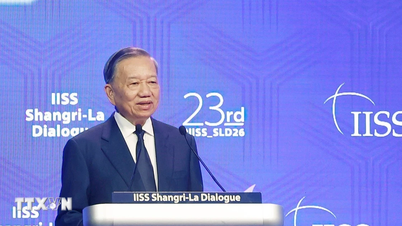
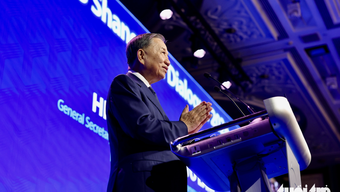
Against the backdrop of Asia's leading security forum taking place at a time of increasing strategic competition among major powers, and conflicts and instability emerging in many regions of the world , the messages delivered by Vietnamese leaders are considered to reflect not only Vietnam's perspective but also address the common concerns of the region and the international community.
A message about the challenge

The Indonesian newspaper Kontan noted that General Secretary and President To Lam's simultaneous mention of three crises—the crisis of international order, the crisis of the development model, and the crisis of strategic trust—shows Vietnam's comprehensive approach to global challenges. According to the newspaper, the emphasis on "strategic trust" is noteworthy because this is an increasingly important factor impacting relations between nations in a volatile international security environment.
Meanwhile, Singapore's CNA, a television and digital news channel, paid particular attention to the message that current crises are not inevitable and must not be accepted by humanity. According to CNA, the call to strengthen international law, promote inclusive development models, and enhance dialogue and cooperation among nations offered a positive perspective in a world facing numerous intertwined challenges.

Another topic that has received widespread attention is the central role of ASEAN. Both the Indonesian news agency Antara and the newspaper Tempo quoted General Secretary and President To Lam as saying that ASEAN has sufficient motivation and determination to prevent competition from turning into confrontation, to prevent connectivity routes from becoming dividing lines, and to prevent one country's security from becoming another's insecurity. According to Indonesian observers, this message is particularly significant in the context of Southeast Asia being increasingly affected by geopolitical competition.
China's Xinhua news agency also highlighted the Vietnamese leader's statement that ASEAN needs to maintain its central role through internal solidarity, strategic autonomy, and the ability to create a common agenda. According to the news agency, these remarks reflect a desire to maintain ASEAN as a structure for dialogue and balance in the region.
Strategic dialogue and trust
Beyond merely reflecting the challenges, many experts believe that the speech by General Secretary and President To Lam offered important insights into how to respond to current threats.
The South China Morning Post (SCMP) assessed that the speech offered a noteworthy framework for strategic trust-building in the context of a rapidly changing regional security environment, highlighting how the Vietnamese leader referred to the "strategic trust crisis" as a silent but particularly dangerous threat, and how the increasing perception of each other's actions through a lens of suspicion and insecurity is increasing the risk of misunderstandings and miscalculations in international relations.
SCMP also noted the warnings from General Secretary and President To Lam about the new challenges posed by the rapid development of artificial intelligence, big data, quantum technology, and cyberspace. The newspaper highlighted Vietnam's proposal to build emergency communication mechanisms, enhance transparency, and establish appropriate codes of conduct.
Sharing the same view, Türkiye's Anadolu news agency stated that the overarching message in the speech was a call for countries to exercise restraint, enhance cooperation, and resolve disagreements through dialogue rather than confrontation. According to Anadolu, General Secretary and President To Lam emphasized that countries need to proactively prevent risks before crises erupt, instead of only reacting after tensions have escalated.
Peace-building factors
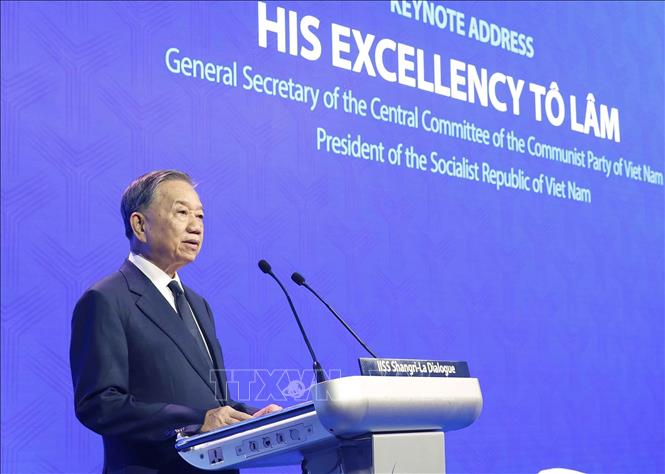
Besides the content of the speeches, international scholars also paid much attention to Vietnam's increasingly prominent role and position.
Speaking with a reporter from the Vietnam News Agency (TTXVN), Dr. Ei Sun Oh, a senior expert at the Pacific Research Centre of Malaysia, stated that Vietnam has officially stepped onto the "regional stage" as a constructive diplomatic factor for peace and stability. According to him, the speech at Shangri-La was not just a policy address but also an affirmation of Vietnam's position on the international stage.
Malaysian experts believe that Vietnam is positioning itself as a responsible partner, actively contributing to common issues of concern to ASEAN and the international community. In particular, Vietnam's commitment to a rules-based international order and international law is considered to have received broad support from many countries in the region.
According to Ei Sun Oh, Vietnam not only prioritizes building strategic trust in international forums but also demonstrates this through practical actions. Hosting the 2019 US-North Korea Summit is proof of Vietnam's capacity as a neutral, reliable, and responsible diplomatic host.
From Singapore, Professor Vu Minh Khuong of the Lee Kuan Yew School of Public Policy commented that the international attention to the speech by General Secretary and President To Lam was not accidental. According to him, the world sees in Vietnam a nation steadfastly pursuing peace, cooperation, and development, and capable of transforming differences into cooperation and building trust among partners.
Professor Vu Minh Khuong believes that in the context of increasingly complex geopolitical situations, Vietnam is being seen as a remarkable model of its ability to maintain balanced relations with major powers while upholding independence, self-reliance, and pursuing the common interests of the region. He asserts that Vietnam is increasingly becoming an important component in the global cooperation ecosystem.
Sharing this view, Dr. Mohamed Effendy B Abdul Hamid, a senior lecturer at the National University of Singapore, believes that the international community now places high expectations on Vietnam and views Vietnam's approach as a noteworthy reference point in addressing new challenges. According to him, the speech at Shangri-La helped to clarify Vietnam's vision for regional and international issues during this turbulent period.
Choi Shing Kwok, Advisor at the Institute of Southeast Asian Studies at Yusof Ishak (Singapore), considers Vietnam's speech and participation at the 23rd Shangri-La Dialogue as signaling its readiness to play a more proactive, positive, and important role in regional affairs.
The New York Times (USA) stated that the opening remarks by General Secretary and President To Lam presented a new image for Vietnam – not only as a country with a flexible foreign policy, but also as a proactive force in global affairs and a resilient manufacturing hub, wishing to contribute to shaping policies and partnerships in Southeast Asia.
Positive feedback from international media and academics indicates that the keynote address by General Secretary and President To Lam at the Shangri-La Dialogue resonated strongly. Not only was it highly praised for its content addressing global challenges and proposed solutions, but the speech also reflected an image of Vietnam that is increasingly proactive, confident, and responsible in regional and international affairs.
In a world facing numerous uncertainties, messages about dialogue, cooperation, international law, the central role of ASEAN, and strategic confidence-building are seen by many observers as practical contributions of Vietnam to efforts to maintain peace, stability, and sustainable development in the region and the world.
Source: https://baotintuc.vn/thoi-su/viet-nam-khang-dinh-tam-nhin-kien-tao-20260531100738218.htm
![[Photo] Solemn bathing ceremony and Buddha procession in Hue](https://vphoto.vietnam.vn/thumb/1200x675/vietnam/resource/IMAGE/2026/05/31/1780228263543_1-jpg.webp)


![[Photo] The General Secretary, President and his wife begin their state visit to the Philippines.](https://vphoto.vietnam.vn/thumb/1200x675/vietnam/resource/IMAGE/2026/05/31/1780230559452_anh-man-hinh-2026-05-31-luc-19-28-11.png)
![[Photo] Admire the coral "masterpiece" amidst the million-year-old heritage of Dak Lak province.](https://vphoto.vietnam.vn/thumb/1200x675/vietnam/resource/IMAGE/2026/05/31/1780221235105_anh-man-hinh-2026-05-31-luc-16-53-27.png)






![[Photo] Admire the coral "masterpiece" amidst the million-year-old heritage of Dak Lak province.](https://vphoto.vietnam.vn/thumb/402x226/vietnam/resource/IMAGE/2026/05/31/1780221235105_anh-man-hinh-2026-05-31-luc-16-53-27.png)





![[Video] Sunset at Lap An Lagoon – Where the sun sets over the fishing nets](https://vphoto.vietnam.vn/thumb/340x192/vietnam/resource/IMAGE/2026/05/31/1780192137701_beach-landscape-sea-water-nature-grass-745871-pxhere-com.jpeg)


















































Comment (0)