

Currently, the tomb and church of Vo Xuan Can are located in the two communes of Cam Thuy and Tan Thuy (Le Thuy district, Quang Binh province). His tomb is situated on a mound of land along the Dau Giang river, in Tan Hoa village, Tan Thuy commune. The church has been restored on the site of the old Le Quoc church, located near National Highway 1, in Hoa Luat Nam village, Cam Thuy commune.
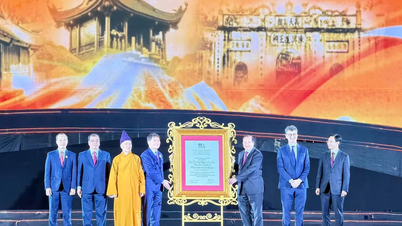
Given the outstanding values of the site, on November 4, 2020, the Minister of Culture, Sports and Tourism issued Decision No. 3232/QD-BVHTTDL classifying the tomb and church of Vo Xuan Can as a national historical site.
Mr. Vo Xuan Can was born on November 14, 1772, in a rural area rich in patriotic and studious traditions. From a young age, he was known for his diligence and intelligence, inherited from a family with a long tradition of scholarly achievements and many members holding official positions.
Vo Xuan Can quickly determined his path with the philosophy of "serving as an official to shoulder worldly responsibilities, performing righteous deeds with the ultimate goal of serving the people." Therefore, throughout his 50 years as an official (1802-1852), he accomplished many things, deserving of historical recognition.
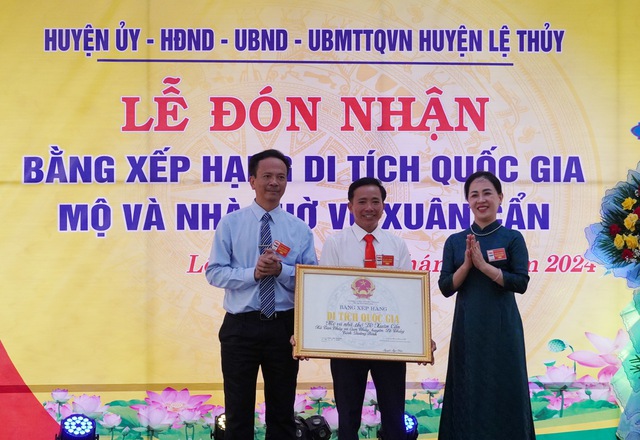
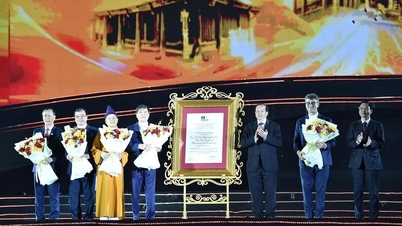
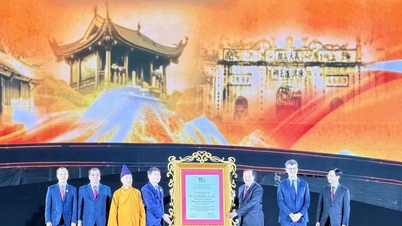
Representatives from the Quang Binh Department of Culture and Sports, along with leaders from Le Thuy district, presented the certificate designating the tomb and church of Vo Xuan Can as a National Historical Monument.
Võ Xuân Cẩn passed the Cống sĩ (equivalent to Cử nhân) examination during the Nguyễn dynasty but did not enter official service. In 1802, he joined the Hanlin Academy at the invitation of Emperor Gia Long. From then until 1852, he held many of the most important positions in the court, such as: Minister of Justice, Minister of Public Works; Hanlin Academy Scholar; Grand Scholar of the Eastern Pavilion; managing affairs of the Ministry of Personnel; concurrently leading the National History Institute; Director-General of the National History Institute... Regardless of his position, he proved to be a highly learned, refined, upright, honest, compassionate, and dedicated official capable of bringing peace to the country.
In the second year of Gia Long's reign (1803), he was appointed as the Deputy Governor of Hung Hoa, and then as the Chief Clerk in Binh Dinh. In 1820, when Emperor Minh Mang ascended the throne, he was appointed as the Deputy Governor of Son Nam. Afterwards, he was summoned back to the capital by the court to serve as the Left Deputy Minister of the Ministry of Justice.
Recognizing Vo Xuan Can as an official wholeheartedly devoted to the people, Emperor Minh Mang appointed him as the Deputy Governor of Nghe An to govern the region on the Emperor's behalf. In 1826, he was summoned back to the capital to assume the position of Governor of Hoai Duc, and later transferred to the position of Chief Justice of Bac Thanh. After some time, the Emperor invited him back to the capital to serve as Right Deputy Minister of the Ministry of Personnel, and then promoted him to Minister of Public Works.
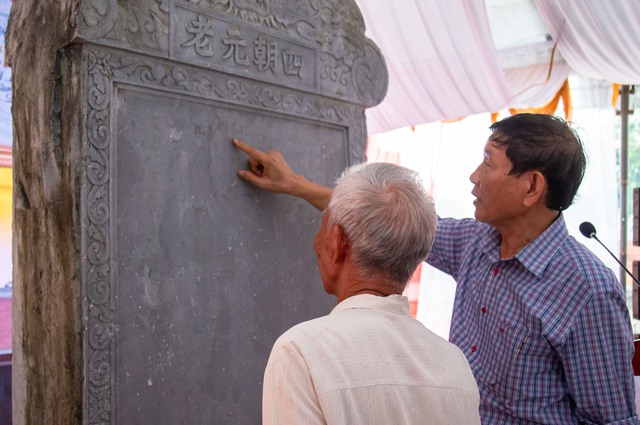
Associate Professor of History Ngo Minh Oanh, along with representatives of the Vo Xuan family, stand before the "Four Dynasties' Elders" stele located in the Vo Xuan Can ancestral temple area. The stone stele is a valuable artifact and a precious source of information for studying the life and 50-year career of Vo Xuan Can as an official.
In 1833, he was appointed Governor-General of Binh Phu province. Binh Phu province, where he served as Governor-General, made a significant contribution in terms of manpower and military supplies to the imperial army in defeating the Siamese army in 1834 and Le Van Khoi's army in 1835, recapturing Phan An citadel (Gia Dinh).
Throughout his 50 years of service under four emperors (Gia Long, Minh Mạng, Thiệu Trị, Tự Đức), holding eight local positions and nine positions in the imperial court, he consistently demonstrated adeptness in selecting and discreetly recommending talented individuals… he successfully handled most of the important positions in the imperial court.
"The legacy that Vo Xuan Can left for his descendants of the Vo Xuan family in particular, and the people of Le Thuy in general, will be preserved, protected, and actively promoted, contributing to the socio-economic development of the locality"...
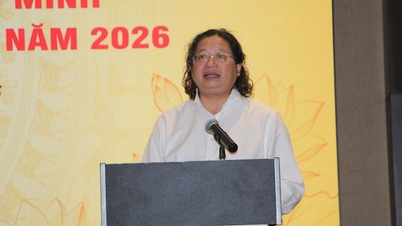
Ms. Dang Thi Hong Tham , Vice Chairwoman of the People's Committee of Le Thuy District
In April 1852, he passed away at the age of 81. King Tự Đức, saddened by his death, issued a decree granting gold and silk, arranged for his funeral, sent officials to offer sacrifices, and bestowed upon him the posthumous name Văn Đoan. On July 9, 1852, King Tự Đức ordered his poem and inscription to be carved onto a stone stele erected at the village entrance, bearing the title "Tứ triều nguyên lão" (A man of great virtue in four dynasties).
Ms. Dang Thi Hong Tham, Vice Chairman of the People's Committee of Le Thuy District (Quang Binh), said: "The national historical relic of the tomb and church of Vo Xuan Can has typical historical and cultural value of Quang Binh province in particular and the country in general. Under the feudal regime, many people studied hard, passed examinations, became honest officials, loved their country and people, and wholeheartedly served the nation."
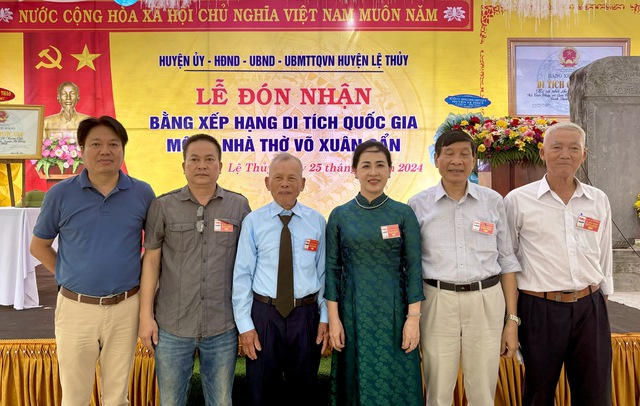
Leaders of Le Thuy district and representatives of the Vo Xuan clan pose for a commemorative photo.
"The 'Four Dynasties' stele is a valuable artifact and a precious source of information for studying the life and 50-year career of Vo Xuan Can. This historical and cultural relic is a representative example of Le Thuy district, a land renowned for its culture and culture, with its kind and studious people… helping generations of Le Thuy district residents to be proud and to educate future generations about its traditions," affirmed Ms. Dang Thi Hong Tham.
Source: https://toquoc.vn/vo-xuan-can-vi-quan-duoc-4-trieu-vua-trong-dung-20240625162954963.htm


![[Photo] Prime Minister Pham Minh Chinh presides over a meeting on private sector economic development.](/_next/image?url=https%3A%2F%2Fvphoto.vietnam.vn%2Fthumb%2F1200x675%2Fvietnam%2Fresource%2FIMAGE%2F2025%2F12%2F20%2F1766237501876_thiet-ke-chua-co-ten-40-png.webp&w=3840&q=75)


























































Comment (0)