"Words" transcend the mountains.
These days, joy spreads throughout the villages of Yen Khuong, Na Meo, Tam Thanh, Bat Mot, Nhi Son… in Thanh Hoa province. Here, teachers, students, and villagers have waited for many years for a spacious school – a place to study, eat, and live comfortably for the children of this border region. That dream is now gradually taking shape amidst the vast mountains, in the vibrant sounds of the groundbreaking ceremony – as if calling for the return of hope.
At an age when she should be in school, Ho Thi Xanh (from Ta Com village, Trung Ly commune) carries a basket of firewood on her shoulder every day. Her father is in prison for drug trafficking, and her mother left the village after recovering from addiction and has not returned. Since then, Xanh has lived with her cousin's family, spending her time doing housework and looking after her younger siblings.
She couldn't remember her exact age. She only knew that her schooling had stopped in the sixth grade. When asked, she hesitated, "I stopped going to school because it was too far away."
Xanh's story is not unique. In many villages along the Thanh Hoa border, children's path to school is not only blocked by geography, but also by poverty, the burden of making a living, and a lack of adequate learning conditions.
Lang Thi Quynh Nhu (from Vin village, Bat Mot commune) has to walk for hours to school every day. Since the 8th grade, she has had to live in rented accommodation near the school, surviving on a meager 200-300 thousand dong per month plus a little food sent by her family.
As a ninth-grade student, Nhu was already used to managing her own life. She shared: "In the first few days away from home, I was very scared. At night, missing my mother, I cried and wiped away my own tears."
Bat Mot Secondary School has nearly 200 students who need boarding facilities, but currently only 38 can be accommodated – mostly students from extremely disadvantaged backgrounds. The remaining students have to find their own accommodation, facing difficult daily commutes.
Even without boarding facilities to pursue education, the children in the boarding area at Muong Lat Ethnic Minority Boarding Junior High School are not much better off due to inadequate facilities. Many dorm rooms are cramped, requiring a large number of students to live together. Cheo Ha Phuong (6th grade) said: "I share a room with 14 other students; it's a bit crowded."
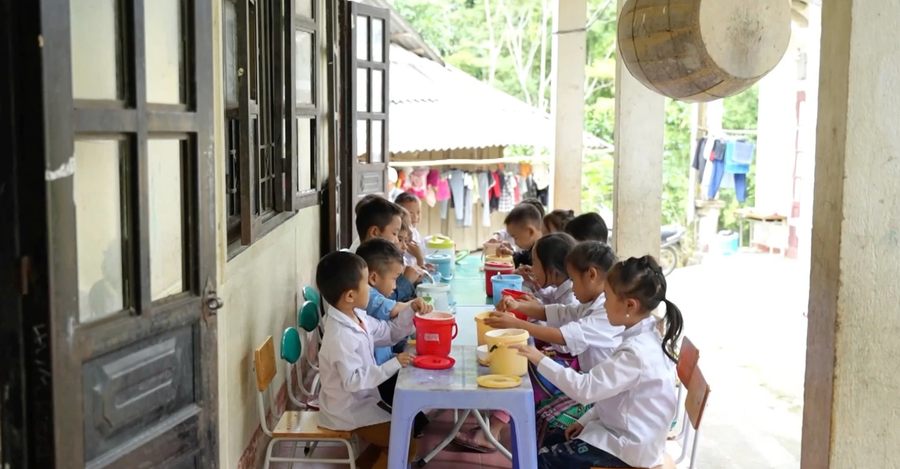
Many schools do not have boarding facilities, so students have to bring lunch from home.
This school year, Na Meo Ethnic Boarding Junior High School (Na Meo commune) has 162 boarding students, but only one dormitory with 6 rooms. Each room is about 40 square meters and houses more than 20 students. It's a prefabricated, two-story building with a corrugated iron roof, lacking air conditioning, water heaters, and even private bathrooms. At the beginning of the hot season, the children suffer from the oppressive heat. But throughout the winter, on many bitterly cold days, the cramped bathroom means students have to take turns showering from 4 pm until evening to finish.
Nevertheless, for many students in mountainous areas, being able to live in a boarding school is still a blessing. Otherwise, they would have to walk dozens of kilometers every day along steep, slippery forest paths, which are especially dangerous during the rainy season.
In many schools, students still bring lunch from home – sometimes just plain rice with a little vegetables or sesame salt – to eat in class. But for them, being able to go to school and learn to read and write is a great joy.
Not only the students, but also the teachers "stationed" in remote areas face countless difficulties. To reach Suoi Long school (Trung Ly 1 Primary School), teachers have to overcome winding, muddy mountain roads during the rainy season.
Teacher Ho Van Cha shared that, in addition to teaching, teachers also go to each house to encourage students to attend class: "Many parents are not interested. We have to pick up the children and bring them to school, trying to teach them to read and write so that they have a chance to escape poverty in the future."
Lacking official staff housing, Na Mèo Ethnic Boarding Junior High School has utilized bamboo, reeds, and palm leaves to construct a makeshift shack on an empty plot of land, serving as accommodation for five teachers from the lowlands who come to work there. A young female teacher, whose home is in Quảng Phú ward, nearly 200 kilometers from the school, has to sleep temporarily in the school's archives room. Meanwhile, Principal Nguyễn Văn Dương, originally from Nga Thắng commune, has been living in his small office, barely 20 square meters in size, for almost 10 years...
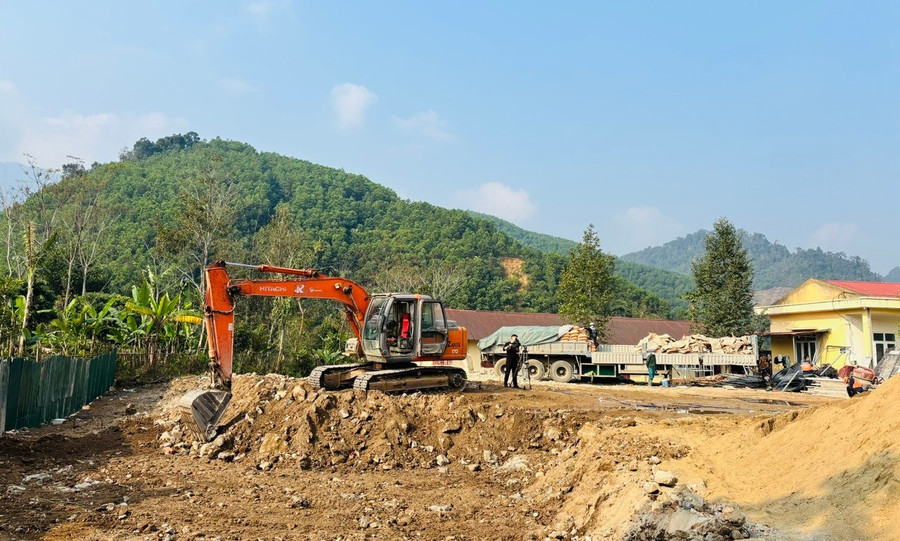
Land leveling at multi-level boarding schools in Thanh Hoa is being carried out urgently.
Building dreams in the border region.
Given the many difficulties, the construction of multi-level ethnic boarding schools in the border areas of Thanh Hoa province has become an urgent need. Now, on that arduous journey, things are looking brighter, and opportunities and hope for literacy are emerging.
The Politburo 's Conclusion Notice No. 81-TB/TW dated July 18, 2025, on the policy of investing in school construction for border communes, has materialized with the foundations of multi-level boarding schools taking shape, kindling hope for knowledge, compassion, and a brighter future for the border regions of the Fatherland.
In the decision approving the project for the integrated primary and secondary boarding schools that have already commenced construction, in addition to building a modern and comprehensive main school complex, the State will invest in building many separate school branches for primary school students with complete facilities, teaching equipment, boarding houses, and accommodation for teachers who live far from home. These school branches are located more than 10 kilometers away from the main school complex. In some cases, the branch is more than 20 kilometers from the commune center, such as the branch in Mua Xuan village, Son Thuy commune.
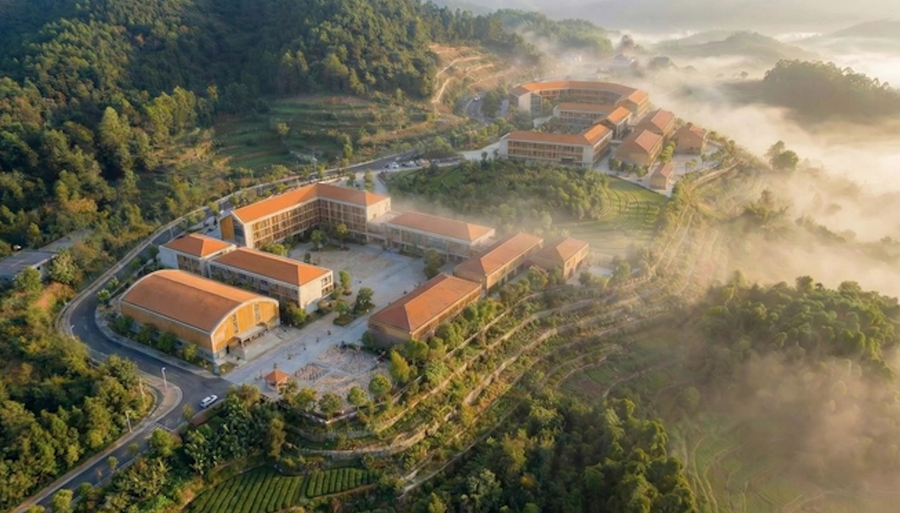
A model of a multi-level boarding school in Thanh Hoa province.
According to Deputy Director of the Department of Education and Training Nguyen Van Dinh: “In reality, organizing boarding for primary school students would be very difficult in terms of care and nurturing, especially for first and second graders. Therefore, building separate school branches in remote villages far from the center would both create conditions for children to stay in boarding facilities, make it convenient for parents to drop off and pick up their children, and contribute to eliminating the situation of combined classes and improving the quality of education .”
Mr. Nguyen Van Hoan, Deputy Principal of Yen Khuong Secondary School (Yen Khuong commune), shared: “The school has 313 students, and about 70 of them are currently living in rented accommodation. Most teachers live far from home, and living conditions are still lacking. When the new school is completed, we expect about 500 students to register for boarding.”
According to Mr. Le Hong Sam, Principal of Bat Mot Secondary School (Bat Mot commune), out of 262 students at the school, only about 30 receive support for meals and accommodation in the boarding facility, while nearly 100 students have to live in rented rooms. Mr. Sam hopes: “The new school will provide students with safe accommodation, especially those from remote villages. With better facilities, teachers can confidently innovate their teaching methods. Students will receive a proper education and will return to build their homeland in the future.”
That joy also spread to every family. Mrs. Luong Thi Thuy (Kham village, Tam Thanh commune) said emotionally: "Seeing our children struggle to go to school makes us feel so sorry for them. Now that there's a new school, we are overjoyed beyond words. This will be a support system for our children to nurture their dreams."
Investing in the construction of boarding schools at all levels is not only a solution for immediate educational needs, but also a long-term strategy. When literacy is brought to the highlands, it will ignite hope for a brighter future for the people in the border regions of the country, gradually making that hope a reality.
According to the People's Committee of Thanh Hoa province, there are currently 41 educational facilities with over 14,500 students in 16 border communes. In 2026, the province plans to start construction on 17 projects with a total investment of approximately 823 billion VND, focusing on building and upgrading multi-level boarding schools to meet the learning and living needs of students in remote areas.
Source: https://giaoducthoidai.vn/vuon-toi-tuong-lai-tu-ban-lang-post771555.html



























































































Comment (0)