


The digital revolution
The biggest difference that will make the 2026 World Cup historic is that it will be the first World Cup where artificial intelligence is deeply integrated into every aspect of the tournament. The strategic partnership between FIFA and leading technology companies has made what was previously only seen in science fiction a reality.
One of the most significant breakthroughs is the creation of "3D digital replicas" of the 1,200 participating players (48 teams, each registering a maximum of 25 players). The technology will scan their bodies with ultra-high resolution and recreate a parallel world of football in digital space, where every minute movement of a player is digitized with absolute accuracy compared to reality on the pitch.
This approach serves not only entertainment purposes or image rights, but more importantly, it forms the basis for an upgraded version of the Semi-Automatic Offside Catching system to be used at the 2026 World Cup.
Unlike previous controversies surrounding offside lines, AI can now calculate and make offside decisions in less than 5 seconds, instead of relying on visual observation from the referee. 3D models allow video referees (VAR) to see through even the most chaotic situations, where the human eye or traditional camera angles are often obscured.
This promises to bring about maximum fairness and, more importantly, to avoid disrupting the emotional flow of the game – something that has been considered a "victim" of technology in recent years.
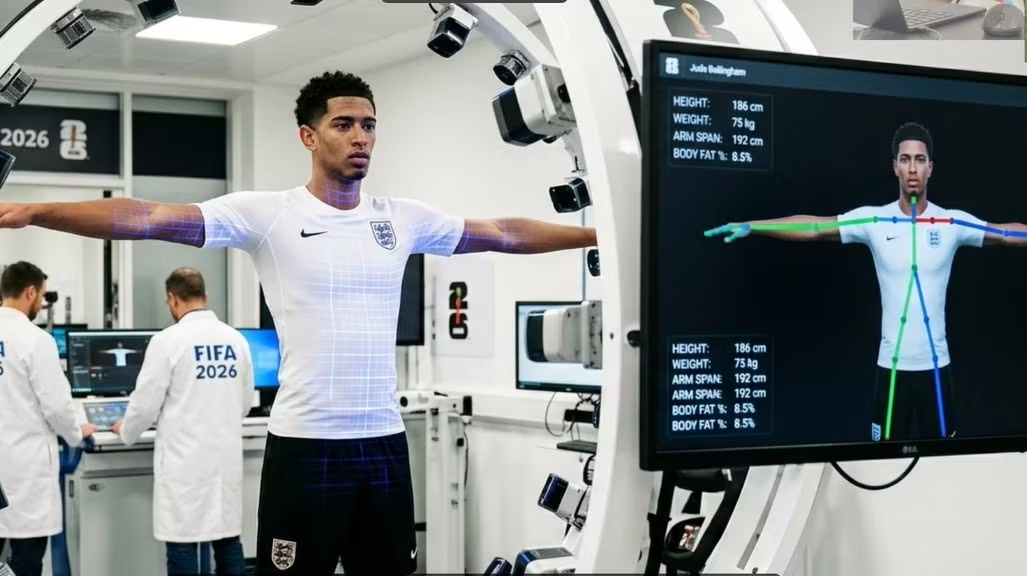
AI appears on the model.
AI can also change the way coaches approach matches. FIFA's Football AI Pro platform is proof of this breakthrough. With the analytical support from this platform, for the first time, smaller teams like Curacao or Cape Verde can access in-depth analysis that was previously only available to football powerhouses with substantial resources.
AI helps analyze millions of data points from matches to suggest substitutions, adjust formations, or predict injury risks for players in real time. This will help narrow the skill gap, creating a more unpredictable and exciting World Cup than ever before.
Looking to the future, the 2026 World Cup appears poised to be a giant "laboratory" for AI to redefine world football. As AI matures, the role of humans in football – from referees to coaches – will shift from execution to monitoring and decision-making based on intelligent cues.
AI helps improve the viewer experience.
The audience experience will also enter a new chapter with the AI-processed "Referee View." "Referee View" uses body-worn cameras to capture live footage from the referee's perspective on the pitch. Watching from the referee's point of view, fans will feel like they're playing an immersive video game.

The Premier League in the 2025/26 season already uses Referee View. But at the 2026 World Cup, fans can watch it more comfortably thanks to AI intervention. Artificial intelligence will process shaky scenes (caused by referee movement) to create a more pleasant, less irritating viewing experience.
This program allows viewers to see exactly what the main referee is seeing on the field with the most stable and smooth image possible. Thanks to AI, fans can access an experience that traditional cameras can hardly replicate.
This year's 2026 World Cup in North America is not just about the battle for the gold trophy. It's also about adapting to the wave of technology. Football, traditionally considered a sport of emotion and human error, is gradually transforming into a more precise and scientific entity with the support of artificial intelligence.
The 2026 World Cup will be the pioneering tournament in that plan. With the presence of AI, will humans and computers work together to create legendary moments on the pitch, or will they be criticized for decisions made in an overly mechanical and dry manner? The tournament in June-July will provide the answer.
Source: https://tienphong.vn/world-cup-2026-se-thay-doi-the-nao-nho-cong-nghe-ai-post1842770.tpo

![[Image] Hanoi's urban life under the challenge of a "scorching hot" environment](https://vphoto.vietnam.vn/thumb/1200x675/vietnam/resource/IMAGE/2026/05/25/1779706979265_nang-nong-t5-2026-minh-duy-7-4636-jpg.webp)
































































































Comment (0)