Cyberspace – a new ideological “frontier”
For decades, war was typically identified by the sound of gunfire, border disputes, or tangible military confrontations. But in the digital age, a new form of conflict is silently unfolding every day, every hour, on smartphones, social media platforms, and in global cyberspace. It is the war for control over social perception.
Unlike traditional forms of sabotage, cognitive warfare does not require the destruction of physical infrastructure or the direct use of force. Its goal is to undermine social trust, disrupt information, create a climate of skepticism, and gradually erode community cohesion from within.

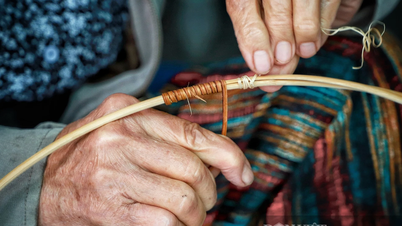
The Mong ethnic group's rice cake pounding festival. Photo: A Lu
In this context, ethnic minority areas and religious communities are becoming particularly targeted by hostile forces. The rapid development of the internet, social media, AI, Deepfake, and cross-border communication platforms has completely changed the way information is disseminated. Cyberspace, once merely a communication environment, is gradually becoming a new "ideological frontier" for each nation.
The most dangerous thing today is not simply misinformation, but the gradual loss of people's ability to distinguish right from wrong, truth from falsehood. When skepticism emerges and persists, the fundamental values of society are also at risk of erosion. According to many experts, the ultimate goal of perception manipulation campaigns is not to make people completely believe in falsehoods, but to make them gradually doubt what is true.
AI, Deepfake, and "soft attacks"
While subversive activities used to leave clear traces, now, with the support of AI, Deepfake, Big Data, and underlying algorithms, misinformation can be designed so sophisticatedly that it's very difficult to distinguish between truth and falsehood. A fake video of a speech, a manipulated audio recording, or a personalized article tailored to the reader's psychology can all become tools for inciting extremism, dividing communities, and manipulating public opinion. Even more worrying, this content is often disseminated gradually, infiltrating online groups, entertainment clips, or content with national cultural themes to create a sense of familiarity and make it difficult to guard against.
In many ethnic minority areas, the rapid increase in smartphone and internet usage in recent years has opened up significant opportunities for accessing knowledge, public services, and digital transformation. However, this also poses a risk of increased exposure to harmful and toxic information, as digital skills and the ability to verify information remain limited for some people.
In reality, many complex incidents related to ethnicity and religion in recent times have shown signs of being incited or amplified through social media and cross-border communication platforms.
These distorted narratives often focus on sensitive issues such as land, religious freedom, ethnic policies, or personnel management, thereby exaggerating individual shortcomings into "systemic problems," attributing them to accusations such as "religious oppression," "erasing national identity," or " human rights violations."
Shifting the focus of subversive activities from the field to the digital environment.
While previously subversive activities primarily involved the dissemination of reactionary materials, large gatherings, or illegal proselytization, they have now shifted significantly to the digital environment. Some exiled reactionary organizations and extremist groups masquerading as "democracy" and "human rights" advocates are changing their methods of operation towards a softer and more sophisticated approach.
Experts argue that in the age of AI, the fight against cyberattacks cannot rely solely on technical measures or handling violations. More importantly, it requires building the community's "self-resistance" through improved digital literacy, strengthening social trust, and developing a positive information ecosystem. When people are able to identify misinformation and proactively verify information, campaigns to manipulate perceptions will have less impact.
Instead of using dry, rigid propaganda materials, they built online groups, using the national language, music, customs, and cultural identity to subtly infiltrate extremist ideologies into everyday entertainment content. This gradual, persistent influence allows harmful and toxic information to silently permeate social life.
In some areas of the Central Highlands, reactionary elements continue to exploit economic difficulties, land issues, and religious activities to incite separatist and autonomous ideologies. In some areas inhabited by the Hmong people in the North, rhetoric about a "Hmong State" is still being disseminated under the guise of illegal proselytization, superstition, and fake news on social media.
The worrying aspect is that subversive forces are always thoroughly exploiting loopholes and shortcomings in the implementation of policies at the local level to distort and misrepresent the nature of the issues and create pressure from international public opinion.
The greatest risk is the erosion of trust.
According to media and cybersecurity experts, the most frightening aspect of cognitive warfare lies not in a single piece of fake news, but in the prolonged erosion of social trust. As people lose their ability to distinguish truth from falsehood, right from wrong, skepticism emerges. From there, the fundamental values of the community are also at risk of being shaken. A nation may be economically or militarily strong, but if it loses social consensus and the ability to protect its own perceptions, it still risks being manipulated from within.
In this context, protecting the Party's ideological foundation is not only a political task but also a task of preserving society's "spiritual immunity" against the cross-border impacts of digital technology.
This is also a strategic requirement to protect national sovereignty and awareness, preserve national cultural identity, and strengthen national unity in the digital age.
(To be continued)
Nguyen Thanh Huyen
(Deputy Director of the Department of Ethnic and Religious Affairs, Central Propaganda and Mass Mobilization Department)
Source: https://tienphong.vn/khong-gian-mang-va-cuoc-chien-gianh-niem-tin-o-vung-dac-thu-post1845953.tpo


![[Photo] General Secretary and President To Lam and the President of the Philippines hold talks.](https://vphoto.vietnam.vn/thumb/1200x675/vietnam/resource/IMAGE/2026/06/01/1780286997787_anh-man-hinh-2026-06-01-luc-11-09-43.png)

![[Photo] Reception to welcome General Secretary and President To Lam and his wife on their State visit to the Philippines](https://vphoto.vietnam.vn/thumb/1200x675/vietnam/resource/IMAGE/2026/06/01/1780295488620_vna-potal-chieu-dai-chao-mung-tong-bi-thu-chu-tich-nuoc-to-lam-va-phu-nhan-tham-cap-nha-nuoc-toi-philippines-8798060-7855-jpg.webp)












































































Comment (0)