

June 1st marks the official implementation of Circular 50 on the nationwide transition from conventional gasoline to E10 bioethanol. According to industry experts, this step has been prepared for many years and is part of the roadmap for developing biofuels and gradually reducing dependence on fossil fuels.
Experience instead of worrying
On the morning of June 1st, the first day of official nationwide distribution of E10 bioethanol fuel, operations at many gas stations in Ho Chi Minh City proceeded quite normally. The number of customers filling up remained stable, and no concerns or questions about the fuel being used were reported.
At some gas stations in the city, people are mainly concerned with refueling their vehicles, rather than choosing between E5 and E10 gasoline. At a gas station on Tran Nao Street, An Khanh Ward, Mr. Nguyen Van Thai said he had been filling his Honda Dream with E10 gasoline for over a month and hadn't noticed any unusual signs. "I still ride my motorbike every day, the engine starts normally, and I don't see any difference compared to before," Mr. Thai shared.
Similarly, Mr. Hung, a driver of a Toyota Innova used for work, said that he has been using bioethanol fuel for many years, previously E5 and now E10. According to him, the vehicle is still operating smoothly, with no incidents related to the fuel system or engine.
However, at a gas station on Dien Bien Phu Street, Thanh My Tay Ward, a salesperson said that some customers are still cautious. These customers choose to fill up with E5 gasoline because they are concerned that the higher ethanol content in E10 gasoline may affect engine parts, especially in older vehicles.
At gas stations across Hanoi , sales remained stable on the first day of E10 bioethanol fuel sales. Many customers said that instead of just hearing information from various sources, they chose to experience it firsthand to get an objective assessment of the fuel's quality on the first day of implementation. Ms. Nguyen Thuy Duong, from Cau Giay ward, Hanoi, decided to fill her tank with E10 fuel to experience it firsthand and said she would monitor fuel consumption and vehicle performance before giving a final assessment.
Regarding fuel suppliers, it was observed that on the morning of June 1st, many gas stations in Ho Chi Minh City had completed the conversion of their storage tanks to accommodate the new fuel type. Mr. Van Cong That, Director of KNJ Kim Ngoc Co., Ltd., stated that the station has two fuel storage tanks. Last week, one tank was cleaned and flushed to receive E10 gasoline and put into operation from June 1st. The other tank still contains RON 95 mineral gasoline with only a few thousand liters remaining, which was expected to be sold out within the day before being cleaned and converted to E10. However, on the evening of May 31st, the number of customers seeking to buy RON 95 gasoline increased by approximately three times compared to normal days, so the station quickly sold out its reserves.
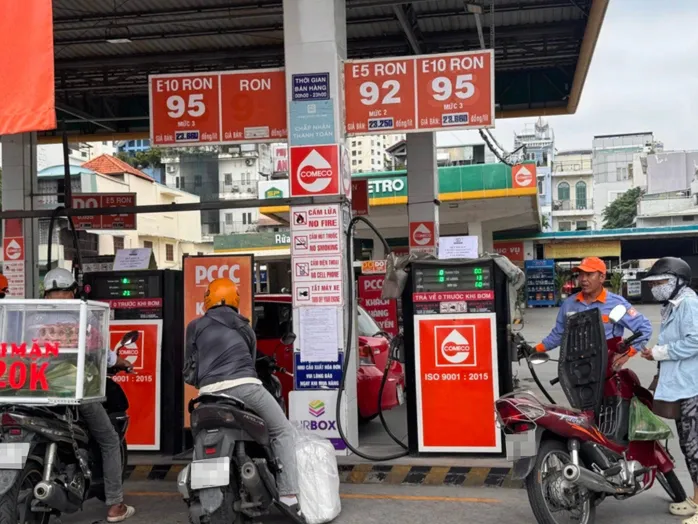
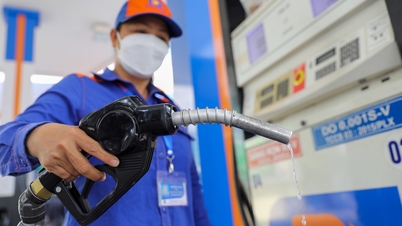
Gas stations nationwide will only be selling E5 and E10 bioethanol fuel from June 1st. Photo: NGUYEN HAI
According to the owner of this gas station, before the conversion, he was worried because although the tanks were already empty, the distributor could not confirm the delivery time for E10 gasoline. By the morning of June 1st, the supply had been fully provided to both storage tanks.
Meanwhile, Mr. Nguyen Xuan Thang, Director of Hai Au Phat Petroleum Company Limited, said that as of May 31st, the company still had a small amount of mineral gasoline in stock, so he was quite concerned about how to handle it. He had contacted the management agency to find out about the relevant regulations but had not received specific guidance other than information that there would be a written instruction.
According to Mr. Thang, the company had been selling both E10 gasoline and conventional gasoline simultaneously since May 28th, before switching entirely to E10 on June 1st.
Commitment to quality control of E10 gasoline.
Speaking with a reporter from the Nguoi Lao Dong newspaper, Mr. Bui Ngoc Bao, Chairman of the Vietnam Petroleum Association, said that looking back at the development of the energy sector, Vietnam has undergone many important fuel transitions over the past 40 years.
Specifically, in the 1990s, Vietnam switched from the former Soviet Union's GOST fuel standards to European standards. By 2000, leaded gasoline was completely replaced by unleaded gasoline. Subsequently, the petroleum industry continued to implement many changes to improve fuel quality, including the complete replacement of RON 92 mineral gasoline with E5 bio-gasoline from late 2017 to early 2018.
Unlike previous transitions, the implementation of E10 is considered a proactive step towards realizing green development goals, reducing emissions, and enhancing national energy security. "This is a process that has been relatively well prepared by the Government, regulatory agencies, and businesses, with a clear roadmap," Mr. Bao commented.
According to the Chairman of the Vietnam Petroleum Association, in addition to supervision by specialized management agencies, fuel quality is also regularly checked through the standards, measurement, and quality system under the Ministry of Science and Technology. Petroleum businesses must strictly comply with technical standards and regulations for products circulating in the market.
Mr. Bao acknowledged that there had been some cases of improper fuel mixing or trading in substandard fuel in the past. However, in recent years, this situation has decreased thanks to increased inspection and monitoring efforts and increasingly orderly business operations.
For users, especially owners of older vehicles using carburetors, the Vietnam Petroleum Association recommends servicing the fuel system before switching to E10. Cleaning the fuel lines, replacing the fuel filter, or adjusting the carburetor will help the vehicle run more smoothly.
From the perspective of biofuels, Mr. Do Van Tuan, Chairman of the Vietnam Biofuel Association, said that tens of millions of cars and motorcycles have used E10 gasoline to date. Every day, tens of millions of vehicles worldwide operate normally with this type of fuel.
According to Mr. Tuan, most motorcycles and cars manufactured from 2009 onwards have been designed by manufacturers using materials compatible with E10 gasoline. For very old vehicles, if non-metallic parts such as fuel lines, gaskets, or seals deteriorate, they can be replaced at a relatively low cost. "It can be confirmed that E10 gasoline is not the cause of engine damage in cars or motorcycles," Mr. Tuan emphasized.
He also suggested that consumers should evaluate E10 based on real-world experience rather than solely on information circulating on social media. According to him, this is not a new fuel but has been widely used for many years in the US, European countries, China, India, Thailand, and the Philippines.
Regarding concerns about the risk of fire and explosion, Mr. Tuan affirmed that to date, there is no scientific basis or actual record from countries using E10 gasoline to show that this type of fuel increases the risk of vehicle fires and explosions. According to him, some car fires that caused concern before 2015 were mainly related to counterfeit gasoline, including the mixing of methanol instead of ethanol. This is because methanol can damage the fuel system, especially the fuel lines, posing a potential safety risk during use.
Mr. Dao Duy Anh, Deputy Director of the Department of Innovation, Green Transformation and Industrial Promotion (Ministry of Industry and Trade), affirmed that consumers can be completely assured when using E10 gasoline. The quality of E10 gasoline is strictly controlled according to the latest national technical standard, QCVN 01:2026, amended from QCVN 01:2022. Management agencies such as the Ministry of Industry and Trade, the Ministry of Science and Technology, and local authorities all have inspection and monitoring forces to ensure that products circulating in the market always comply with national technical standards.
"Consumers can feel reassured as they transition to a fuel that is considered cleaner and more advanced. However, it is also necessary to recognize that any transition can create certain concerns, because people have been accustomed to using one type of fuel for a long time and are now switching to a new fuel with different characteristics," he said.
Therefore, the representative from the Ministry of Industry and Trade recommended that the first thing consumers need to do is trust the quality of gasoline and diesel fuel authorized by the State for circulation in the market. Besides that, although regulatory agencies have conducted many thorough surveys and assessments to determine which types of vehicles are suitable for each type of fuel, users should still refer to the manufacturer's recommendations. In particular, it is necessary to strictly adhere to regulations on periodic maintenance for vehicles. "If you fully implement the maintenance schedule and follow the manufacturer's instructions, potential problems during use will be minimized," Mr. Duy Anh emphasized.
Source: https://money.vtv.vn/xang-e10-phu-song-cung-cam-ket-manh-me-109260602091141771.htm

![[Photo] General Secretary and President To Lam presides over a meeting on preparations for the review of one year of operation of the three-tiered government system.](https://vphoto.vietnam.vn/thumb/1200x675/vietnam/resource/IMAGE/2026/06/02/1780391821195_a1-bnd-4595-9717-jpg.webp)












































































Comment (0)