

At the ceremony commemorating 100 pediatric liver transplants and the pediatric liver transplant scientific conference held on May 29th, Associate Professor Pham Duy Hien, Deputy Director of the hospital, emphasized that this achievement helps children with end-stage hepatobiliary diseases live healthy lives right here in Vietnam. Professor Hien stated that previously, this group of pediatric patients always faced the risk of death or their families had to take them abroad for treatment at exorbitant costs.
The National Children's Hospital launched its pediatric liver transplant program in 2005. After an initial phase of receiving support from international experts, the domestic medical team has now mastered many complex techniques such as emergency liver transplantation, incompatible blood group transplantation, transplantation for low-birth-weight children, transplantation from brain-dead donors, and handling complex genetic metabolic diseases.
To date, the hospital has recorded a 90.2% survival rate for pediatric patients five years after transplantation, comparable to figures from major centers worldwide . It is also the first unit in Asia to successfully perform liver transplants on children with cirrhosis caused by gene mutations affecting bile acid metabolism. Notably, in 2025, doctors will successfully perform the first pediatric liver transplant using organs from brain-dead donors.
Statistics show that in 100 liver transplant cases, doctors noted that approximately 70% of pediatric patients had congenital biliary atresia, while the remainder had metabolic disorders, primary liver cancer, or end-stage cirrhosis.
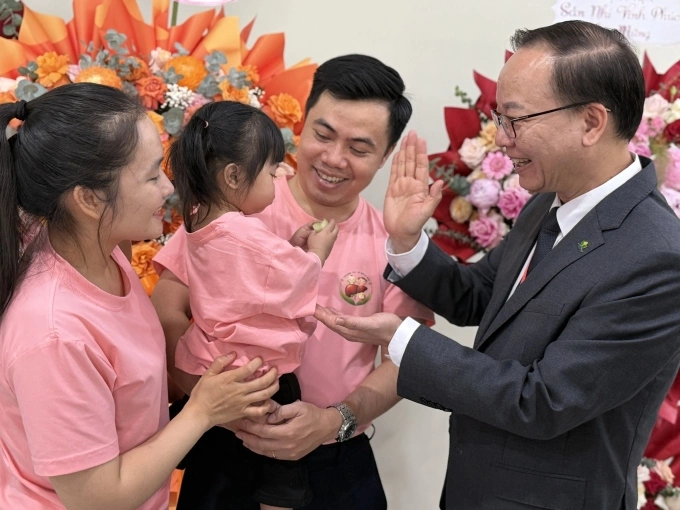
Typically, experts successfully revived Phan Linh Phuong (2.5 years old, residing in Ho Chi Minh City). Doctors discovered that the child had congenital biliary atresia when she was only a few days old. After an unsuccessful Kasai surgery, the patient had to undergo a liver transplant to survive.
At 17 months old and weighing only 8 kg, the child underwent surgery to receive a liver transplant donated by her uncle. One year after the surgery, the child's health remained stable, she gained weight well, and her liver function indicators were normal.
The child's family said they had to pay nearly 500 million VND more for the organ harvesting and transplantation process, in addition to the amount covered by health insurance. Post-transplant care requires significant effort because family members must administer anti-rejection medication for the child for life and adhere to strict medical care conditions.
According to Professor Tran Minh Dien, Director of the National Children's Hospital, the cost of a liver transplant for children currently ranges from 500-700 million VND, which is among the lowest in the region. Health insurance covers most of the costs for children under 6 years old.
Nevertheless, the scarcity of donated organs remains a major challenge. The hospital currently has 65 pediatric patients awaiting liver transplants, 25 of whom require urgent surgery. To help address the economic challenges, the Hope Foundation has sponsored 17 liver transplants at the hospital, bringing the total number of organ transplants supported by the foundation nationwide to 39.
Dr. Dinh Anh Tuan, Director of the Department of Maternal and Child Health (Ministry of Health), stated that the 100 transplant cases mark a significant milestone for the hospital and the entire pediatric organ transplant sector in Vietnam. Authorities will continue to refine the Law on Donation and Transplantation of Human Tissues and Organs in the future, thereby creating a legal framework to help this field develop sustainably in the new phase.
According to vnexpress.net
Source: https://baodongthap.vn/100-tre-suy-gan-thoat-cua-tu-nho-ghep-tang-chi-phi-thap-a241491.html
![[Image] Hanoi Police officially crowned champions of V-League 2025/2026](https://vphoto.vietnam.vn/thumb/1200x675/vietnam/resource/IMAGE/2026/05/31/1780244769054_ndo_br_039d561b692be875b13a-jpg.webp)
























![[Photo] The General Secretary, President and his wife begin their state visit to the Philippines.](https://vphoto.vietnam.vn/thumb/1200x675/vietnam/resource/IMAGE/2026/05/31/1780230559452_anh-man-hinh-2026-05-31-luc-19-28-11.png)
























































Comment (0)