

Editor's Note: After nearly a year of implementing the two-tiered local government model (since July 1, 2025), the Agriculture and Environment Newspaper is undertaking this series of articles to document the movements and changes at the grassroots level, where the new administrative apparatus and its team of public servants have strived to overcome many difficulties to serve the people better and more effectively.
Practical experience at the grassroots level confirms that the revolution to streamline the administrative apparatus and reorganize the country not only helps save budget and reduce intermediate levels in the system, but also opens up new avenues for development, bringing new expectations to realize the aspiration of building a prosperous and happy nation.
The windows in Nam Tam always light up late.
In the late afternoon of June, the sun from the Sin Ho plateau slanted down onto the concrete surface. The stifling heat made the air in the approximately 30 m² room of the Culture and Social Affairs Office of Nam Tam commune (Lai Chau province) even more oppressive.
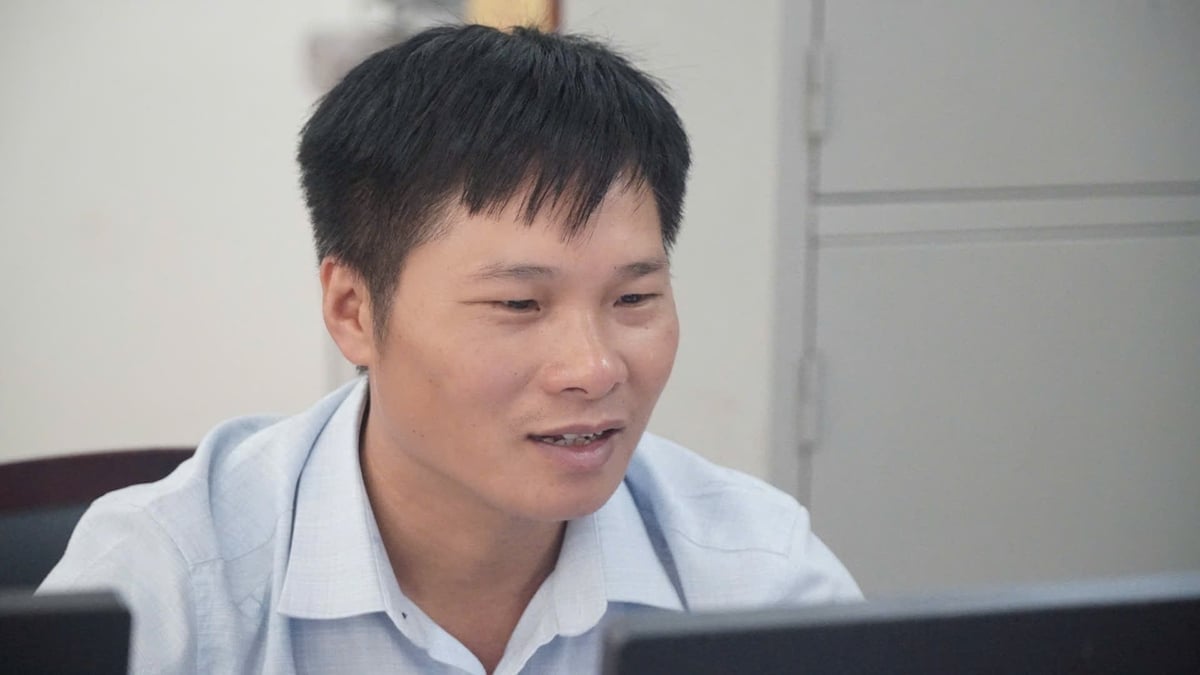
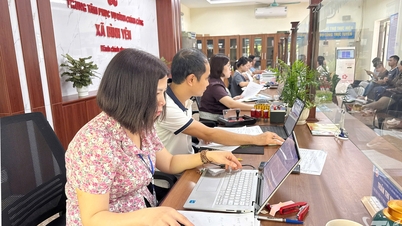
Mr. Tan A Binh, a specialist in the Culture and Social Affairs Department of Nam Tam commune, spends all day "glued" to his computer. Photo: Duc Binh.
On Tan A Binh's desk, a glass of cool water had almost all its ice melted. Water had pooled in a puddle across the tabletop. Since mid-afternoon, he had reached for the glass several times, but his phone kept vibrating or the computer screen in front of him kept flashing new notifications. Data cells, documents, and work-related chat groups kept piling up as if there were no end to it.
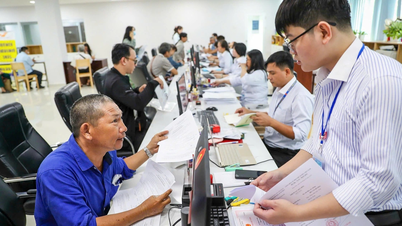
In the office, the only sounds were the clicking of keyboards and mouse clicks. Occasionally, Mr. Binh would lean over to quickly exchange a few words with a colleague about an incomplete declaration form, then return to his computer screen, his hand continuing to move the mouse between the numerous open document files.
The door to the room swung open. A Dao ethnic man entered, clutching a crumpled stack of papers. Tan A Hac had come to register the death and claim benefits for his recently deceased relative. He sat down on the edge of a chair, his eyes red and his voice choked with emotion each time he had to mention the name of the deceased. At times, the nearly 50-year-old man bowed his head for a long time, his hands tightly gripping the death certificate folded in quarters.
Mr. Binh pulled his chair closer, carefully checking the information on the documents while quietly asking questions to ease the man's embarrassment. The specialist from the Culture and Social Affairs Department entered the information, printed the forms, and then bent down to point out the places where signatures were needed. In the hallway, the voices of people waiting to complete procedures continued steadily, interspersed with the incessant ringing of the telephone on the desk.
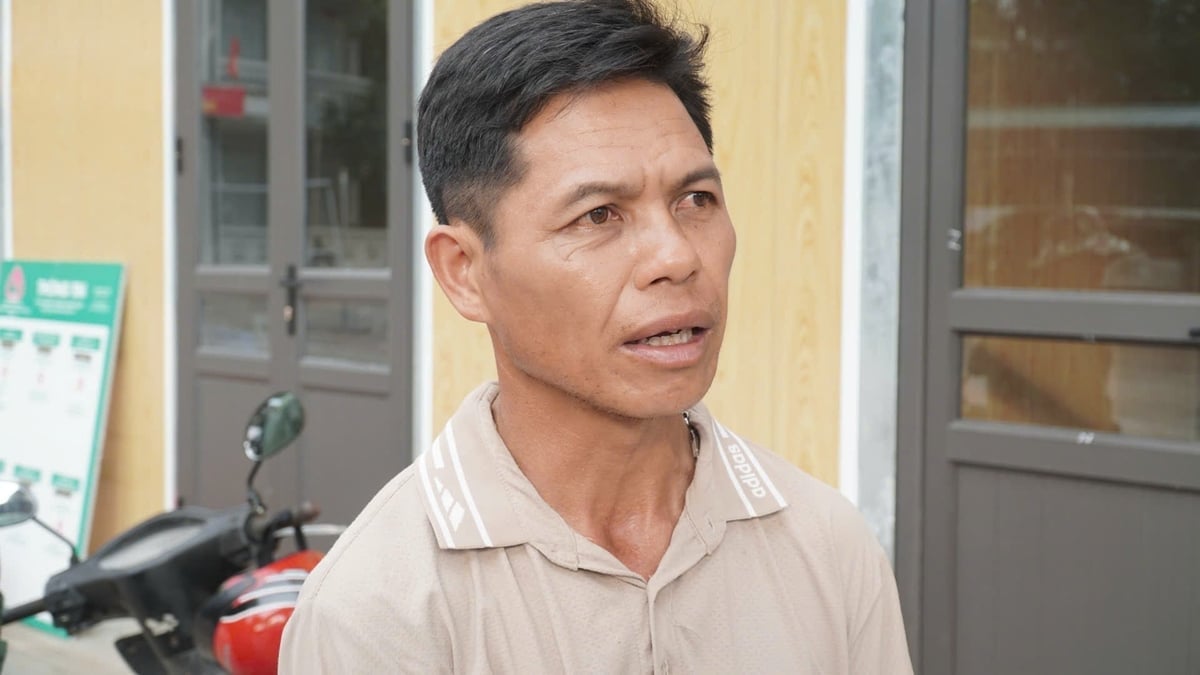
Mr. Tan A Hac expressed his gratitude to the commune authorities for their assistance in expediting the procedures for the unfortunate death of a family member. Photo: Duc Binh.
Upon receiving his completed application, Tan A Hac was silent for a few seconds. The redness in his eyes from when he entered softened. Previously, for procedures related to the support program, he had to go down to the former Lung Thang commune for verification, then to the hospital to complete the paperwork, and only then to the district to wait for approval and signing of documents. This often involved waiting for many days, and he didn't know who to call to inquire about the results. Now, with everything integrated and processed right at the commune, all procedures were completed in just half an hour.
At his desk inside, Ha Manh Hai, Head of the Culture and Social Affairs Department of Nam Tam Commune, had just finished a meeting with the commune leaders. Immediately upon returning, he quickly opened his computer to continue working. “Since the implementation of the two-tiered government system, a lot of work has been transferred from the district, but we still lack staff,” Hai confided, his hands continuously typing responses to work notifications on the Zalo app.
Nam Tam commune was established by merging three former communes: Lung Thang, Nam Cha, and Nam Tam (formerly part of Sin Ho district, Lai Chau province). The commune covers a natural area of over 242 km², with a population of 12,720 people across 26 villages. Of this population, the Dao ethnic group accounts for approximately 37.5%, the Thai 25.2%, the Lu 21.45%, and the remainder are other ethnic groups.
The three former communes merged into one, resulting in a larger area and a correspondingly larger workload. Sometimes, documents from the province would arrive late in the afternoon, but reports had to be completed by the next morning. Many meetings in remote villages didn't finish until late at night.
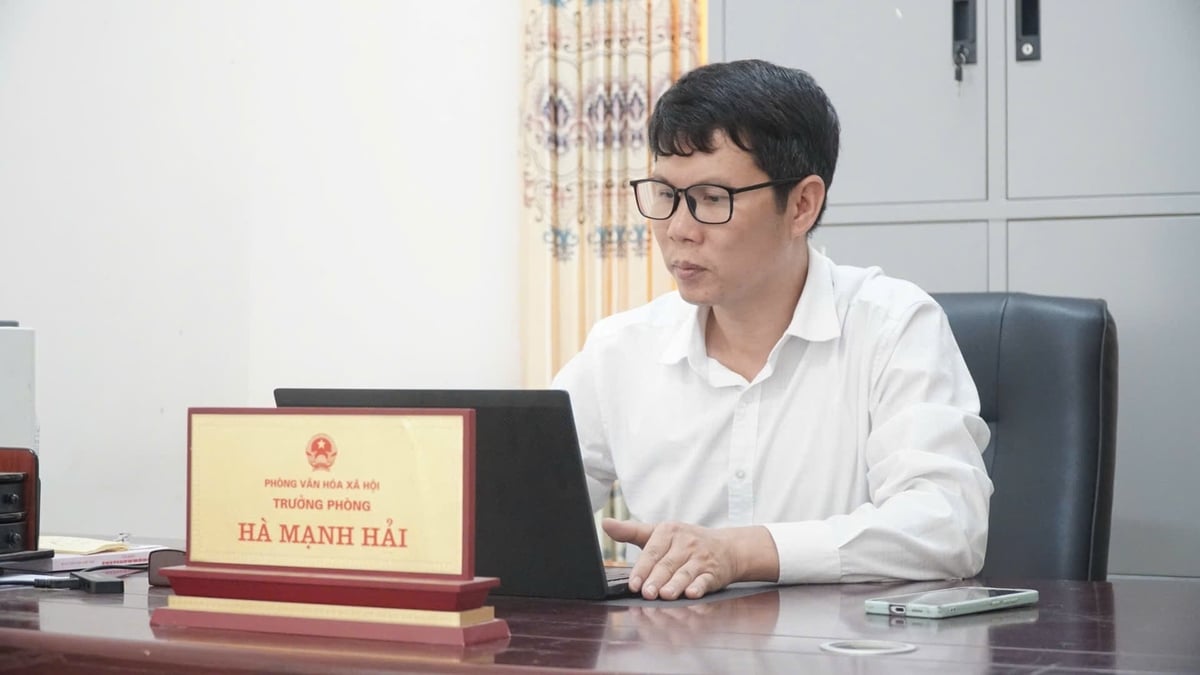
Mr. Ha Manh Hai, Head of the Culture Department, has been transferred from the former Lai Chau city to Nam Tam commune. Photo: Bao Thang.
“Now the department head is directly involved in handling files alongside the specialists. Many days I have to take my computer home and work until late at night,” the department head, whose permanent residence is in the former Lai Chau City, said with a weary smile, his eyes still glued to the computer screen. For him, the biggest pressure isn't a large report, but the dozens of small tasks piling up every hour.
The road down to the village is "further" than the road home.
On the second floor, the Vice Chairman of the People's Committee of Nam Tam Commune, Mr. Bui The Dung, stood up, quickly poured himself a pot of strong, now-cold tea, then pulled a plastic chair out onto the porch, glancing towards the row of makeshift staff quarters behind the headquarters. There, small rooms hastily constructed from panel sheets were stiflingly hot, often making it hard to leave early. But that was still fortunate, because, according to him, many remote and mountainous areas faced even greater difficulties, with many officials having to temporarily borrow student dorm rooms to live in. Even the Nam Tam Commune People's Committee headquarters itself was originally the property left behind by the Nam Ma Protective Forest Management Board.
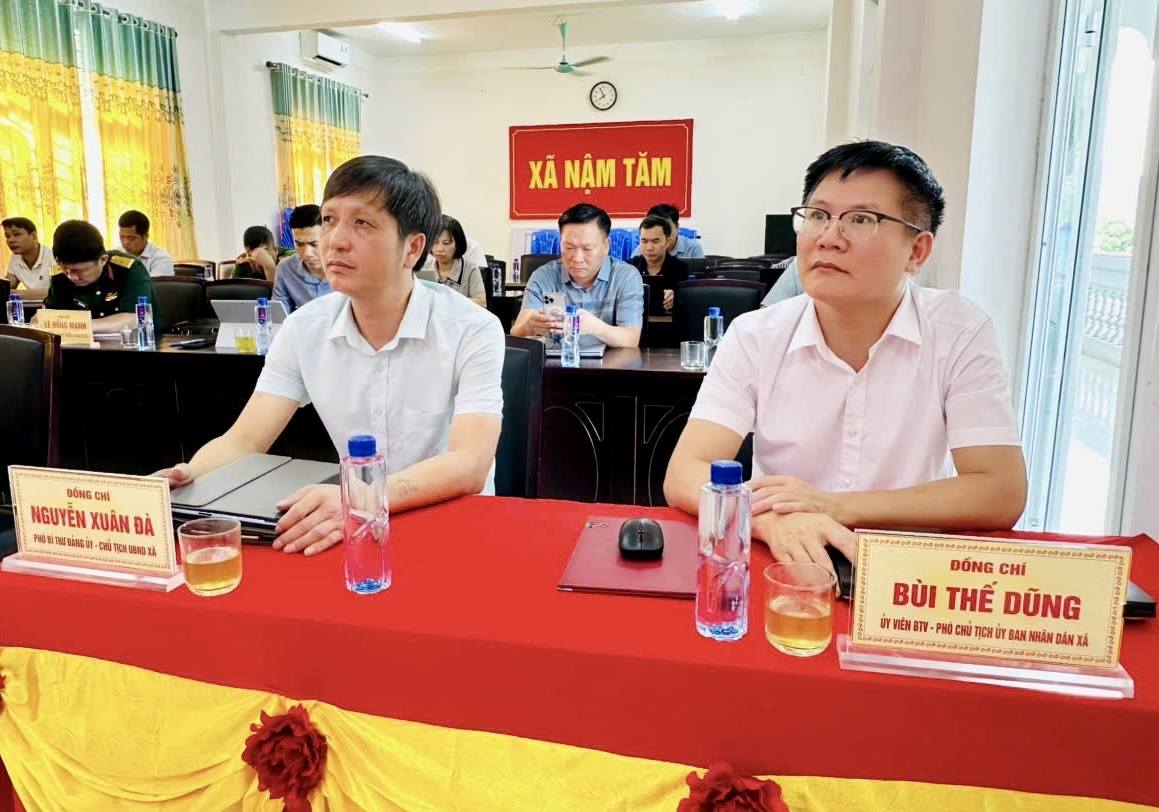
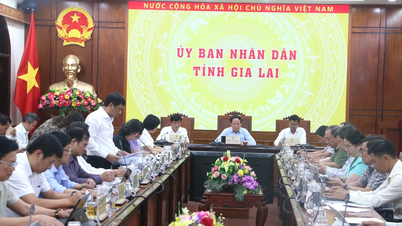
Leaders of Nam Tam commune participate in the preliminary review meeting of the two-level government. Photo: Nguyen Huong.
After the merger, the number of officials from various areas concentrated in the commune increased, while the facilities were almost entirely reused from the old headquarters. Old computers, cramped offices, insufficient staff housing, yet the work had to continue uninterrupted.
"The most difficult thing is still changing people's habits," the Vice Chairman of the commune expressed, because although many procedures can now be processed online, people are still used to bringing their documents to the commune office to inquire and ensure everything is done correctly. Many people are not yet familiar with using smartphones or submitting applications online.
That's understandable in a mountainous area like Nam Tam. "There are remote villages with steep, winding roads, requiring 2-3 hours to reach, even longer than the journey to the old Lai Chau city. During the rainy season, the dirt roads become muddy and slippery, and in many sections, vehicles have to crawl meter by meter through the mud and landslides," the Vice Chairman of the Nam Tam Commune People's Committee explained.
What the officials of Nam Tam remember most is probably the National Assembly and People's Council elections at all levels in early April. According to their assigned duties, groups of officials went down to the villages early in the morning to guide people through the procedures, disseminate information about policies, and explain the rights and obligations of citizens on this "National Election Day." It is said that in the remote villages of the former Nam Cha commune, the commune officials had to leave the night before to be ready to welcome the first voters to cast their ballots.
But that wasn't the end of it. As the final ballots were counted, everyone, without a word, rushed back to headquarters, with piles of reports, forms, and data that had been "stuck" since morning waiting to be processed. Some still had mud clinging to their trousers. The clicking of keyboards echoed again amidst the open data files filling the screens, a familiar rhythm in the two specialized departments.
The chairman of Nam Tam commune, Nguyen Xuan Da, said that what is important for local authorities today, besides the capacity to handle the increased workload after the merger, is guiding people to use digital technology. "Party branch secretaries and village heads must know how to use smartphones and Zalo so that work can be carried out efficiently," he said.
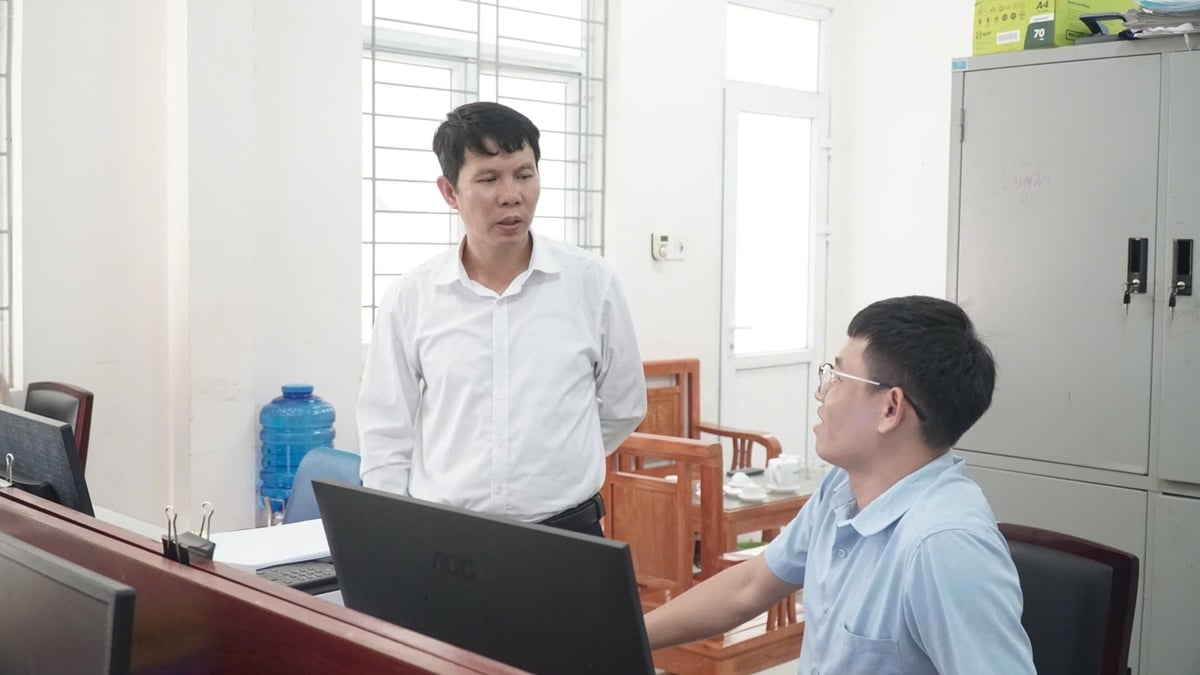
The head of the Culture and Social Affairs Department of Nam Tam district is discussing matters with a specialist. Photo: Duc Binh.
However, given the many difficulties in this remote village, coupled with the fact that many young people of working age have gone away to work, it's not simple at all. In some villages, phone signals are still intermittent, and the internet is sometimes available and sometimes not. Many elderly village chiefs are unfamiliar with the procedures, so commune officials have to call them to provide guidance and send screenshots of each step so they can update or review the information.
After nearly a year of implementing the two-tiered local government model in Nam Tam, countless difficulties and obstacles have added pressure to the work at the commune level, but it has also opened up expectations for a more people-oriented system that can address issues at the grassroots level.
Belief begins with small changes and is gradually nurtured and grows on the Sin Ho plateau.

On the Sin Ho plateau. Photo: Thoa Dong.
Source: https://nongnghiepmoitruong.vn/365-ngay-ve-voi-dan-o-nam-tam-d813997.html
![[Photo] Secretary of the National Assembly Party Committee, Chairman of the National Assembly presides over the meeting of the Standing Committee and Executive Committee of the National Assembly Party Committee.](https://vphoto.vietnam.vn/thumb/1200x675/vietnam/resource/IMAGE/2026/06/03/1780480353201_ndo_br_bnd-2585-jpg.webp)
![[Photo] General Secretary and President To Lam presides over a meeting with the Central Organizing Committee.](https://vphoto.vietnam.vn/thumb/1200x675/vietnam/resource/IMAGE/2026/06/03/1780482764658_a1-bnd-4741-3342-jpg.webp)


















![[Photo] First session of the 14th Congress of the Vietnam Trade Union](https://vphoto.vietnam.vn/thumb/1200x675/vietnam/resource/IMAGE/2026/06/03/1780465947883_ndo_br_img-3852-jpg.webp)



















![[Video] Sunset at Lap An Lagoon – Where the sun sets over the fishing nets](https://vphoto.vietnam.vn/thumb/1200x675/vietnam/resource/IMAGE/2026/05/31/1780192137701_beach-landscape-sea-water-nature-grass-745871-pxhere-com.jpeg)





















Comment (0)