

Co-organized by three Vingroup member units, including the Foundation for a Green Future, VinUni University, and the Vingroup Young Tech Talent Club - VinTechTalent, the competition aims to find and develop highly applicable technological initiatives to address pressing environmental challenges in the region, while promoting innovation and interdisciplinary collaboration among young people.
439 teams, comprising 1,439 contestants from 22 countries, participated in the competition. Teams from Vietnam accounted for the majority with 174 registered groups, followed by India (114 teams), the Philippines (44 teams), China (including Hong Kong and Taiwan) (23 teams), Indonesia (20 teams), and others.
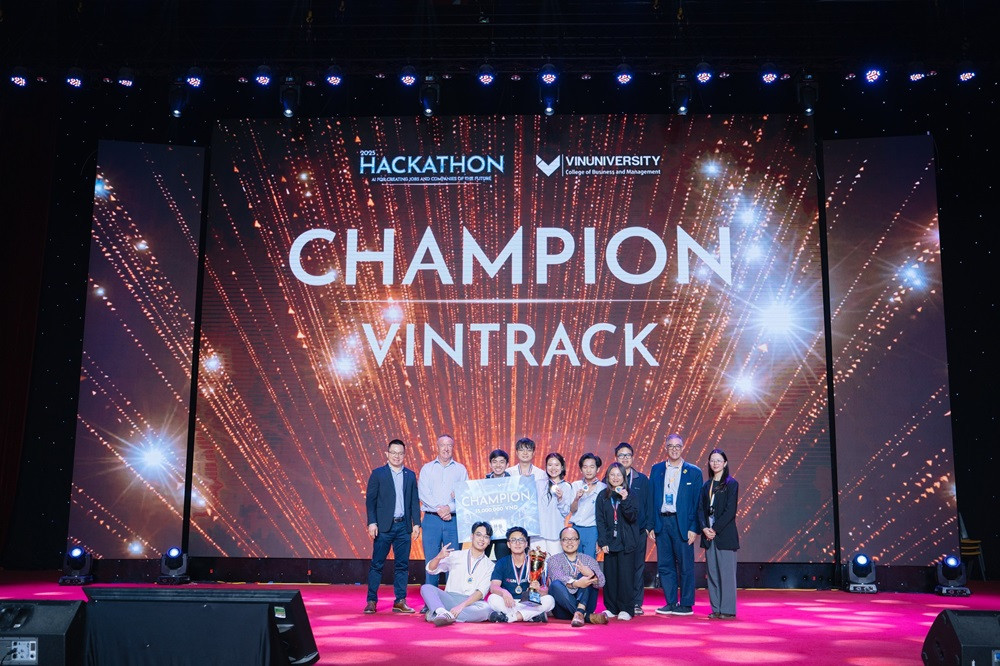
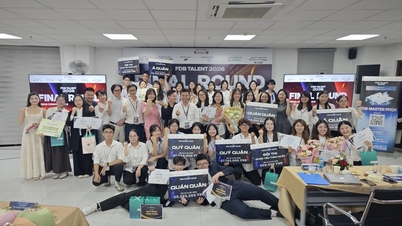
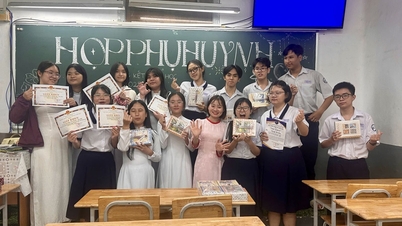
The top 30 outstanding teams will be sponsored to compete in person at VinUni University ( Hanoi ). (Illustrative image: The winning team of the VinUni Hackathon 2025 competition. Photo: VinUni University.)
Notably, many participating teams come from top universities in the QS World University Rankings and Asian University Rankings 2026. Among the top universities in the world are the National University of Singapore - NUS (ranked 8th in the world) and Nanyang Technological University - NTU (ranked 12th in the world) from Singapore; the University of Hong Kong (ranked 11th in the world), Hong Kong University of Science and Technology - HKUST (ranked 44th in the world), and Hong Kong Polytechnic University (ranked 54th in the world) from Hong Kong (China); Seoul National University - SNU (ranked 38th in the world) and Yonsei University (ranked 50th in the world) from South Korea; Kyoto University (ranked 57th in the world) from Japan; the University of Malaya - UM (ranked 58th in the world) from Malaysia; and the Indian Institute of Technology Madras (ranked 180th in the world) from India.
In addition, many participating teams came from universities with high rankings in the QS Asian University Rankings, such as the University of Indonesia - UI (ranked 47th in Asia) from Indonesia, Ateneo de Manila University (ranked 141st in Asia) from the Philippines, and Nazarbayev University (ranked 201st in Asia) from Kazakhstan. Furthermore, the competition also saw participation from teams from many leading universities in science and technology in Vietnam, including Hanoi University of Science and Technology, Ho Chi Minh City University of Technology - Vietnam National University, and VinUni University.
The three main themes of the competition demonstrate the equal interest of Asian youth in current environmental challenges and sustainable development. The theme "Water Resources and Climate Change Adaptation in Agriculture" accounted for the highest percentage, with approximately 37% of registered teams, followed by "Urban Air Quality and Climate Change Resilience" with 33% of registered teams, and "Renewable Energy and Low-Emission Transportation" with 30% of registered teams.
The contestants' academic fields span from computer science, artificial intelligence, engineering, sustainable development, agriculture, logistics to health and environmental science, demonstrating the strong interdisciplinary nature of this year's competition. Through this, the competition not only promotes technological innovation but also opens opportunities for young people in the region to collaboratively create solutions with practical applications and long-term impact on the community.
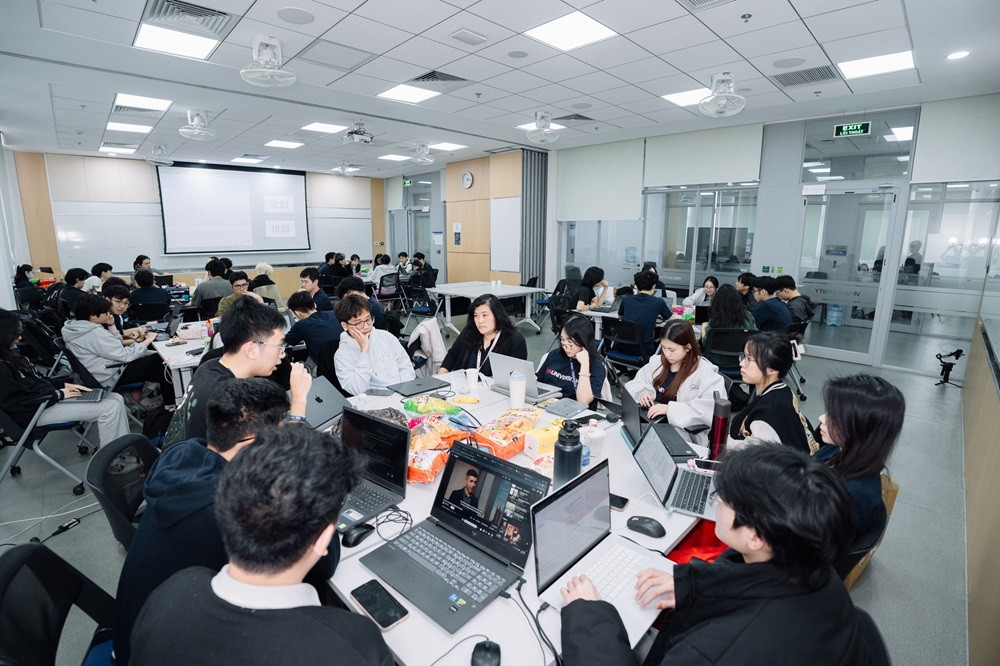
The Asian Hackathon for Green Future aims to become a platform for promoting cross-border exchange and cooperation among young people in the region to develop practical solutions for the community. Photo: VinUni University.
“Through the Asian Hackathon for Green Future 2026, the Foundation for a Green Future continues to affirm its commitment to reaching international standards in initiatives promoting sustainable development and innovation. Not only is it accompanying Vietnam's green transformation journey, but the Foundation also aims to connect the intellectual resources of young people across Asia, contributing to mobilizing high-value ideas to address environmental challenges and future development,” said Dr. Le Thai Ha, Executive Director of the Foundation for a Green Future and Head of the competition organizing committee.
Following the Preliminary Round, the top 30 teams are expected to be announced in early June 2026 and participate in an intensive training program with international experts before entering the 36-hour live Hackathon from July 2-5 at VinUni University, Hanoi.
The projects will be judged by a panel of leading Asian experts in technology, innovation, and sustainable development. The top 30 will compete for prizes totaling up to US$24,000, including a first prize of US$8,000, a second prize of US$5,000, two third prizes of US$3,000 each, and five consolation prizes of US$1,000 each.
Beyond the scope of a competition, the Asian Hackathon for Green Future is becoming a platform bringing together hundreds of teams from numerous countries and leading universities across Asia, demonstrating the immense potential of a cross-border collaborative ecosystem where technological innovations not only remain as ideas but can be nurtured, refined, and developed into practical solutions for society.
List of judges for the Asian Hackathon for Green Future 2026: - Head of the Judging Panel: Prof. Duong Nguyen Vu, Vice Rector in charge of postgraduate training at VinUni University, and Director of Science at the Artificial Intelligence Research Center of VinUni. - Assoc. Prof. Carrie Ling - Director of the Entrepreneurship Centre and Adjunct Associate Professor in the Department of Systems Integration and Design at the Hong Kong University of Science and Technology - Dr. Paul Wang - Director of the Technology Entrepreneurship Centre, Executive Director of the Technology Entrepreneurship Academy, and Deputy Director of the Knowledge Exchange Office at the University of Hong Kong; - Assoc. Prof. Shauhrat S. Chopra - Vice-Chancellor for Undergraduate Studies at the School of Energy and Environment, City University of Hong Kong; - Mr. David Falcon - Director of ESG at VinFast; - Assoc. Prof. Dr. Nguyen Trung Thanh - Deputy Head of the Department of Data Science and Artificial Intelligence, School of Technology, National Economics University; - Dr. Nguyen Duy Dat - Head of the Department of Environmental Technology at Ho Chi Minh City University of Technology |
Source: https://vietnamnet.vn/439-doi-thi-tu-khap-chau-a-tham-gia-asian-hackathon-for-green-future-2026-2517853.html

![[Image] Close-up view of the interchange connecting the two expressways and Long Thanh Airport.](https://vphoto.vietnam.vn/thumb/1200x675/vietnam/resource/IMAGE/2026/05/25/1779703378210_ndo_br_z7863716673926-224453a31600126cce10622af6290afd-4549-jpg.webp)


![[Image] Hanoi's urban life under the challenge of a "scorching hot" environment](https://vphoto.vietnam.vn/thumb/1200x675/vietnam/resource/IMAGE/2026/05/25/1779706979265_nang-nong-t5-2026-minh-duy-7-4636-jpg.webp)













































































Comment (0)