

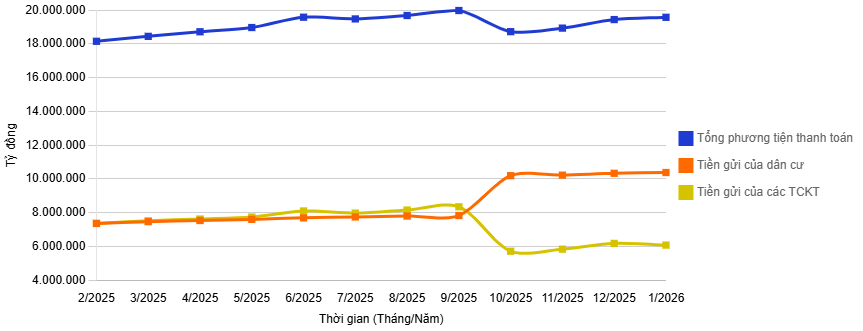
According to data from the State Bank of Vietnam (SBV), by the end of January 2026, the total means of payment reached over 19.57 million billion VND, an increase of 0.69% compared to the end of the previous year.
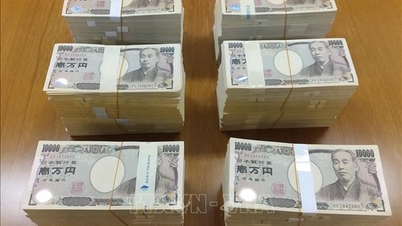
Household deposits continued to increase to over 10.38 million billion VND, while deposits from economic organizations decreased to approximately 6.08 million billion VND.
Notably, at the beginning of 2026, many banks adjusted their deposit interest rates upwards, especially for medium and long-term maturities, in order to attract capital.
Previously, the State Bank of Vietnam announced that by mid-May 2026, outstanding credit in the entire economy reached approximately 19.4 million billion VND, an increase of 18.3% compared to the same period. Meanwhile, total capital mobilization of the system reached approximately 18 million billion VND, an increase of nearly 14.9%.
One noteworthy point is that Vietnam's credit-to-GDP ratio is currently the highest among lower-middle-income countries (exceeding 144% according to March 2026 data). This indicates that the economy remains heavily dependent on capital from the banking system.
According to experts, an economy's excessive reliance on bank credit can increase risks to the financial system. This is because banks' mobilized capital is primarily short-term, while the capital needs of businesses and the economy typically extend into the medium and long term.
According to the State Bank of Vietnam, the banking sector is facing many difficulties as the global economy is volatile and unpredictable, international interest rates remain high, and geopolitical risks are increasing, putting pressure on inflation control and monetary policy management. Domestically, slow capital mobilization is also putting pressure on the capital balance of credit institutions.
Against this backdrop, the State Bank of Vietnam continues to pursue the goals of controlling inflation, stabilizing the macroeconomy, supporting growth, and ensuring the safety of the banking system.
Regarding credit, the credit growth rate in recent years has consistently exceeded the growth rate of capital mobilization, putting pressure on the capital balance and liquidity of the banking system. This has led to increasing pressure on liquidity and interest rates.
In light of this situation, the State Bank of Vietnam has recently been repeatedly requesting credit institutions to lower interest rates. At the same time, the agency has also directed its regional branches to strengthen supervision of the implementation of interest rate reductions by credit institutions in their areas; and to review units with high deposit and lending interest rates in order to conduct specialized inspections when necessary.
Source: https://vietnamnet.vn/tien-gui-dan-cu-lap-ky-luc-moi-vuot-10-38-trieu-ty-dong-2519119.html
![[Image] Pleasant weather helps students enter the 10th grade entrance exam with confidence.](https://vphoto.vietnam.vn/thumb/1200x675/vietnam/resource/IMAGE/2026/05/29/1780034401612_ngay-1-thi-lop-10-minh-duy-8-5009-jpg.webp)

![[Photo] Ba Lang An Lighthouse - the "eye of the sea" amidst the "rock museum" of Quang Ngai province.](https://vphoto.vietnam.vn/thumb/1200x675/vietnam/resource/IMAGE/2026/05/29/1780038698840_anh-man-hinh-2026-05-29-luc-14-10-42.png)
































































































Comment (0)