In their early stages of development, many small and medium-sized enterprises (SMEs) choose to deploy IT infrastructure using traditional models with internal servers or by renting server space in data centers. However, as businesses grow, their scale expands, and data volumes increase rapidly, this model often reveals limitations in performance, cost, and scalability.
The shift to the cloud is strongly underway among small and medium-sized enterprises (SMEs). According to the 2025 SMB Technology Report, 67% of SMEs have integrated at least one cloud solution into their daily business operations, while 54% use SaaS applications to run core processes.
These figures reflect a reality: as businesses grow, traditional IT infrastructure often begins to become a bottleneck. Below are five common signs that SMEs should consider migrating their IT systems to the cloud.

The system starts to slow down as traffic increases.
One of the most noticeable signs is that the system operates stably under low load but starts to slow down as the number of users increases. Websites become responsive, internal applications take longer to process, or system congestion occurs during peak times.
The primary reason lies in the fixed infrastructure architecture. Physical servers or internal virtual machines are only configured with a certain level of resources. When demand spikes, SME systems struggle to scale immediately, and adding new servers often takes a long time to deploy and predict future demand—which isn't always accurate.
According to research from numerous technology organizations, even a one-second increase in page load time can significantly reduce user experience and conversion rates. Cloud computing solves this problem by scaling resources according to actual demand. When traffic increases, the system can automatically expand to ensure performance, then shrink when demand decreases.
Infrastructure costs are increasing continuously with each expansion.
In the initial stages, investing in a few servers might be sufficient to run the system. However, as the business expands, IT costs typically increase in large increments: purchasing additional servers, upgrading storage equipment, expanding the network, or renting more space in a data center.
The drawback of this model is that businesses must invest in infrastructure in advance for future needs, leading to many resources not being fully utilized over the long term. In addition to purchasing costs, businesses must also consider long-term operating costs such as electricity, cooling, hardware maintenance, and system administration personnel.
The cloud model helps businesses shift from large capital investments to an on-demand model. Instead of having to purchase infrastructure for many years in advance, businesses can deploy resources as needed and adjust flexibly to their growth rate.
The IT team spends most of their time on operations.
In many SMEs, IT teams are often small but frequently handle a large volume of infrastructure operations: managing servers, updating systems, monitoring storage, troubleshooting hardware issues, or ensuring system stability.
When the majority of resources are used to maintain existing systems, businesses find it difficult to implement new technological initiatives. This is especially true when businesses want to develop digital applications, data analytics, or integrate new business platforms.
Migrating systems to the cloud significantly reduces the burden of infrastructure operation. Many tasks such as resource management, data backup, or system monitoring can be automated or directly supported by the cloud service provider. This allows IT teams to focus more on strategic projects instead of just maintaining the system.
Risk of data loss in case of an incident.
Data is increasingly becoming a core asset for businesses. However, many SMEs still use manual backup methods or have not developed system recovery plans in case of failure.
Events such as hardware failures, ransomware attacks, or prolonged power outages can cause system disruptions lasting for hours. According to cybersecurity reports, the average cost of a system disruption can be enormous if a business lacks effective backup and recovery mechanisms.
Cloud platforms enable the deployment of automated backup mechanisms, data replication between multiple infrastructure regions, and rapid system recovery. This significantly reduces downtime and minimizes the risk of data loss.
It is difficult to deploy new technologies.
When businesses want to deploy new data analytics systems, AI applications, or digital platforms, their existing infrastructure may lack the necessary processing resources or be incompatible with modern technical requirements.
Upgrading entire physical infrastructure to meet these needs is often costly and time-consuming. This is why many businesses choose the cloud as a flexible platform to test and deploy new technologies more quickly.
Cloud computing provides rapid access to computing resources, storage, and a wide range of cutting-edge technology services, helping businesses shorten time to market for their products and services.
CMC Cloud – The ideal cloud platform for the growth phase of SMEs.
When businesses begin to experience these signs, reassessing their IT infrastructure is a necessary step. Migrating to the cloud not only helps address performance, cost, security, and operational issues, but also creates a flexible foundation for future expansion.
In this context, CMC Cloud provides a cloud infrastructure and service ecosystem designed specifically for Vietnamese businesses. The platform is developed by CMC Telecom according to international standards and operates on an Uptime Tier III certified data center system in Vietnam. This infrastructure is designed to ensure high availability and meet the data security and compliance requirements of domestic businesses.
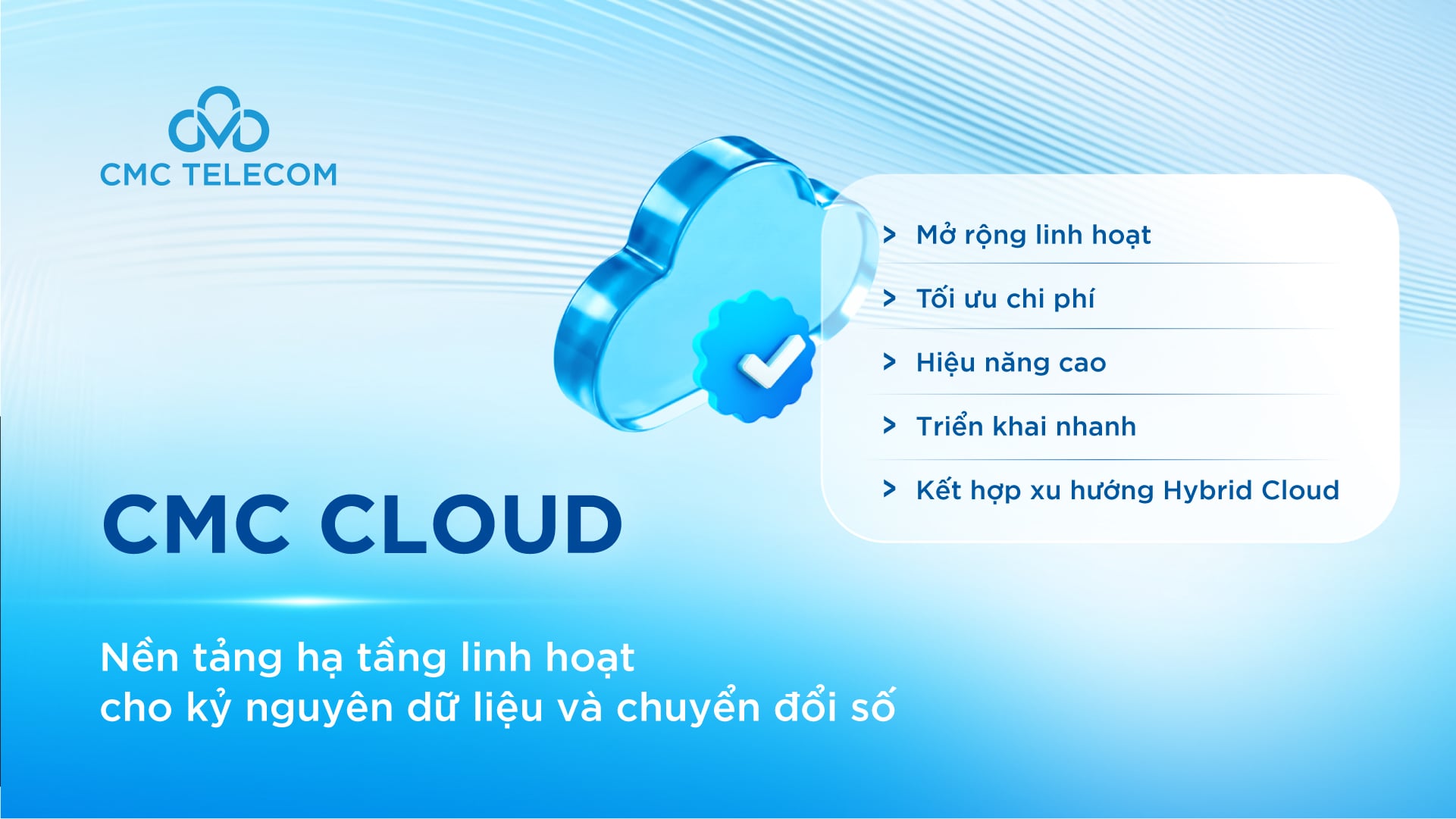
The CMC Cloud platform provides a full range of essential infrastructure for businesses, from Elastic Compute services, high-performance storage systems, cloud networking, backup, to Disaster Recovery solutions, etc. These services enable businesses to build flexible IT systems that can scale as needed and ensure operational continuity.
Beyond providing infrastructure, CMC Cloud also supports businesses in the process of consulting on architecture, system migration, and optimizing operations in the cloud environment. This is especially important for SMEs, which often have limited IT resources and require a clear transition roadmap.
For SMEs – where IT resources are often limited – this approach helps create a clear roadmap for the cloud migration process, reduces risks, and ensures stable system operation from the outset. It's time to reassess your company's IT infrastructure. Explore CMC Cloud solutions and learn how your business can safely, flexibly, and cost-effectively migrate its systems to the cloud.
Source: https://cmctelecom.vn/bai-viet/5-dau-hieu-cho-thay-sme-nen-chuyen-he-thong-it-len-cloud/





![[Image] Hanoi's urban life under the challenge of a "scorching hot" environment](https://vphoto.vietnam.vn/thumb/1200x675/vietnam/resource/IMAGE/2026/05/25/1779706979265_nang-nong-t5-2026-minh-duy-7-4636-jpg.webp)
![[Image] Close-up view of the interchange connecting the two expressways and Long Thanh Airport.](https://vphoto.vietnam.vn/thumb/1200x675/vietnam/resource/IMAGE/2026/05/25/1779703378210_ndo_br_z7863716673926-224453a31600126cce10622af6290afd-4549-jpg.webp)

























































































Comment (0)