

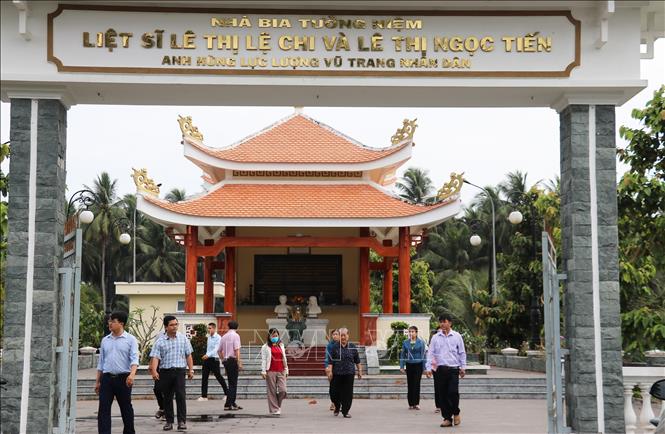
After April 30, 1975, over 80% of households in the commune were poor. Through the efforts of the local government and people, Binh Ninh has risen to become one of the model new rural communes, a typical example in the province for shifting the production structure, breaking away from monoculture rice farming, and diversifying crops and livestock.
Starting with a heroic past as a foundation.
During the resistance war against the American imperialists, Binh Ninh commune served as a bridgehead for receiving and transporting weapons from the old Ben Tre province (now the new Vinh Long province) and frequently held bases for agencies of My Tho and Go Cong provinces (later Tien Giang province - now the new Dong Thap province). Therefore, Binh Ninh commune was a target of fierce attacks by the enemy aimed at destroying the revolutionary movement there.
Over 21 years (1954-1975), the enemy dropped thousands of tons of bombs and ammunition on Binh Ninh. It is estimated that, on average, each resident suffered from more than 1 ton of war weapons, with their homes destroyed. Despite the destructive bombing and fierce attacks and sweeps by the enemy, Binh Ninh remained a solid base for the revolution. This is a shining example and a driving force for the people and government of Binh Ninh commune in their efforts to develop the economy , culture, and society.
Located in a low-lying area along the Tien River and bearing the brunt of war, Binh Ninh commune in the former Tien Giang province (now Dong Thap province) faced significant economic difficulties after April 30, 1975. The fields were barren, coconut groves were damaged by bombs and chemical weapons, and transportation and infrastructure were virtually nonexistent. The poverty rate in Binh Ninh commune at that time was approximately 40%.
In harmony with the nationwide effort to rebuild and heal the wounds of war, the Party Committee, government, and people of Binh Ninh commune began the reconstruction of their homeland with the title of "Hero of the Armed Forces," recognized on October 20, 1994.
To date, the poverty rate in the commune has decreased significantly, to only 0.75%, and the rural landscape has become more attractive. This is a commendable achievement for a remote commune, driven primarily by the heroic traditions of the resistance war against the American imperialists to save the country.
Mr. Nguyen Cong Toan, Head of the Culture and Social Affairs Department of Binh Ninh commune, as well as the local people, clearly feel the changes in this area. He happily shared that the dirt road of the past has now been replaced by a smooth asphalt road. The targets of "electricity, roads, schools, and health stations," which were just dreams during the subsidy period of the 1980s, have now been achieved 100%.
A flourishing future in the homeland of heroes.
The appearance of the former revolutionary base area has changed dramatically compared to previous years, a testament to the transformation of a once poor but heroic rural area. Along the smooth, paved roads, fields of red chili peppers, golden F1 eggplants, and in the distance, coconut groves and tiled-roof houses create a truly beautiful sight.

According to Mr. Duong Thanh Trung, Vice Chairman of the People's Committee of Binh Ninh commune, one of the commune's experiences in economic development is perfecting the in-field irrigation system in conjunction with the development of rural transportation; and strengthening the transfer of agricultural science and technology to the people.
Before the freshwater conversion program, nearly half of the commune's area along the Tien River was affected by saltwater intrusion, resulting in severely acidic and saline soils. After the Tien River dike system was completed, it effectively prevented saltwater intrusion. The completed inland irrigation system is now sufficient to irrigate 3,321 hectares of agricultural and livestock land, preventing saltwater intrusion, storing freshwater, and ensuring production according to the seasonal schedule.
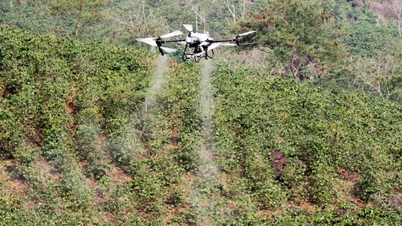
In recent years, agriculture has played a crucial role in the economy of Binh Ninh commune, developing in a sustainable, commodity-oriented direction. The locality focuses on existing key crops and livestock such as coconuts, fruit trees, vegetables, and pig, chicken, and cattle farming. The commune's orientation is to concentrate on crop cultivation in a way that ensures food safety and hygiene, organic farming, and high technology; livestock farming is focused only on large-scale farm-based production, ensuring environmental protection, and significantly reducing household and family-based livestock farming.
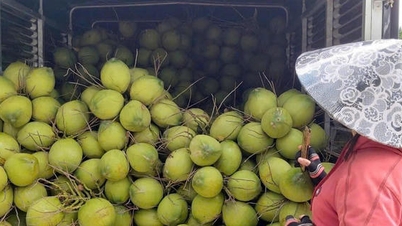
The encouragement of applying science and technology to intensive farming has helped increase the productivity of the 2,626 hectares of coconut trees in the locality from 22 tons/ha/year previously to 24 tons/ha/year currently. According to statistics, when coconut trees reach the stable harvesting stage, coconut farmers earn an average profit of approximately 91.2 million VND/ha/year.
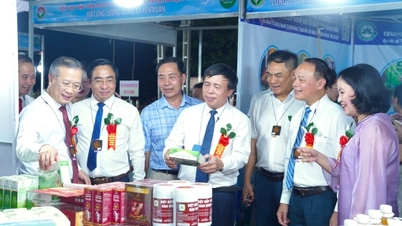
Cooperative forms of production and consumption linkages along the value chain, associated with the establishment of planting area codes for export, are receiving attention. Currently, the commune has 4 products recognized as 3-star OCOP products and 16 cocoa products recognized as 4-star OCOP products by Xuan Ron Cho Gao Cocoa Company.
Mr. Tran Hoang Nhat Nam, Secretary of the Party Committee of Binh Ninh commune, said that during the 2025-2030 term, the commune will focus on leveraging local strengths for sustainable development, such as: building Binh Ninh commune to meet the standards of a modern new rural area by 2030; developing the economy in a rational and efficient direction; gradually reducing the proportion of agriculture and increasing the proportion of industry and services.
Regarding industry, the commune focuses on leveraging the advantages of Provincial Road 864 to attract industrial development along both sides of the road, with priority given to the area south of Provincial Road 864 to the Tien River (concentrating on the section from Hoa Dinh commune to the former Binh Ninh commune).
Regarding services and commerce, along the Tien River from Lien Hoa Pagoda eastward, the commune plans to attract investment in social housing, terraced houses, and riverside resort villas to take advantage of Provincial Road 864, the Tien River, and the urban sprawl from the former My Tho city. The commune will promote spiritual tourism and encourage the development of experiential tourism, agricultural tourism, and green tourism models.

Returning to Binh Ninh commune in April and witnessing the transformation of the rural landscape, we are even more impressed by the unwavering will and tireless efforts of the local Party committee, government, and people. The socio-economic development achievements of Binh Ninh commune in the 51 years since peace was restored will serve as a solid foundation for the locality to continue achieving even greater success.
Source: https://baotintuc.vn/thoi-su/51-nam-thong-nhat-dat-nuoc-khoi-sac-vung-can-cu-cach-mang-20260429155858137.htm

![[Photo] General Secretary and President To Lam presides over the meeting to approve the draft report on the results of the second inspection by the Politburo of the Standing Committee of the Hanoi City Party Committee.](https://vphoto.vietnam.vn/thumb/1200x675/vietnam/resource/IMAGE/2026/05/26/1779789811432_a2-bnd-4430-9620-jpg.webp)







































































Comment (0)