

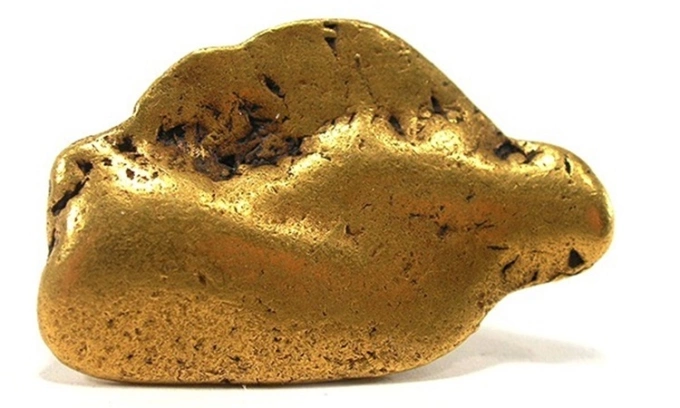
In a study published on May 21 in the journal Physical Review Letters, two computer chemists, Santu Biswas and Matthew Montemore, at Tulane University in the US, discovered why gold is more difficult to oxidize than similar metals. According to them, the atomic arrangement on the surface of gold creates such a tight structure that oxygen molecules cannot easily detach to trigger oxidation (the process by which oxygen (or elements like sulfur) react with the metal and bind to its surface). This accumulation of oxygen bonds is what causes "rust" in iron and tarnishing in other metals. The degree of oxygen adhesion depends on how tightly the metal's atomic structure holds its electrons.
Gold is one of the most valuable metals on Earth due to its exceptional resistance to rust, tarnishing, and corrosion, meaning it doesn't react strongly with other atoms or molecules. When a block of gold is cut, the exposed surface reshapes itself within seconds. The atoms rearrange themselves to create a zigzag texture, a phenomenon called "re-surface reconstruction."
According to Science Alert, Biswas and Montemore used computer simulations to understand what happens when oxygen molecules come into contact with gold surfaces that have different atomic arrangements, including a regenerated surface (atoms arranged in a tight hexagonal pattern) and a non-regenerated surface (a looser, square-shaped structure). On the regenerated surface, the oxygen molecules don't find enough space to easily split into two atoms as they do on the non-regenerated surface. This may explain why tiny gold nanoparticles behave differently from bulk gold. They don't fully develop into the regenerated surface typically found on larger gold blocks, exposing more reactive, square-shaped regions.
Scientific American reports that a research team calculated the energy required to oxidize gold before and after regeneration. They found that oxygen molecules in the air (consisting of two oxygen atoms bonded together) easily detach and attach to gold atoms on the non-regenerated surface. The regeneration process pulls many gold atoms out of the gold mass, inserting them into the surface and transforming the simple square structure into a dense hexagon with many ridges and grooves. This process brings the gold surface closer to a thermodynamic equilibrium, allowing the gold atoms to easily exchange heat with each other but making it more difficult for oxygen to penetrate.
This new discovery could help scientists design gold catalysts that strike a balance between corrosion resistance and efficient oxygen activation.
( According to vnexpress.net )
Source: https://baodongthap.vn/ly-do-vang-khong-bi-han-gi-a241335.html




![[Photo] General Secretary and President To Lam presides over the meeting to approve the draft report on the results of the second inspection by the Politburo of the Standing Committee of the Hanoi City Party Committee.](https://vphoto.vietnam.vn/thumb/1200x675/vietnam/resource/IMAGE/2026/05/26/1779789811432_a2-bnd-4430-9620-jpg.webp)



























































































Comment (0)