

(CLO) An Egyptian-British archaeological team has just identified an ancient tomb near Luxor as the burial place of Pharaoh Thutmose II.
This marks the first time in more than a century that an ancient Egyptian royal tomb has been discovered, the Egyptian Ministry of Tourism and Antiquities announced on Tuesday.
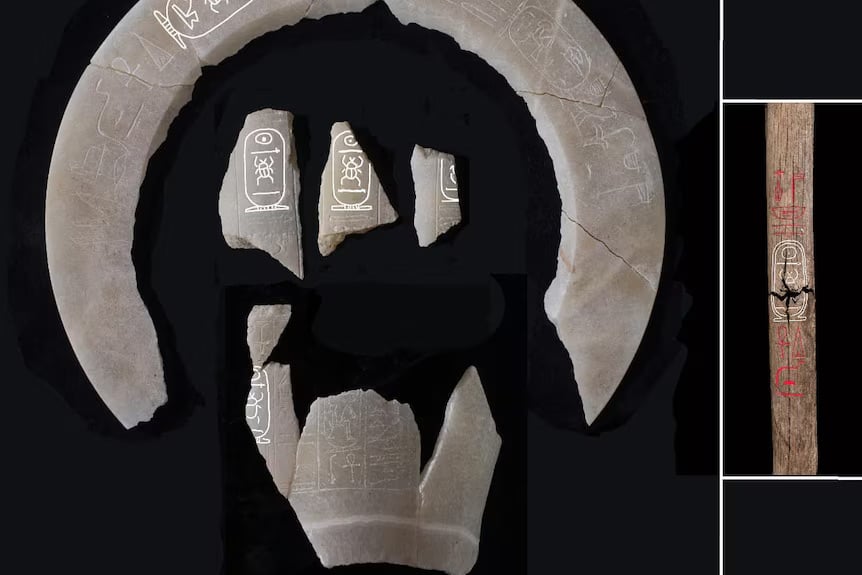
Some of the excavated artifacts. Photo: Egyptian Ministry of Tourism and Antiquities
The tomb of Thutmose II is located in the western Valley of the Kings. According to the Egyptian Ministry of Tourism and Antiquities, it is the last royal tomb of the 18th Dynasty still missing and the first royal tomb to be found since the tomb of King Tutankhamun was discovered in 1922.
Archaeologists identified the tomb thanks to alabaster jars found at the site, which bore the names of Pharaoh Thutmose II and Queen Hatshepsut – one of the few queens to ever rule Egypt.
In addition, the archaeological team also found pieces of the king's funeral furniture, as well as pieces of mortar with blue inscriptions, yellow stars and ancient religious texts.
However, the tomb is said to be poorly preserved due to flooding shortly after the king's death. There are signs that most of the artifacts inside have been moved from their original location, and archaeologists are currently carrying out restoration work.
According to experts, the discovery could help shed more light on the reign of Thutmose II, a pharaoh little known compared to his successors such as Thutmose III or Hatshepsut. Historical records show that Thutmose II ruled for about a decade in the 15th century BC but died early, leading to Queen Hatshepsut taking power and becoming one of the most powerful female pharaohs in Egyptian history.
Archaeologists also hope that the tomb may contain new clues about royal burial rites of the 18th Dynasty, a period considered the height of ancient Egyptian civilization. Some researchers have also questioned whether Thutmose II's body could still be in the tomb or if it had been removed earlier.
The tomb excavation project is part of Egypt's recent efforts to boost archaeological discoveries, attract tourists and assert the country's role in preserving its ancient heritage.
Cao Phong (according to ABC, SCMP, Reuters)
Source: https://www.congluan.vn/ai-cap-phat-hien-ra-lang-mo-pharaoh-moi-lan-dau-trong-hon-100-nam-post335325.html


![[Photo] National Assembly Chairman Tran Thanh Man receives First Vice Chairman of the Federation Council of the Federal Assembly of the Russian Federation](/_next/image?url=https%3A%2F%2Fvphoto.vietnam.vn%2Fthumb%2F1200x675%2Fvietnam%2Fresource%2FIMAGE%2F2025%2F12%2F02%2F1764648408509_ndo_br_bnd-8452-jpg.webp&w=3840&q=75)















































![[Photo] General Secretary To Lam and his wife attend the 50th Anniversary of Laos National Day](https://vphoto.vietnam.vn/thumb/402x226/vietnam/resource/IMAGE/2025/12/02/1764644139308_1.jpeg)
























Comment (0)