

The special art program "Echoes of the Fatherland," organized under the direction of the Central Propaganda and Mass Mobilization Department (held on April 28th at My Dinh National Stadium - Hanoi ), kicked off the series of political and artistic programs "Proud to be Vietnamese" in 2026, attracting nearly 40,000 attendees and millions of viewers on television and digital platforms.
Young people are no longer "unfamiliar" with "politically-oriented music".
Many spectators arrived at the stadium very early, despite the intense afternoon sun. This scene reminded people of pop concerts and the phenomenon of "following idols" (internationally in the past and domestically recently).
"Echoes of the Homeland" chooses an artistic approach that retells history and national identity through contemporary artistic language. The program makes its mark thanks to the combination of semi-classical, rock symphony, and traditional instruments, creating a majestic and contemporary musical space.
In addition, other outstanding national art programs during the recent April 30th holiday included the "Glory of Vietnam" live show and the Ha Long Carnival 2026 - themed "Wonders Shining in a New Era," held on April 30th at the October 30th Square. Both were packed with audiences, mostly young people.
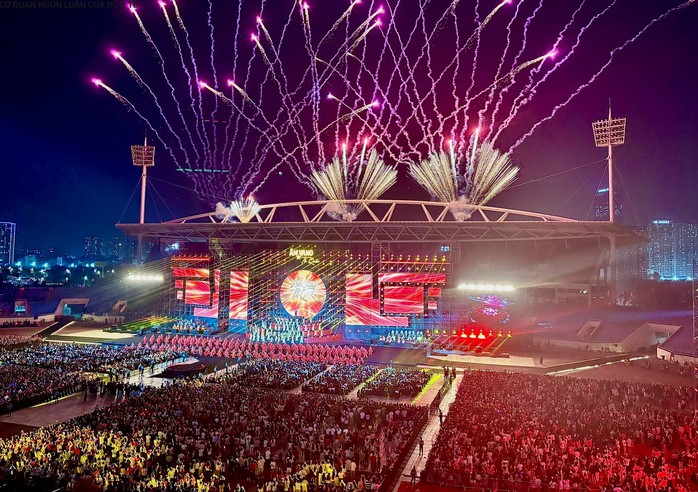
The "Echoes of the Homeland" program recently took place with nearly 40,000 attendees. (Photo: Tuan Huy)
For a time, the term "political music" was automatically associated by young people with its dry, propagandistic nature rather than its emotional impact. However, in recent years, this has been rapidly changing. From stirring remixes appearing on social media platforms to songs about homeland and country trending, this resurgence isn't forced, but stems from the young people's own need for identity, pride, and community connection. This phenomenon originates from completely different approaches seen in recent concerts.
While previous programs often followed a familiar pattern: slogan-like lyrics and traditional harmonies, the new generation of artists has almost completely changed the approach. They incorporate folk elements into pop, EDM, rap, and indie music. They tell stories of their country using everyday language instead of somewhat rigid discourse. And most importantly, they infuse personal emotions into the national spirit.
Songs like "Continuing the Story of Peace" and "The Country Full of Joy," remixed in a modern style on TikTok, have garnered millions of views. Meanwhile, products combining traditional and contemporary music by artists like Hoa Minzy, Den, and Hoang Thuy Linh continue to create a strong impact on young audiences.
National pride in the "TikTok" era
It's not hard to see that the change lies in the fact that today's young people still retain their patriotic spirit; they are simply indifferent to or unwilling to accept outdated methods of conveying it. When music breathes life, possesses an engaging visual language, catchy melodies, and genuine emotions, messages about homeland, history, or national pride become more accessible than ever before.
There, national pride is no longer a grand or distant concept. It can begin with a piece of Vietnamese background music in a travel video, a video of the red flag with a yellow star at an international concert, or a moment when thousands of young people sing together a song about their homeland.
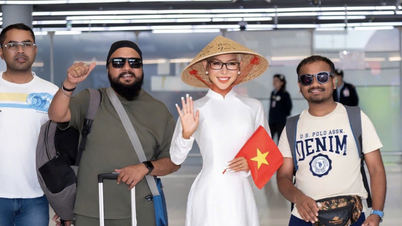
The biggest difference with this generation is that they express their patriotism in a more natural and personalized way. They are not afraid to wear modernized ao dai (traditional Vietnamese dress), listen to remixed folk music, feel proud when Vietnamese artists appear on international stages, or are moved by historical images retold in modern language.
Social media has contributed to transforming patriotism into a popular cultural experience, rather than something confined to celebratory occasions. For example, in the "Echoes of the Homeland" concert, the program opened with a grand spectacle featuring hundreds of performers, lighting, smoke effects, and music creating an impressive stage effect. The highlight was the formation of lotus flowers and the map of Vietnam by the artists, symbolizing national unity.
Towards the end, the program shifted to a modern, vibrant atmosphere with contemporary performances and rock band acts, creating an emotional climax.
Music - "soft power"
Many Asian countries have demonstrated the soft power of popular culture. South Korea has K-pop, Japan has anime, and China is investing heavily in traditional entertainment products. Vietnam is also starting with music.
When a song incorporating Vietnamese cultural elements reaches tens or hundreds of millions of views; when images of the ao dai (traditional Vietnamese dress), traditional drums, and folk songs appear in modern music videos, it's not simply an entertainment product, but a way for Vietnamese culture to be recognized and spread. Young artists today understand very well that international audiences are not looking for a copy of US-UK or K-pop music. What makes Vietnam different is its cultural identity.
Therefore, the trend of incorporating traditional elements into pop music is not only a way to create viral content, but also a way to build Vietnamese musical identity in the age of globalization. More broadly, modern patriotic music also helps create positive social connections.
In a social media landscape often dominated by controversy, negativity, and division, musical works imbued with national pride easily resonate with people's emotions.
When music has the power to spread, patriotism is no longer a slogan but a genuine emotion. And perhaps that is what makes today's songs about homeland so powerfully resonant.
Source: https://nld.com.vn/am-nhac-yeu-nuoc-dang-tro-lai-theo-phong-cach-moi-196260512200008789.htm
![[Photo] General Secretary and President To Lam presides over a meeting on preparations for the review of one year of operation of the three-tiered government system.](https://vphoto.vietnam.vn/thumb/1200x675/vietnam/resource/IMAGE/2026/06/02/1780391821195_a1-bnd-4595-9717-jpg.webp)


























































Comment (0)