

The election will be a race between Modi's Bharatiya Janata Party (BJP) and an alliance of two dozen opposition parties. It is the world's largest election, with nearly a billion voters expected to participate and taking place over seven days across the world's most populous country.
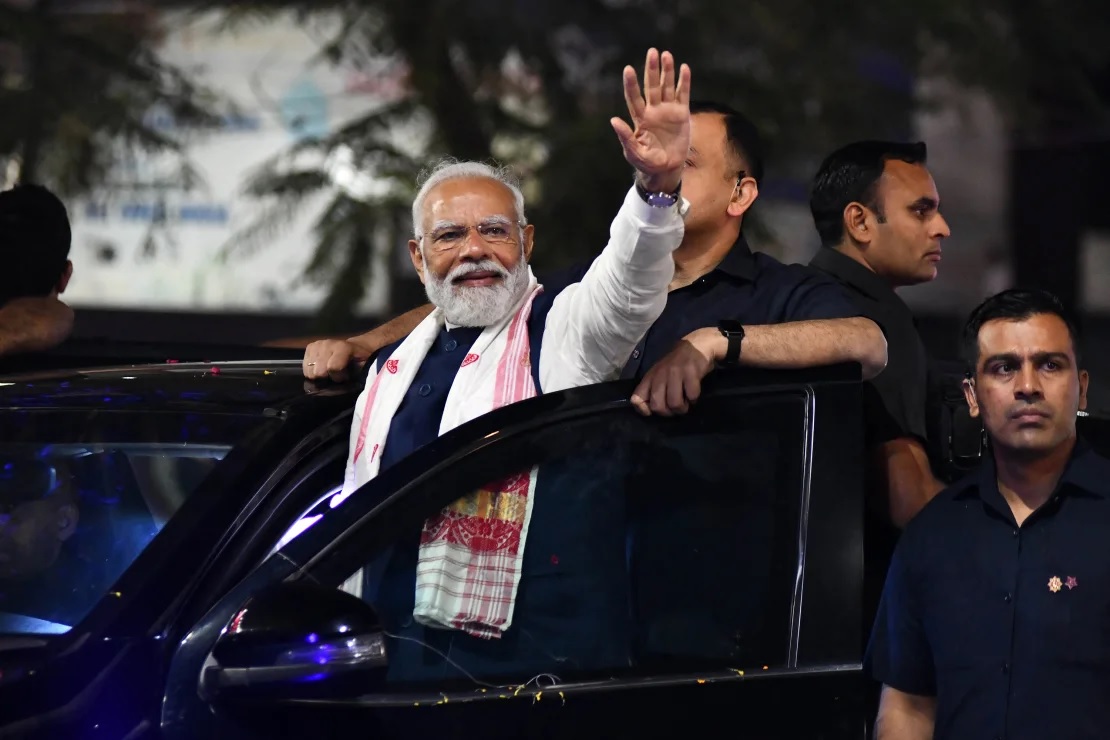
Indian Prime Minister and Bharatiya Janata Party leader Narendra Modi is projected to be re-elected. Photo: AFP
On Friday, in the largest of the seven phases, 166 million voters in 102 precincts across 21 states and territories will cast their ballots.
Surveys indicate the BJP party will easily win a majority. "In the next five years, we will bring our country into the top three economies in the world, launch the final and decisive offensive against poverty, and open up new avenues for growth…," Modi wrote in the BJP's election manifesto.
If he wins, Modi will be the second Indian prime minister to be elected three times in a row, after post-independence leader Jawaharlal Nehru. Modi said that his first two terms were an appetizer and the main course would be served in his third term.
Chandrachur Singh, who teaches politics at Hindu University in Delhi, said the BJP has a clear advantage but also faces real challenges. “This is not an election without problems,” he said.
Voters will cast ballots for 543 seats in India's lower house of parliament, with two more seats nominated by the president. The majority party will form a new government and appoint one of its candidates as prime minister.
Bui Huy (according to CNN, Reuters, AFP)
Source
![[Photo] Delegation attending the 14th Congress of the Vietnam Trade Union visits the Mausoleum of President Ho Chi Minh.](https://vphoto.vietnam.vn/thumb/1200x675/vietnam/resource/IMAGE/2026/06/03/1780451842301_ndo_br_img-3824-jpg.webp)



























































Comment (0)