

Hilarious and awkward situations arise from following the "hot trend".
Mukbang is a word of Korean origin, a portmantein of "meokneun" (eating) and "bangsong" (broadcasting), referring to the practice of recording or livestreaming eating scenes to interact with viewers. Such videos, or trends featuring novel dishes and healthy eating tips, posted on TikTok and Facebook, attract young people.
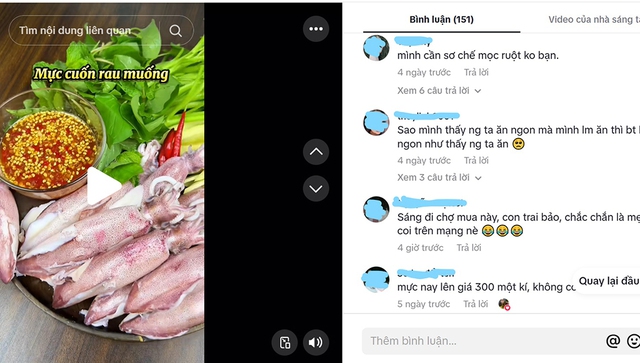
The dish of steamed squid wrapped in raw water spinach once caused a sensation on social media.
PHOTO: SCREENSHOT
Le Thanh Thuy (30 years old, residing in Tan Hung Ward, Ho Chi Minh City) said that many dishes that went viral online, with thousands of views and comments, made her try to imitate them. Some were quite delicious, but others gave her unforgettable experiences. "The mangosteen salad was good, but the steamed squid wrapped in raw water spinach was so pungent with the taste of the raw water spinach that I vomited terribly. I'll never dare eat it again," Thuy recounted.
From that bad eating experience, Thuy believes that eating videos, mukbangs, and food trends on social media should only be watched for reference, and that one should carefully consider whether they are suitable for oneself before following them. "Not every eating trend is right or suitable for everyone," Thuy said.
Nguyen Thanh Phuc (28 years old, residing in Hiep Phuoc commune, Ho Chi Minh City) also believes that eating videos or nutritional guides on social media should only be considered as a reference source and not be trusted absolutely. According to Phuc, these contents have positive aspects such as suggesting delicious dishes or suitable menus, but the effectiveness depends on each person's constitution and diet. "Before, I ate rice paper dipped in cold water because it was so 'trendy,' everyone was sharing it like crazy… and then I had severe stomach pain, so be careful not to follow trends," Phuc said.
Sharing the same view, Luong Thi Thuy Quyen, a student at Ton Duc Thang University, believes that when watching videos on social media promoting food or diets, viewers need to proactively research the product thoroughly before following it. "It's necessary to be selective and distinguish between correct and incorrect information instead of blindly following trends, because I once followed a weight-loss diet on TikTok, and not only did it not work, but I also had an allergic reaction," Quyen said.
The tendency to follow trends.
Associate Professor Trinh Hoa Binh, a sociologist and former Director of the Center for Public Opinion Research (Institute of Sociology), believes that short videos on social media have become a familiar part of the lives of many young people today. Beyond simply watching for entertainment, a segment of young people tend to imitate everything from eating habits and food preparation to the behaviors displayed by the online characters.
According to Mr. Binh, this stems from a sense of curiosity, a desire to experience new things, and a wish to assert oneself as a modern person who keeps up with trends. Many young people follow online food trends not only out of interest but also to show themselves as someone who is "adventurous," knowledgeable, and not left behind by current trends.
However, according to Mr. Binh, it is difficult to assert that these trends bring real benefits. They can only be considered harmless if the shared content is correct, positive, and valuable. "Conversely, many videos, including eating videos, are created primarily to attract attention, stimulate curiosity, or serve the purpose of personal display. In those cases, imitation brings almost no significant benefit, and may even have many negative consequences, especially for health," Mr. Binh said, adding that these are individual behaviors but are carried out in a highly communal social media environment, so preventing or changing this habit is not easy.
Regarding online content offering dietary advice for weight loss, improved health, or body transformation, Mr. Binh emphasized the need for extreme caution among young people. According to him, much of this information has not been fully scientifically verified and lacks the assurance of professional agencies or experts in the field of health. "Many pieces of advice are merely personal opinions, even based on intuition, so applying dietary methods or nutritional regimens based on videos lacking scientific basis can lead to unpredictable health risks. Instead of blindly trusting and following these advice, young people should consult official, verified sources of information to avoid unfortunate consequences," Mr. Binh stated.
Many potential risks exist.
Dr. Truong Huu Khanh, a professional consultant at Children's Hospital 1, believes that mukbang videos, which provide instructions on eating, losing, or gaining weight on social media, are quite popular but pose many potential health risks, especially for teenagers.
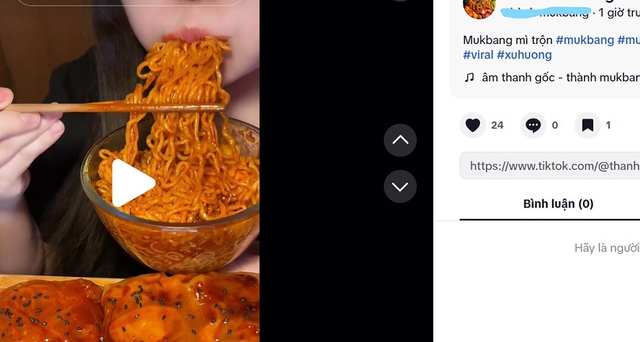
A mukbang video on TikTok
PHOTO: SCREENSHOT
According to Dr. Khanh, each age group has different nutritional and developmental needs, so dietary plans found online cannot be applied arbitrarily. "They are definitely not accurate," Dr. Khanh emphasized.
Dr. Khanh stated that mukbang videos or eating guides are followed by many young people, but most are only for reference and not suitable for everyone. For young people, especially teenagers – a period of crucial physical development – following eating trends can affect their health if not properly advised. When facing weight or nutritional issues, young people should consult a doctor or nutritionist instead of blindly trusting content on social media.
Dr. Khanh also stated that a large following or popularity of a TikToker does not necessarily mean that the information they share is accurate. According to him, many videos are created with the aim of attracting views, so viewers need to remain vigilant, always verify information, and consider its suitability for their own health before imitating or following similar content.
"Nothing can be trusted 100%. Even if the instructor is reputable, that diet or exercise regimen may not be suitable for everyone," said Dr. Khanh. He advised young people to monitor their body's reaction when adopting a particular diet or food, and to consult a healthcare professional about online eating videos before following them to avoid negative health effects.
Source: https://thanhnien.vn/an-theo-mang-xa-hoi-bat-trend-coi-chung-toang-185260530201909384.htm





![[Image] Nearly 125,000 Hanoi students completed the Literature exam for the 10th grade entrance exam.](https://vphoto.vietnam.vn/thumb/1200x675/vietnam/resource/IMAGE/2026/05/30/1780117233041_ndo_br_thiet-ke-chua-co-ten-2-png.webp)

































































































Comment (0)