

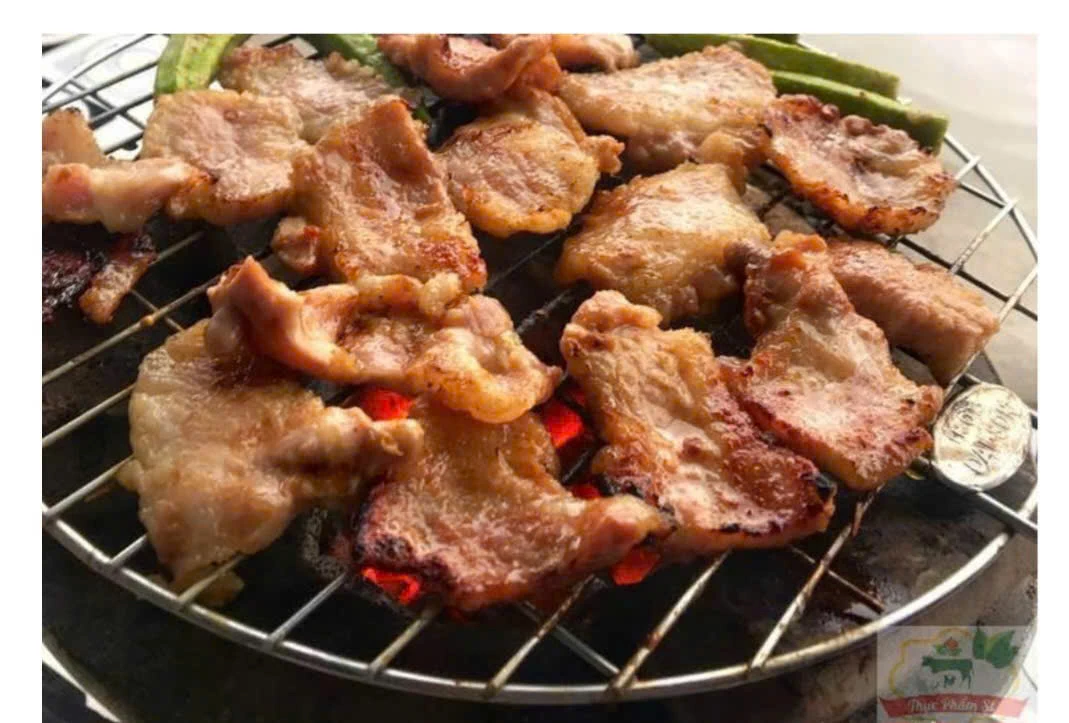
Many people consistently prioritize pork in their diets.
Ms. Ba, who runs a budget-friendly rice restaurant on Street No. 7 (now Pham Son Khai Street), An Khanh Ward, Ninh Kieu District, shared that since mid-March, she has had to "ask" customers for an extra 2,000 dong for each portion of rice sold, because the price of pork has increased since Tet (Lunar New Year). Even with just an extra 2,000 dong per portion (bringing the price to 27,000 dong/portion), customers, including students and laborers who have been regulars for many years, are unhappy.
Mr. Tuan, who owns a house in an alley off April 30th Street, Thoi Binh Ward, Ninh Kieu District, specializes in delivering pre-packaged meals to security guards working for companies and banks. He announced 10 days in advance that he would increase the price of his pre-packaged meals by 2,000 VND per portion, but as soon as he announced it, his regular customers started complaining, comparing his prices to those of other restaurants. "If I don't increase the price, I'll have to reduce the amount of rice, meat, or stir-fried vegetables a little to make a small profit. If customers don't accept the new price, I'll probably have to stop selling or just sell whatever I can, because I'm out of options!" Mr. Tuan said sadly.
In fact, the increase in the price of daily necessities by 2,000-5,000 VND is not much, but for salaried workers or students who have many expenses while their income hasn't increased, especially students who are almost entirely dependent on their families and parents, it will be a significant burden. As for high-end restaurants, price increases have been in place since the Lunar New Year of 2025 and most have maintained those prices until now. A well-known noodle shop owner on 3rd of February Street, near Can Tho University, said they increased the price of a bowl of noodles by 5,000 VND to compensate for the rising price of pork, but since the price increase, the number of customers has gradually decreased, revenue has dropped, while fixed costs have remained unchanged. "Honestly, my shop doesn't want to raise prices. I'd rather sell less and make less profit. But I'm forced to increase prices according to the rising price of pork, earning more money but not seeing any increase in profit," the shop owner shared. Of course, there are still cases where shop owners "take advantage" of holidays and Tet (Lunar New Year) to raise prices to make more profit, and then keep those prices...
Returning to the topic of live pig prices in many provinces and cities in the Mekong Delta region, prices have now reached 8-8.2 million VND/quintal, which is 2.2-2.5 million VND/quintal higher than the same period in 2024. Meanwhile, at many markets and pork trading points in Can Tho City, pork leg is sold at 120,000-130,000 VND/kg, pork belly at 140,000-150,000 VND/kg, and pork ribs at around 170,000-180,000 VND/kg. In supermarkets and convenience stores, prices are even higher: pork ribs at 230,000-245,000 VND/kg, lean pork at 150,000-159,000 VND/kg, and pork belly at 190,000-200,000 VND/kg… These prices have increased by at least 20,000-30,000 VND/kg compared to the beginning of 2025. Despite the price increase, pork remains unsold in markets due to decreased demand. Many traders report a 20-50% drop in pork sales. Currently, farmers are eager to restock, but piglets are scarce and their prices have tripled, reaching nearly 3 million VND/pig. Since it takes about 4 months to raise them before they can be sold, opportunities for high prices are limited. Furthermore, the lessons learned from the 2020 pork price surge still cause concern for many. At that time, pork prices plummeted from 100,000 VND/kg to below 40,000 VND, so the chances of recovery and restocking in the locality now are not easy.
Based on the above situation, relevant agencies and departments need to recalculate and balance prices to ensure reasonable price stability. At the same time, they should increase the supply of goods that can replace pork, such as fish and poultry. The Departments of Industry and Trade, Finance, Natural Resources and Environment, along with districts, counties, and businesses, need to participate in market stabilization and strengthen measures to manage and regulate live pig prices in the area… However, it is necessary to recognize that the increase in pig prices is in line with market conditions, because after a long period of disease outbreaks, production costs are very high, but the herd size has decreased significantly. If the selling price is low, it will not incentivize farmers to restock. This is also a filtering process to help livestock production move towards sustainability, reduce spontaneous production, ensure disease safety, improve production quality, and make it easier to control. From the consumer's perspective, especially in the Mekong Delta region where pork is a staple in most dishes, perhaps there should be a more balanced and diverse selection of dishes, such as chicken, duck, shrimp, and fish, which are more affordable, instead of always prioritizing braised pork, pork ribs with rice, and pork bone noodle soup.
Text and photos: AN KHÁNH
Source: https://baocantho.com.vn/ap-luc-len-ban-an--a184975.html
![[Photo] Prime Minister Pham Minh Chinh attends the Conference on the Implementation of Tasks for 2026 of Vietnam Television.](/_next/image?url=https%3A%2F%2Fvphoto.vietnam.vn%2Fthumb%2F1200x675%2Fvietnam%2Fresource%2FIMAGE%2F2026%2F01%2F10%2F1768047311329_ndo_br_dsc-3214-jpg.webp&w=3840&q=75)


![[Photo] People's Public Security forces deployed to protect the 14th National Congress of the Party](/_next/image?url=https%3A%2F%2Fvphoto.vietnam.vn%2Fthumb%2F1200x675%2Fvietnam%2Fresource%2FIMAGE%2F2026%2F01%2F10%2F1768034712186_ra-quan-bvdhd-bca-39-8977-jpg.webp&w=3840&q=75)



































![[Infographics] Resolution No. 79-NQ/TW of the Politburo on the development of the state-owned economy](https://vphoto.vietnam.vn/thumb/402x226/vietnam/resource/IMAGE/2026/01/10/1768038914679_chp_3-11-23.jpeg)





































Comment (0)