

At that time, the country was in a dark, deadlocked state, with no way out. "A big question with no answer."
Since the French colonial invasion of Vietnam in 1858, patriotic movements against the French have continuously taken place: the Can Vuong movement against the French based on feudal ideology with patriotic kings Ham Nghi, Thanh Thai, and Duy Tan; the peasant uprising movement of Hoang Hoa Tham lasting 30 years; and the patriotic movements of the early 20th century led by Phan Boi Chau and Phan Chu Trinh based on bourgeois democratic ideas. These movements exemplified patriotism and the aspiration for independence, but they successively failed due to a lack of correct political direction, appropriate methods, a sufficiently strong leadership organization, and, most importantly, a failure to unite the entire nation.
That harsh situation demanded new thinking, a strategic vision, and clear, thorough goals that could overcome the impasses on the path of national development. By what path, method, and force could we regain independence, freedom, and develop the country? The young man Nguyen Tat Thanh - Nguyen Ai Quoc - Ho Chi Minh, in his journey to find a way to save the country and lead the revolution, arrived at the right understanding and acted accordingly.
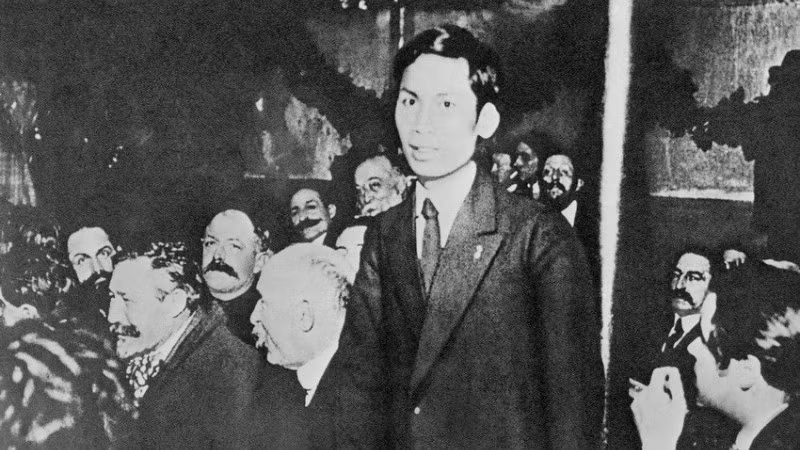
Firstly, the cause of national liberation, social liberation, and national development must start from the people, for the people, and take the people as the foundation. In December 1920, at the Tours Congress that established the French Communist Party, leader Nguyen Ai Quoc clearly stated the goal: "Freedom for my compatriots, independence for my homeland, that is all I want, that is all I understand" (1) .
From the practical experience of the struggle in Vietnam and from the revolutions around the world that he studied, leader Nguyen Ai Quoc clearly saw: "Revolution is the common cause of the entire people, not just one or two individuals," "if we don't exert ourselves, we will surely not succeed," "a few people cannot do it, but many people working together will surely succeed." He believed that immediate action was necessary, and that relying on the strength of the entire people would inevitably lead to success.
On January 28, 1941, leader Nguyen Ai Quoc returned to his homeland with the Central Committee of the Party to directly lead the revolution. In Cao Bang, he told Comrade Vo Nguyen Giap that it was necessary to unite the entire people, arm the entire people, with the people first, then the weapons; with the people, there will be weapons, with the people, there will be everything.
When the revolution succeeded in 1945, under the conditions of the ruling Party, President Ho Chi Minh paid great attention to the interests of the people. “Whatever benefits the people, we must do our utmost to do. Whatever harms the people, we must do our utmost to avoid,” “if the country is independent but the people do not enjoy happiness and freedom, then independence is meaningless” (2) . The government and local authorities need to: “Use the people's talent, strength, and resources to benefit the people” (3) . He believed that public affairs should be brought to the people for discussion, asked for their opinions, and explained to them so that they understand and do things correctly. “If the people think a resolution is not right, let them propose amendments. Based on the people's opinions, we should correct our cadres and organizations” (4) . He emphasized that our country is a democratic country.
"All benefits are for the people."
All powers belong to the people” (5) .
Secondly, for a revolution to succeed, it must have the leadership of a genuine revolutionary party. Nguyen Ai Quoc's understanding of the role of a revolutionary party was clear from the moment he embraced Marxist-Leninist theory. Therefore, in 1919, he joined the French Socialist Party, a party of the Second International defending colonial peoples. In December 1920, he participated in the founding of the French Communist Party. Later, while active in the Communist International, he became even more determined to establish a revolutionary party in Vietnam.
Leader Nguyen Ai Quoc clearly stated that the revolution “First of all, there must be a revolutionary party, to mobilize and organize the people internally, and to connect with oppressed nations and the proletariat everywhere externally. The revolution can only succeed if the party is strong, just as a ship can only sail if the helmsman is steady. For the party to be strong, it must have an ideology as its core, and everyone in the party must understand and follow that ideology. A party without an ideology is like a person without intelligence, a ship without a compass” (6) . The ideology mentioned is Marxism-Leninism - “the most genuine, most certain, and most revolutionary ideology”. He worked hard to prepare the conditions in terms of politics, ideology, theory, organization, and personnel to establish the Communist Party of Vietnam in the Spring of 1930.
The Party successfully led the August Revolution of 1945. Under the conditions of the Party's rule, in 1947, President Ho Chi Minh put forward 12 points on the character of a genuine revolutionary Party, the first of which is: "The Party is not an organization for gaining wealth and power. It must fulfill the task of liberating the nation, making the Fatherland rich and strong, and the people happy" (7) . He requested: To ensure the Party's stability, do not forget any of those twelve points. A genuine revolutionary Party must be a moral, civilized Party, truly for the country and for the people.
Thirdly, the Vietnamese revolution upheld the spirit of self-reliance, self-strength, and pure internationalism. In early 1921, in Paris, leader Nguyen Ai Quoc met with the French Minister of Colonies, Albert Sarraut, and demanded that France return Vietnam's independence. This was not done. Leader Nguyen Ai Quoc decided to fight to win independence. Active in the Communist International, he clearly saw the noble proletarian internationalism and the desire for the world to live in peace and friendship, "calm skies and calm seas." He understood that oppressed nations desperately needed international support and help, but also realized that "if you want others to help you, you must first help yourself" (8) .
The August Revolution of 1945 was a victory of self-reliance and self-strengthening, in accordance with Ho Chi Minh's ideology of "using our own strength to liberate ourselves."
The August Revolution of 1945 was a victory of self-reliance and self-strengthening, in accordance with Ho Chi Minh's ideology of "using our own strength to liberate ourselves."
The newly independent nation, formerly a semi-feudal, poor, and backward colonial country, was envisioned by President Ho Chi Minh as a strong and prosperous nation that could "stand shoulder to shoulder with the great powers of the world." To achieve this, it was necessary to strive to improve the people's education, because "an ignorant nation is a weak nation." It was also essential to learn science and technology from advanced countries.
In a letter to the US Secretary of State on November 1, 1945, he wanted to send 50 Vietnamese youths to America to “study technology, agriculture, and other specialized fields” (9) . In 1946, in his appeal to the United Nations, he declared “an open policy and cooperation in all fields” (10) . In 1947, he stated that Vietnam wished to “be friends with all democratic countries and not make enemies of anyone” (11) .
In leading the construction of socialism in the North, President Ho Chi Minh focused on applying Marxism-Leninism and learning from the experiences of other countries, while also emphasizing independence and self-reliance. He chose the appropriate form, speed, and steps and found Vietnam's own laws, gradually advancing towards socialism. Vietnam needs its own way of doing things: "We cannot be like the Soviet Union, because the Soviet Union has different customs and traditions, and a different history and geography" (12) .
The thoughts, views, and guidance of President Ho Chi Minh throughout the process of seeking a path to national salvation and leading the revolution have, together with the Party, guided the nation from one victory to another and enabled it to achieve the strength, potential, position, and international prestige it enjoys today.
The thoughts, views, and guidance of President Ho Chi Minh throughout the process of seeking a path to national salvation and leading the revolution have, together with the Party, guided the nation from one victory to another, achieving the foundation, potential, position, and international prestige it enjoys today. The 14th National Congress of the Party affirmed the great achievements of 40 years of reform and opened a new era of national progress.
In the new era, Vietnam possesses new strengths and opportunities for rapid and sustainable development. However, it is also necessary to recognize that the four dangers identified by the Party in 1994 still exist, and in some areas, are even more complex. These are the dangers of falling behind economically compared to other countries, the danger of deviating from the socialist path, the danger of corruption, waste, negative practices, and moral decay among a segment of cadres and Party members, and the danger of "peaceful evolution" and "self-evolution" and "self-transformation" within the Party.
The 14th National Congress summarized major lessons, the foremost of which is the unwavering commitment to, application of, and creative development of Marxism-Leninism and Ho Chi Minh Thought; unwavering commitment to the goal of national independence and socialism; unwavering commitment to the Party's reform line; and unwavering commitment to the Party's organizational and operational principles. These four unwavering commitments ensure successful reform, continue to guide development in the new era, seize opportunities, and overcome threats.
The Congress made major decisions to realize the two centenary goals, exploiting all resources and new drivers for double-digit economic growth (over 10%). It emphasized strategic autonomy, self-reliance, self-strength, and self-confidence for a peaceful, independent, powerful, prosperous, civilized, and happy Vietnam. In this glorious endeavor, Ho Chi Minh Thought will forever guide the Party and the Vietnamese nation.
(1) Ho Chi Minh Biographical Chronicle, National Political Publishing House, Hanoi, 2016, volume 1, page 86.
(2) Ho Chi Minh: Complete Works, National Political Publishing House, Hanoi, 2011, vol. 4, p. 64.
(3) Ho Chi Minh: Ibid., vol. 5, p. 81.
(4) Ho Chi Minh: Ibid., vol. 5, pp. 337-338.
(5) Ho Chi Minh: Ibid., vol. 6, p. 232.
(6) Ho Chi Minh: Ibid., vol. 2, p. 289.
(7) Ho Chi Minh: Ibid., vol. 5, p. 289.
(8) Ho Chi Minh: Ibid., vol. 2, p. 320.
(9) Ho Chi Minh: Ibid., vol. 4, p. 91.
(10) Ho Chi Minh: Ibid., vol. 4, p. 523.
(11) Ho Chi Minh: Ibid., vol. 5, p. 256.
(12) Ho Chi Minh: Ibid., vol. 10, p. 391.
Source: https://nhandan.vn/bai-hoc-ve-tam-nhin-nhan-thuc-va-hanh-dong-post966826.html

![[Photo] General Secretary and President To Lam presides over a meeting with the Central Organizing Committee.](https://vphoto.vietnam.vn/thumb/1200x675/vietnam/resource/IMAGE/2026/06/03/1780482764658_a1-bnd-4741-3342-jpg.webp)

![[Photo] Secretary of the National Assembly Party Committee, Chairman of the National Assembly presides over the meeting of the Standing Committee and Executive Committee of the National Assembly Party Committee.](https://vphoto.vietnam.vn/thumb/1200x675/vietnam/resource/IMAGE/2026/06/03/1780480353201_ndo_br_bnd-2585-jpg.webp)

























![[Video] Sunset at Lap An Lagoon – Where the sun sets over the fishing nets](https://vphoto.vietnam.vn/thumb/1200x675/vietnam/resource/IMAGE/2026/05/31/1780192137701_beach-landscape-sea-water-nature-grass-745871-pxhere-com.jpeg)























Comment (0)