

Tesla and VinFast entered the Indian market at the same time, but the journeys of the two electric car manufacturers have taken completely opposite directions.
In the Indian electric vehicle (EV) race, the surprising thing isn't Tesla's modest sales figures, but rather VinFast's phenomenal growth. Both automakers entered one of the world's most promising automotive markets with high expectations, yet their results have been vastly different: VinFast has rapidly accelerated, while Tesla continues to struggle to find its footing.
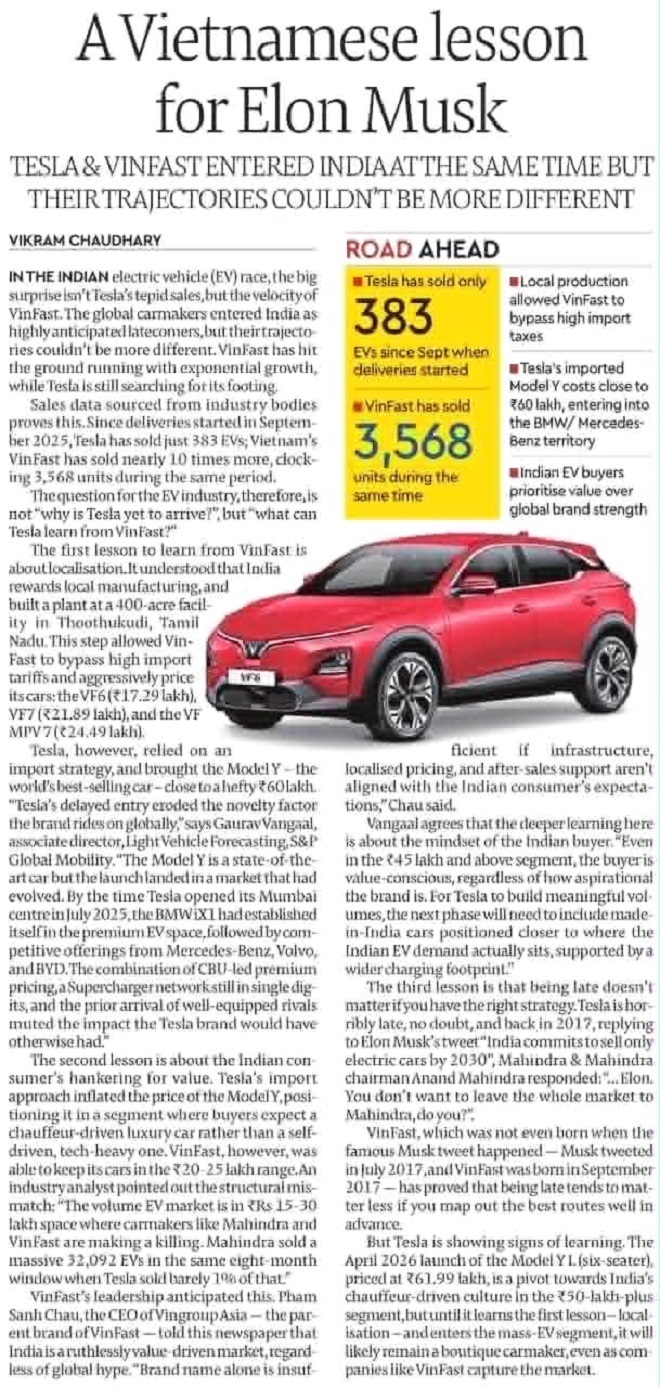
According to industry data, since deliveries began in September 2025, Tesla has only sold 383 electric vehicles in India. During the same period, VinFast sold 3,568 vehicles, nearly ten times more than its American competitor.
Therefore, the question for the Indian EV market now is no longer "Can Tesla survive?" , but "What can Tesla learn from VinFast?".
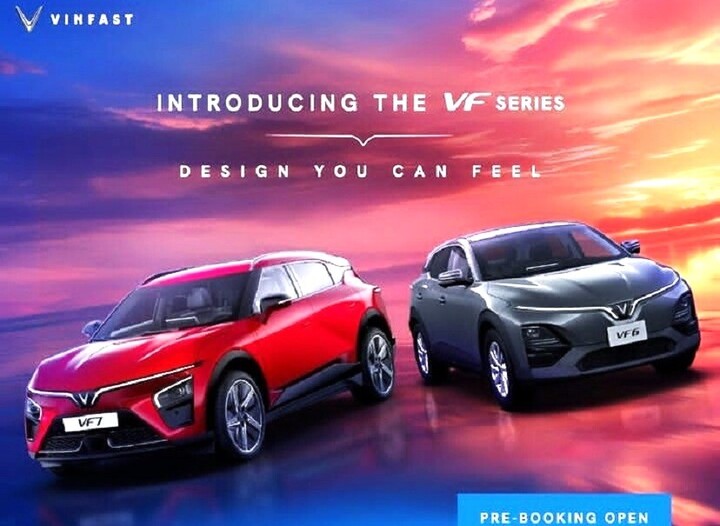
3 lessons from VinFast
The first lesson is localization.
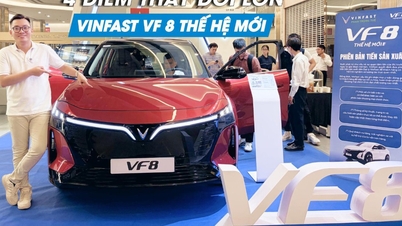
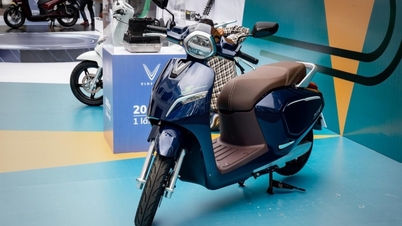
VinFast quickly realized that India prioritizes manufacturers with a local presence. The company built a 400-acre factory in Thoothukudi, Tamil Nadu, thereby avoiding high import duties and enabling it to offer competitive prices for its VF6 (17.29 lakh rupees), VF7 (21.89 lakh rupees), and VF MPV7 (24.49 lakh rupees) models.
Meanwhile, Tesla opted for an import strategy, bringing the Model Y – the company's best-selling model globally – to the Indian market at a price of nearly 60 lakh rupees.
Gaurav Vangaal, Vice President of Passenger Car Forecasting at S&P Global Mobility, commented that Tesla's slow start has caused the company to lose the "novelty effect" that once created its global appeal.
According to him, the Model Y was a technological pioneer, but it was launched in a market that had changed significantly. By mid-2025, the BMW iX1 had already established a strong position in the premium EV segment, while Mercedes-Benz, Volvo, and BYD were also continuously launching competing options.
The high price due to being a completely built-up (CBU) import, the limited network of Supercharger stations, and the presence of many competitors with better features meant that Tesla did not achieve the breakthrough it had hoped for.
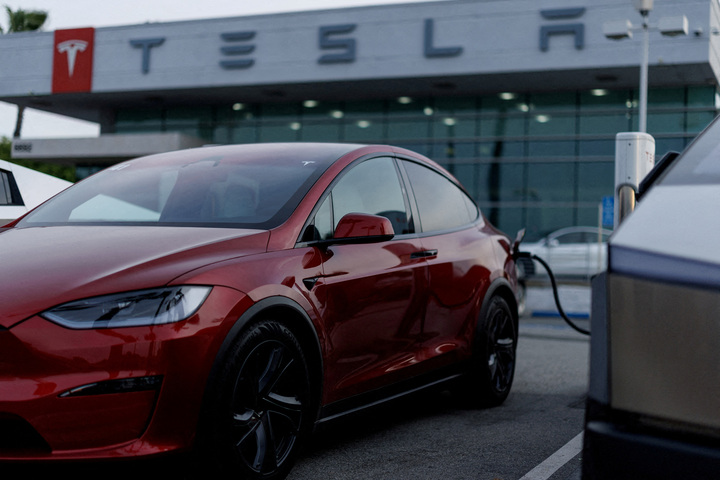
The second lesson lies in the Indian consumer mindset: prioritizing utility over the glamour of a global brand.
The import strategy pushed the Model Y into a price segment where buyers typically expect a luxury car designed for chauffeur-driven needs, rather than a high-tech vehicle focused on autonomous driving experiences.
Meanwhile, VinFast has managed to maintain its price range of 20–25 lakh rupees – a segment considered a "hot spot" in the Indian EV market.
An automotive industry analyst stated that the EV segment with the highest sales volume currently lies in the 15–30 lakh rupee range, where Mahindra and VinFast are fiercely competing. Mahindra alone sold 32,092 electric vehicles in the same eight-month period, while Tesla's sales were less than 1% of that figure.
VinFast's leadership is said to have recognized this trend early on. Pham Sanh Chau, CEO of VinFast Asia, part of Vingroup – VinFast's parent company – noted that the Indian market "places extreme importance on value for money." According to him, even if infrastructure, localized pricing policies, or after-sales service don't fully meet expectations, Indian consumers still prioritize the "value for money" aspect.
"Even in the segment above 45 lakh rupees, consumers are still very value-conscious, no matter how ambitious or high-end the product is," he said.
According to Vangaal, if Tesla wants to expand in India, it will have to get closer to the actual needs of the market by producing vehicles locally and developing a wider network of charging stations.
The third lesson is: arriving late doesn't necessarily mean failure, if you have the right strategy.
Tesla is considered to be lagging behind in India. In 2017, after billionaire Elon Musk posted on social media that "India is committed to selling only electric vehicles by 2030 ," Mahindra's chairman, Anand Mahindra, responded cryptically: "Elon, you don't want to leave the entire market to Mahindra, do you?"
It's noteworthy that at that time, VinFast hadn't even been established yet. Tesla posted its announcement in July 2017, while VinFast was only founded two months later, in September of the same year. However, the Vietnamese automaker has now become an example showing that being a latecomer can still be an advantage if you prepare properly and follow the right strategy.
However, Tesla is showing signs of adjusting.
The launch of the six-seater Model YL in April 2026 at 61.99 lakh rupees is seen as a move to adapt to the culture of using chauffeur-driven vehicles – a popular trend in the segment above 50 lakh rupees in India. However, if Tesla doesn't learn from its experience with localization and understanding the mass EV segment, it will likely remain a niche electric vehicle brand in India, while VinFast continues to expand its presence in the market.
Source: https://vtcnews.vn/bai-hoc-viet-nam-danh-cho-ty-phu-elon-musk-ar1020238.html
![[Photo] Standing Committee member of the Party Central Committee Tran Cam Tu working with the Central Inspection Committee](https://vphoto.vietnam.vn/thumb/1200x675/vietnam/resource/IMAGE/2026/05/28/1779969579668_ndo_br_bnd-2495-jpg.webp)

























































































Comment (0)