

In Diem village, no one remembers exactly when the "banh khuc" cake first appeared, but it's said to have originated during the time of Queen Ba, coinciding with the emergence of Quan Ho folk songs. Since then, the craft of making "banh khuc" has been preserved through many generations to this day.
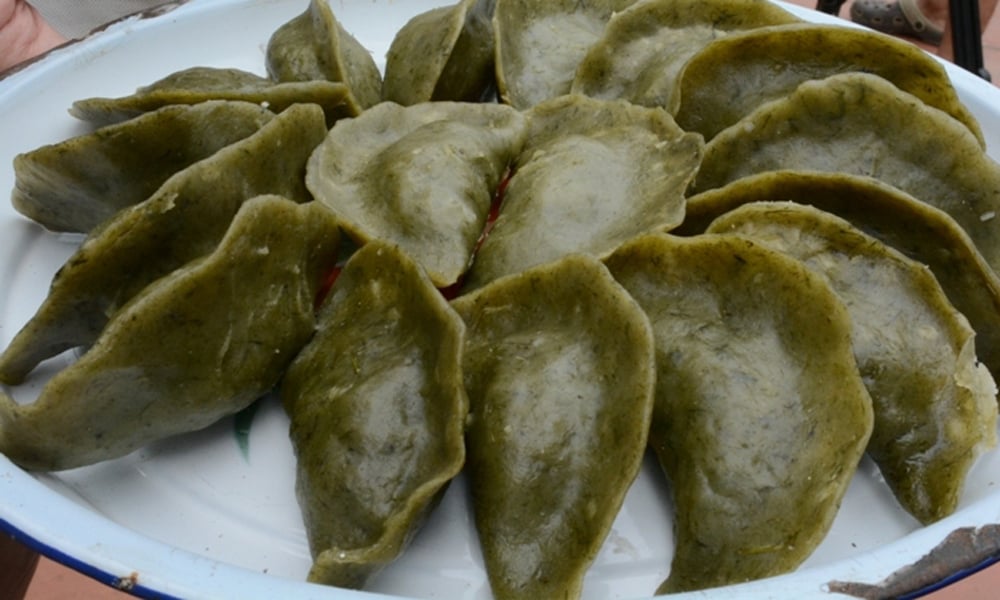 |
Illustrative image. |
Unlike Hanoi's sticky rice cake, which is generously filled with pristine white sticky rice, Diem village's sticky rice cake is unique with its vibrant green outer layer made from sticky rice leaves, leaving a lasting impression on diners.
Diềm Village's sticky rice cakes are made entirely by hand, with carefully selected ingredients and attention to every step. The outer layer of the cake is made from carefully selected rice to ensure the right level of stickiness. The rice is soaked in water for about 3-4 hours, then ground into a fine paste, and then drained. If the paste is too dry, the cake will be hard; if it's too wet, the cake will crumble. After draining, the paste is formed into small balls and blanched in boiling water (also known as "flour dipping"), a step that gives the cake its stickiness.
An indispensable ingredient is knotweed. Fresh knotweed is harvested at the right time when the plant has buds and white powder. The knotweed is washed, blanched, drained, mixed with flour, and pounded until smooth. The ratio of knotweed to flour must also be specific. With the skill of the baker, the green color of the knotweed gradually blends with the white of the flour, pounded until the dough is no longer sticky to the touch – that's the standard.
There are two types of fillings for banh khuc: bean and meat. For the bean filling, the beans are soaked, steamed until cooked, then mixed with pork belly, dried onions, pepper, and seasoned. The meat filling is made from diced pork belly mixed with wood ear mushrooms, chopped onions, and pepper.
After preparing the ingredients, the next step, shaping the cakes, requires meticulous attention to detail. Unlike other types of sticky rice cakes, the sticky rice cakes from Diem village are shaped like cat ears. The baker rotates and flattens the dough ball, then places the filling in the center and wraps it up so that the outer layer is thin but the filling is not visible.
After shaping the dumplings, steam them for about 30 minutes. They are best eaten hot. The glossy, chewy crust blends with the aroma of basil, pepper, beans, meat, and the crunch of wood ear mushrooms.
After October, when the summer-autumn rice harvest ends, the wild spinach (rau khúc) sprouts abundantly. The villagers of Diem harvest it to make cakes and dry it for later use. After the wild spinach season, only dried wild spinach can be used to make cakes, which is why the cakes turn dark brown. While the appearance may not be appealing, the taste is just as delicious as fresh wild spinach cakes.
Source: https://baobacninhtv.vn/banh-khuc-lang-diem-postid443631.bbg


















































































Comment (0)