

 |
| The teammates took a commemorative photo when they visited Mr. Do Anh Tuan's family on April 30, 2026. |
The salty taste of survival in "hell on earth".
In April 2026, more than half a century has passed since the historic reunification of our nation. 51 years—a long enough time for the dust to settle on the bleeding wounds, but also just enough for us to acknowledge and celebrate the miracles of human survival.
Amidst the vibrant atmosphere of April, a month of historical flags and flowers, as the entire nation joyfully celebrated the Liberation Day of Southern Vietnam on April 30th, I was fortunate to attend the most unusual and moving reunion in my more than two decades of writing: a gathering of courageous soldiers from the former 5th Division of the Southeast Region, now sitting side by side, their wrinkled hands trembling as they held the very death certificates of their lives.
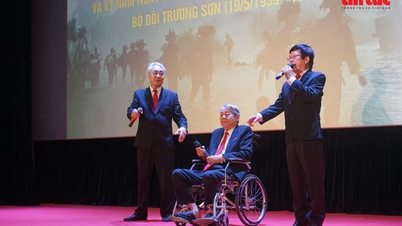
The head of the Liaison Committee, Ngo Hong Muu, humorously introduced the two main figures: Mr. Do Anh Tuan (born in 1940) and Mr. Tran Duy Minh (born in 1947). Mr. Muu chuckled, saying, "They both received death certificates half a century ago, and altars have been set up in their hometowns. If they're not ghosts, then what are they?!" A dry, gentle laugh echoed, but in the deep-set corners of their eyes, tears of hardship welled up.
Nestled behind ancient banyan trees in Tuan residential area, Pho Yen ward, Thai Nguyen province, the simple house of veteran Tran Duy Minh is filled with nostalgia. Looking at his thin, small frame in his twilight years, few would guess that this man was once a "block of steel," forged and tempered by the most brutal acts of revenge in Phu Quoc prison.
In February 1972, his unit received orders to hold a defensive position near the Sa Thầy River (Kon Tum province) to cut off the enemy's attempts to block their supply lines. At dawn, the Vietnamese forces took control of the position. Minh and five comrades were assigned to stay and hold the outpost. Having lost their crucial base, the enemy frantically returned and bombed continuously in an attempt to destroy the position.
Enemy bombs rained down relentlessly for eight hours, churning up the land to the point that not a single branch or blade of grass remained intact. When the smoke from the bombs cleared, the enemy used planes to search the area and discovered Mr. Minh buried under the rubble, but his body was still warm. They immediately took him aboard their planes and abducted him.
Remaining on the battlefield, the grieving comrades gathered the remaining scraps of flesh and bone scattered on the ground, dividing them equally into six portions for hasty burials near the Sa Thầy riverbank.
 |
| Mr. Tuan has treasured and preserved the death certificate for over 50 years. |
Six months later, the death certificate, dated February 14, 1972, arrived in his hometown. Upon hearing the news of her son's death, his mother collapsed, calling out his name until her voice was hoarse and she fainted every time she looked at the altar. At that time, the family's most valuable asset was a bicycle, which the elderly father sadly sold to buy funeral supplies for his son.
Captured by the enemy, Mr. Minh was brutally tortured for a month and a half to extract information, then exiled to Phu Quoc prison. There, he endured every kind of torture, from being tied with barbed wire in a tiger cage, having his hands hammered into a bed of nails, to having his fingernails pulled out one by one. The cruelty of the enemy did not stop at the whipping.
To cope with prolonged hunger strikes by the prisoners, the authorities cruelly cut off all fresh water. Hunger could be endured, but thirst was deadly. On the brink of death, he and his fellow prisoners cleverly boiled fish sauce down into a powder and stuffed it into empty toothpaste tubes. When thirst overwhelmed them, they could simply sip a little of this salty "toothpaste" to stimulate saliva production, sustaining them and refusing to surrender.
A solo journey through the jungle and tears of Agent Orange.
Fate sometimes creates heartbreaking coincidences. Mr. Minh's death certificate arrived in Dac Son commune not long after that of his cousin, Do Anh Tuan. The two brothers lived close in age, their houses on opposite banks of the Cong River. On the day the commune held a joint memorial service, the nurse at the health station, named Sau, had to paddle tirelessly between the two banks because, just as Mr. Tuan's mother and wife regained consciousness, Mr. Minh's mother fainted.
 |
| The diary recounts memories from Mr. Do Anh Tuan's time in the military. In the photo, from right to left: Mr. Tran Duy Minh, Mr. Do Anh Tuan, and Mr. Ngo Hong Muu. |
Although he was younger, Mr. Tuan was seven years older than Mr. Minh. The battle that made him a "martyr" took place at the beginning of the dry season in 1969, when Regiment 2 was ordered to launch a surprise attack to wear down enemy forces in the area of Highway 20, La Nga - Dinh Quan sub-district in Dong Nai province.
The battle ended swiftly. As the units were retreating, they were suddenly met with a thunderous counterattack from B52 bombers and enemy artillery, tearing through the sky. As the head of the ordnance detachment, Tuan stayed behind to prepare for the final withdrawal. His bunker was hit by a bomb and exploded. By the time he managed to escape, the entire unit had already withdrawn. He had no choice but to cut through the jungle, heading west to find his way back to the base on the Cambodian border.
Alone in the treacherous jungle, he subsisted on forest leaves and drank stream water, dodging bombs and bullets during the day and hiding from wild animals at night. For nearly a month, thanks to the survival skills he had learned before going to the front lines, he managed to crawl back to the military supply station in Bom Bo village, but his old unit had long since left. With all contact lost, the regiment had no choice but to send a death notice back to his hometown.
Back home, the young wife, Lai Thi Nga, received devastating news and could only hug her daughter tightly, weeping on the doorstep. She recalled with sorrow, "That day, it was so difficult for me to buy a 53kg pig for my husband's funeral. I personally tore 100 white mourning scarves to distribute to relatives..." Then, on the day the country was reunified, her husband, whom she thought had turned to dust, suddenly returned, alive and well.
 |
| Mr. Do Anh Tuan and Mrs. Lai Thi Nga. |
But before the tears of reunion could dry, tragedy struck again. In 1976, they had another daughter. The child was born healthy, but after 17 months, her limbs withered like sickle handles, and she couldn't breastfeed. The couple scrimped and saved every penny from their ration coupons, buying sugar to mix with water to keep their daughter alive.
The old veteran's eyes were red and swollen: "Back then, we didn't know what Agent Orange was. My grandson consumed 75kg of sugar in 17 months and then quietly left us..." That was the harsh boundary of war, where a safe return sometimes came at the cost of devastating consequences that would last a lifetime.
Closing my notebook amidst the bright April sunshine, I sat silently for a long time, contemplating the words I had just written. The image of the two veterans, their wrinkled hands trembling as they touched their own death notices, haunted my mind.
I increasingly understand the price of peace. The stories of soldiers emerging from death notices are not of the distant past, but remain present, reminding me of a homeland sculpted from blood and bones, from silent tears, and from miraculous resurrections.
Source: https://baothainguyen.vn/xa-hoi/202605/co-nhung-cuoc-tro-ve-mang-mau-huyen-thoai-e2337aa/
![[Image] Close-up view of the interchange connecting the two expressways and Long Thanh Airport.](https://vphoto.vietnam.vn/thumb/1200x675/vietnam/resource/IMAGE/2026/05/25/1779703378210_ndo_br_z7863716673926-224453a31600126cce10622af6290afd-4549-jpg.webp)
![[Image] Hanoi's urban life under the challenge of a "scorching hot" environment](https://vphoto.vietnam.vn/thumb/1200x675/vietnam/resource/IMAGE/2026/05/25/1779706979265_nang-nong-t5-2026-minh-duy-7-4636-jpg.webp)

































































Comment (0)