

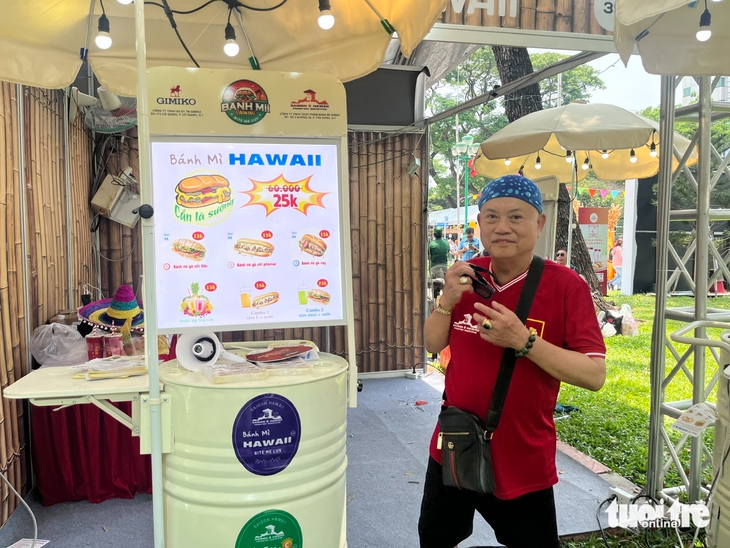
Mr. Vuong Hoang Minh next to his bread cart, designed from a repurposed oil drum, displayed at the 2025 Bread Festival - Photo: N. BINH
Throughout the four days of the Vietnamese Bread Festival (March 21-24 in District 1, Ho Chi Minh City), while many stalls were packed with customers queuing to buy bread, one stall was "extravagant," only having a few loaves of bread available for display, not for sale.
A few staff members were busy handing out flyers next to the rather modern and convenient-looking barrels. These are the bread stands that will appear on the streets of Saigon in April 2025.
Vietnamese bread with Hawaiian flavors.
Mr. Vuong Hoang Minh, the owner of the Hawaiian Bread stall, is a Vietnamese-American who is approaching 70 years old. Slowly taking a warm loaf of bread from a barrel, he happily introduced: "All the chicken-filled loaves and sauces are imported directly from the United States. Hawaii is famous for its chicken dishes, which is also a characteristic of this brand when it comes to Vietnam."
Inside this white-painted barrel are three compartments for bread, along with a thermal insulation system that ensures the bread stays hot and crispy.
Born and raised in Saigon, banh mi (Vietnamese baguette sandwich) is a food deeply connected to his childhood, especially the distinctive mayonnaise flavor that was a hallmark of his generation. He recounts that when he was a child, having a banh mi was considered a luxury! Because the bread was sold directly from the bakery, and each shop had its own secret recipe for the filling. But now, many people say that the taste of banh mi is no longer the same as it used to be. "That's why I want to bring back that authentic taste, the flavor of the past, so that anyone who eats it can reminisce about the banh mi of yesteryear," Mr. Minh said.
Inspired by repurposing oil drums, he designed them into display stands for selling bread on the sidewalk. Those participating in the distribution or sales system need no capital, no experience, no risk of failure, and are not discriminated against based on age or background; they simply register and are given an oil drum cart.
Every day, starting at 5 a.m., bread is delivered to various locations to serve students, workers, and office workers. Each cart is uniformly designed, and the staff wear neat uniforms, ensuring food safety and hygiene.
Hawaiian-style sandwiches don't use pickles or onions, making them suitable for office workers' tastes and easy to carry around without worrying about the smell affecting those around you.
"Specifically, I order bread from producers using their own recipes. The crust is crispy, and the inside is soft. Older people will find it familiar, while younger generations will enjoy this nostalgic taste," he introduced the project.
With his Hawaiian bread project, he's not just selling bread; he's nurturing a plan to build a system, a business model that both benefits the community and ensures a stable income for many people.
"I want to stir up trouble, not make money."
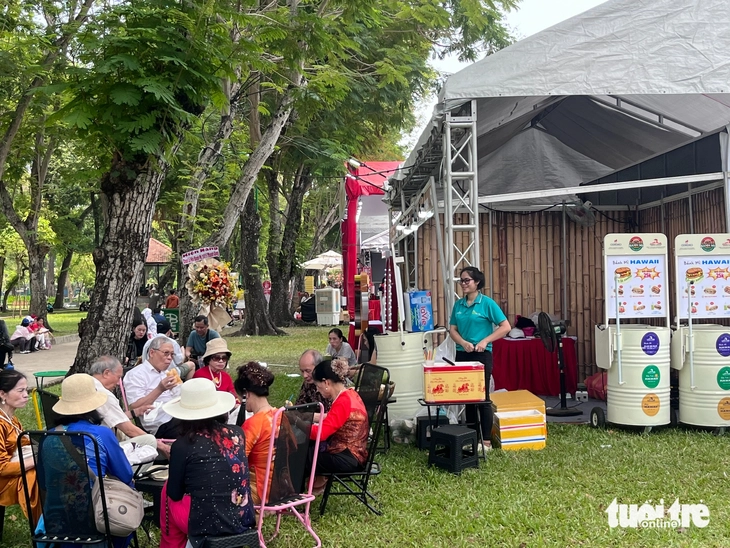
The space of the booth was repurposed as a resting place for festival-goers, instead of being used for business like most other booths - Photo: N. BINH
The Hawaiian bread project was conceived by him and his friends over a period of three months. To date, the team has completed the bread cart system, staff uniforms, and the executive office, with the expectation of launching the chain in April 2025. This model is not limited to just one city; the founder hopes to expand it nationwide.
With each loaf of bread priced at around 25,000 VND, the seller earns 5,000 VND per loaf. This profit helps them cover their living expenses. Mr. Minh estimates that each selling point will sell about 50 loaves of bread within 3-4 hours. Additionally, those with a good location can register to set up a bread cart in front of their house to take advantage of the business opportunity.
The bread project is going quite smoothly, receiving a lot of attention. Mr. Minh acknowledges that every business model has risks, but more importantly, he wants to spread the message that there is a group of people willing to help those in need and contribute to society.
"At this age, I returned to Vietnam to find something to do, not to make money, hoping that this new chain of banh mi shops will support those in need, create jobs, and preserve a unique aspect of Vietnamese culinary culture," Mr. Minh shared.
Regarding the capital investment for the chain, Mr. Minh said there were many difficulties! Fortunately, he received a lot of support from friends, who will help with the investment costs for the barrels used to hold the cakes. "For the cakes and production activities alone, I have to find the capital, calculating how to cover rent, labor costs, and operating expenses, while the profits will be donated to charity. At my age, doing something useful for society is what's important," Mr. Minh shared.
Source: https://tuoitre.vn/banh-mi-hawaii-cua-ong-chu-viet-kieu-my-20250324183132429.htm


![[Photo] Solemn bathing ceremony and Buddha procession in Hue](https://vphoto.vietnam.vn/thumb/1200x675/vietnam/resource/IMAGE/2026/05/31/1780228263543_1-jpg.webp)
![[Photo] Admire the coral "masterpiece" amidst the million-year-old heritage of Dak Lak province.](https://vphoto.vietnam.vn/thumb/1200x675/vietnam/resource/IMAGE/2026/05/31/1780221235105_anh-man-hinh-2026-05-31-luc-16-53-27.png)
![[Photo] The General Secretary, President and his wife begin their state visit to the Philippines.](https://vphoto.vietnam.vn/thumb/1200x675/vietnam/resource/IMAGE/2026/05/31/1780230559452_anh-man-hinh-2026-05-31-luc-19-28-11.png)
















![[Video] Sunset at Lap An Lagoon – Where the sun sets over the fishing nets](https://vphoto.vietnam.vn/thumb/340x192/vietnam/resource/IMAGE/2026/05/31/1780192137701_beach-landscape-sea-water-nature-grass-745871-pxhere-com.jpeg)































![[Photo] Admire the coral "masterpiece" amidst the million-year-old heritage of Dak Lak province.](https://vphoto.vietnam.vn/thumb/402x226/vietnam/resource/IMAGE/2026/05/31/1780221235105_anh-man-hinh-2026-05-31-luc-16-53-27.png)






























Comment (0)