

Adapt to survive.
Digital journalism is not simply about transferring content from print newspapers to websites. It's an ecosystem that operates on data, multi-dimensional interaction, and unlimited accessibility. The emergence of data processing and automation tools helps newsrooms free up labor in repetitive tasks.

Provincial journalists receive training on applying AI in their work. Photo: GIA KHÁNH
As machines become proficient at synthesizing information and writing short news articles, the mindset of journalists is gradually changing. According to Doan Hong Phuc, Standing Vice Chairman of the Provincial Journalists Association, multimedia skills are a mandatory requirement for digital journalists. A modern journalist not only needs to know how to write but also how to film, create short clips, design basic images, and understand how digital platforms operate. They must be "information coordinators," knowing how to use technological tools to make their articles more engaging and accessible. "Currently, we are focusing on organizing training courses on applying artificial intelligence (AI) to journalism, from basic to advanced levels," Mr. Phuc stated.
AI journalism has been discussed for years in established newsrooms and is now being applied in local journalism. Reporters can effectively use AI in the process of searching for and suggesting topics. During information gathering, reporters can use AI software to assist in synthesizing, classifying, and translating documents, reading audio files, creating charts, etc. When writing articles, reporters can ask AI for title suggestions, spell checking, and style correction, saving time and improving the quality of the initial draft.
Editors and technical staff can apply AI to save time in technical tasks, allowing them to focus more on improving content quality. In the in-depth editing process, AI assists in summarizing content, identifying illogical points, suggesting additional information, and making articles more logically sound. “Many technical errors in audio and video, such as wind noise, flowing water sounds, or unfocused character gazes, which even experienced journalists struggle with, can now be completely resolved in an instant thanks to AI. With these technologies, we reduce the professional pressure during fieldwork,” shared journalist Nguyen Thi Dang Khoa, a reporter for An Giang Provincial Newspaper and Radio & Television.
The intersection between humans and tools
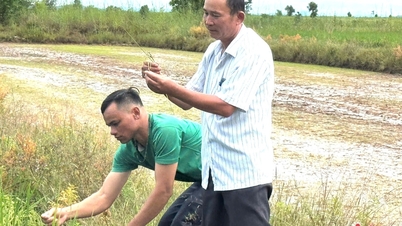
The development of technology brings convenience but also significant risks of fake news and information manipulation. Automated tools can create images, videos , or text that look real but contain false information. A prime example is the recent news about "crocodiles surfacing in the river in Vinh Long province on May 2nd." The AI-generated image was powerful enough to create a wave of misinformation in real life. Without sufficient skill and experience, journalists and news organizations can easily be swept away by this information flood.
At this time, professional ethics becomes the most important "filter" for journalists. They must use those very technologies to verify sources, cross-reference data, and protect the truth. The trust of readers is the most valuable asset of a news organization. That trust can only be built by human honesty, not by the intelligence of algorithms.
At a journalism training course in An Giang in early May 2026, journalist and Master's degree holder Ngo Tran Thinh - Head of the Multimedia Department, News Center - Ho Chi Minh City Radio and Television Station, shared: “We should not view the development of technology as a threat to eliminate humans from journalism. In reality, it is a collaboration. Technology handles the dry, computationally intensive tasks. Humans focus on creative thinking, critical analysis, and emotions. The important thing is that each newsroom needs regulations on the use of AI, ensuring that reporters and editors are fully responsible for their journalistic works.”
According to Mr. Thinh, modern journalists need to know how to turn technology into a powerful "assistant." They use AI in simple news reporting, then continue to tell stories with depth. Instead of blindly chasing speed, their value lies in their ability to analyze, connect events, and offer humanistic perspectives that machines cannot provide. An algorithm can statistically analyze a natural disaster, but only journalists can feel and express the pain of the people, the warmth of human compassion in times of hardship. No matter how far technology advances, the essence of journalism remains serving humanity. Readers turn to journalism not only to learn about events but also to seek guidance, empathy, and faith in positive values.
Digital journalism in the future will be more personalized and intelligent, but its core must still be true stories, written by people with heart and vision. Today's journalists need a cool head to navigate technology and a warm heart to understand the pulse of life. Only then can journalism uphold its mission as a "sharp sword" protecting the truth and a trusted companion of the public.
GIA KHANH
Source: https://baoangiang.com.vn/bao-chi-chuyen-minh-a485818.html




![[Photo] General Secretary and President To Lam presides over a meeting on assessing national development resources.](https://vphoto.vietnam.vn/thumb/1200x675/vietnam/resource/IMAGE/2026/05/20/1779253785852_a1-bnd-2943-8519-jpg.webp)
![[Photo] National Assembly Chairman Tran Thanh Man working with the Standing Committee of the Economic and Financial Committee](https://vphoto.vietnam.vn/thumb/1200x675/vietnam/resource/IMAGE/2026/05/20/1779249584387_ndo_br_1-jpg.webp)























































































Comment (0)