

This news site has officially launched The Filter, a platform described as providing "independent product reviews, reliable buying advice, and sustainable shopping ideas," after a months-long trial period.
The Guardian states that The Filter showcases the best consumer articles, reviews, and product recommendations, all presented completely independently.
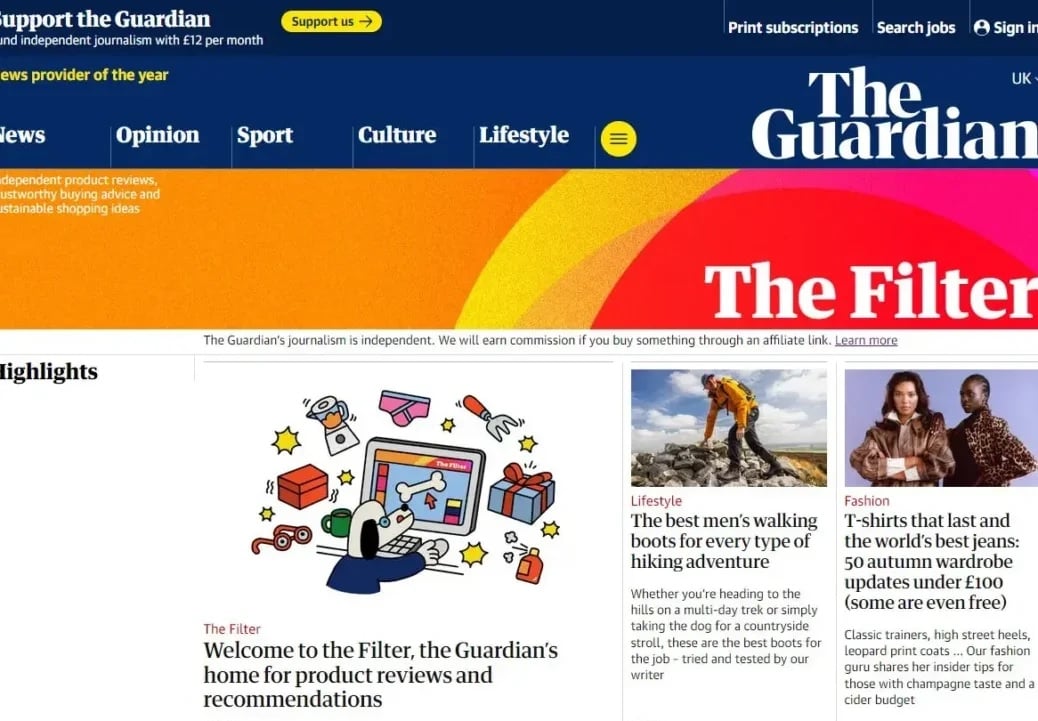
This is the website interface showcasing the products recently launched by The Guardian. Photo: PG
The Guardian's announcement stressed that all articles are free, written by expertly selected writers who research and test products in real-world scenarios, and that no advertisers or retailers pay to be included in the articles.
The Guardian earns a small commission if someone clicks on a link on one of its pages and goes on to make a purchase or sign up for a service. Like many other publishers, they are using Skimlinks, a tool that places tracking code in links for publishers to use so that purchases can be accurately recorded. They are also using the Amazon Associates program for that site's links.
Articles featured on The Filter's launch day last Thursday included a men's walking shoe roundup, fall wardrobe updates under £100, the best non-Tesla electric cars, subscription services that "save you time and money," and gardening tools.
Each page has a disclaimer below the author's name that reads: "The Guardian's journalism is independent. We will earn a commission if you purchase something through an affiliate link."
Last month, Guardian News and Media's chief financial officer, Keith Underwood, revealed that The Guardian would begin offering product recommendations and thus affiliate marketing to generate revenue, "based on the trust we have in the brand."
The Guardian joins a group of publishers that have developed e-commerce/affiliate services in recent years, including The New York Times and Mail Online.
The Independent is also among them, describing e-commerce as one of five key strategic growth pillars and recently revealing that revenue from this segment has increased by 26%, with highlights including Black Friday and travel content.
E-commerce is also part of Reach's strategy to diversify revenue streams, aiming to avoid reliance on advertising, and the media conglomerate says these sectors are seeing "promising growth."
The latest trends and forecasts report from the Reuters Institute for Journalism Studies, published in January of this year, also listed e-commerce as the fifth most important revenue source for news publishers in 2024.
E-commerce typically involves websites selling products directly, while affiliate marketing is when websites promote goods from other retailers and earn a commission on clicks.
The Guardian used to have its own online store selling its merchandise, but that store closed in 2016. The Guardian still operates an online bookstore.
Last month, Guardian Media Group, owned by The Scott Trust, reported a decline in revenue for the year to March 31 after a four-year streak of growth and mounting losses. On the same day, the company revealed it was considering selling the Sunday newspaper The Observer to news firm Tortoise Media. Any profits from The Filter would be reinvested back into The Guardian's publications.
Hoang Hai (according to Guardian, Pressgazette)
Source: https://www.congluan.vn/bao-guardian-ra-mat-trang-gioi-thieu-san-pham-de-tang-nguon-thu-post316778.html





























































































Comment (0)