

 |
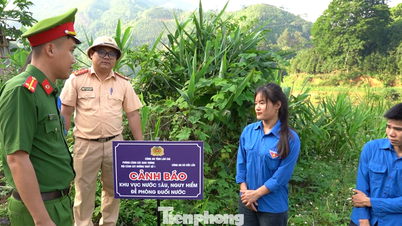
| The people of Ngai Tro village, Lung Cu commune, use clean water for their daily activities. |
Clean water reaches the village.
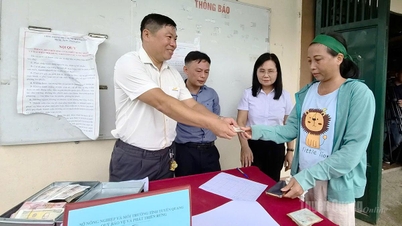
For the past five years, the lives of many Mong ethnic minority households in Thong Nhat village, Yen Phu commune, have changed dramatically. They no longer have to fetch water from streams but now have access to clean water right in their homes. Mr. Duong Van Long, a resident of the village, happily stated that in 2021, the government provided funding for drilling wells and installing water pipes to his house. According to Mr. Long, the well provided by the government has a large capacity, enough for his family and five neighboring households to share. The villagers are very grateful for having access to clean water.
Sharing the same joyful sentiment as Mr. Lồng, Mrs. Lý Thị Mỷ happily said: “Several houses share one well, the water is abundant and very clean. Every month, the neighbors only contribute money to pay for the electricity to pump water, so we no longer have to worry about water shortages!”
Similarly, in Sung Mang commune, the hanging lakes on the rocky mountains have truly changed the fate of the people in Ha Pong Cay village. Mr. Vang Cha Hou recalls the harsh dry seasons of the past when they had to carry water from tens of kilometers away. For nearly 10 years now, since the hanging lakes were built, the villagers not only have enough water for drinking but also for daily life, bathing, and washing. Clean water reaching the village not only quenches thirst but also helps make the lives of the people less arduous, more stable, and more civilized.
Commenting on these changes, Comrade Tran Xuan Duong, Director of the Rural Water Supply Center (Department of Agriculture and Environment), affirmed: Since the Prime Minister launched the program in 1998, a strong transformation has taken place, from awareness to action, among the people. The remarkable growth in the percentage of households using hygienic water is the most vivid evidence of the program's effectiveness, directly contributing to the goal of building new rural areas. By the end of April 2026, the percentage of rural people using hygienic water reached over 96%. The greatest success is the change in mindset; people no longer consider clean water a gift from God to be used indiscriminately, but have understood it as a right and responsibility linked to community health. The province has invested in comprehensive infrastructure with thousands of modern centralized water supply systems to replace unreliable well water sources, thereby creating a solid foundation for the application of digital technology to sustainable clean water management in the new phase.
 |
| The rural clean water project in Nhữ Hán commune provides a stable source of clean water for the local people. |
A breakthrough for clean water security.
Entering the period 2026-2030, the Ministry of Agriculture and Environment has identified that the focus should not stop at bringing water to villages, but must be on safe water supply and smart management.
According to Mr. Tran Xuan Duong, Director of the Rural Water Supply Center: Several centralized water supply projects in the province are now operating online monitoring systems, allowing for real-time monitoring of water quality. Thanks to the integration of automatic monitoring stations via mobile applications, units can proactively adjust valves remotely, ensuring a stable water supply without manual measurement. In particular, for groundwater sources, advanced filtration technologies (RO, Nano) combined with SCADA control systems have been implemented, optimizing extraction and reducing water loss to below 15%, thus optimally protecting water resources.
The Director of the Rural Water Supply Center affirmed: Water is a source of life, but clean water is the measure of civilization and quality of life. Protecting this precious "white gold" and ensuring the 2026 theme truly spreads and the new rural development goals are achieved requires strong involvement from businesses investing in water resource exploitation and protection. In reality, many provinces and cities have implemented public-private partnership models that have helped extend clean water networks to remote and rural areas, providing water quality comparable to urban areas. Alongside this, localities need to strengthen digital communication and establish self-governing groups in villages to protect public sanitation facilities and disseminate knowledge on water conservation. The beneficiaries of rural clean water projects are the local residents.
The 2026 National Week for Clean Water and Environmental Sanitation is not just a high-intensity campaign, but a milestone affirming Vietnam's determination, including Tuyen Quang province's, to improve the quality of life for farmers. With strong support from digital technology , this "white gold" resource will be protected and exploited effectively, creating a solid foundation for a modern, green, and sustainable rural area.
Text and photos: Doan Thu
Source: https://baotuyenquang.com.vn/kinh-te/xay-dung-nong-thon-moi/202605/bao-ve-nguon-nuoc-tu-cong-dong-c5c1433/

![[Image] Hanoi's urban life under the challenge of a "scorching hot" environment](https://vphoto.vietnam.vn/thumb/1200x675/vietnam/resource/IMAGE/2026/05/25/1779706979265_nang-nong-t5-2026-minh-duy-7-4636-jpg.webp)


![[Image] Close-up view of the interchange connecting the two expressways and Long Thanh Airport.](https://vphoto.vietnam.vn/thumb/1200x675/vietnam/resource/IMAGE/2026/05/25/1779703378210_ndo_br_z7863716673926-224453a31600126cce10622af6290afd-4549-jpg.webp)








































































Comment (0)