

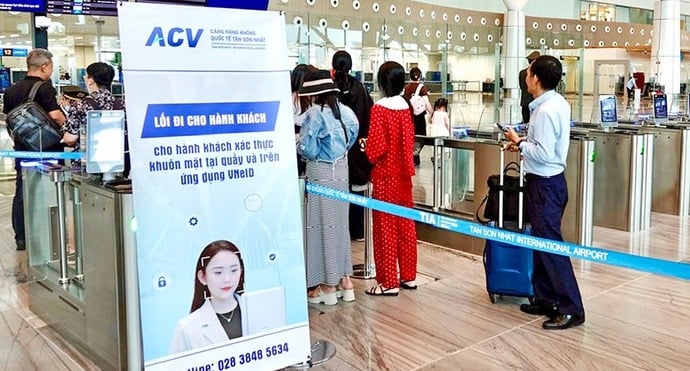
Therefore, in the coming period, the region domestic flights At airports, there will no longer be crowds at check-in counters, nor the worry of forgetting documents at the last minute.
This is a complete overhaul of the ground service chain, from processes and technology to the habits of tens of millions of passengers, and a test of Vietnam's ability to master technology in the digital aviation era.
Excited about flying domestically without paperwork.
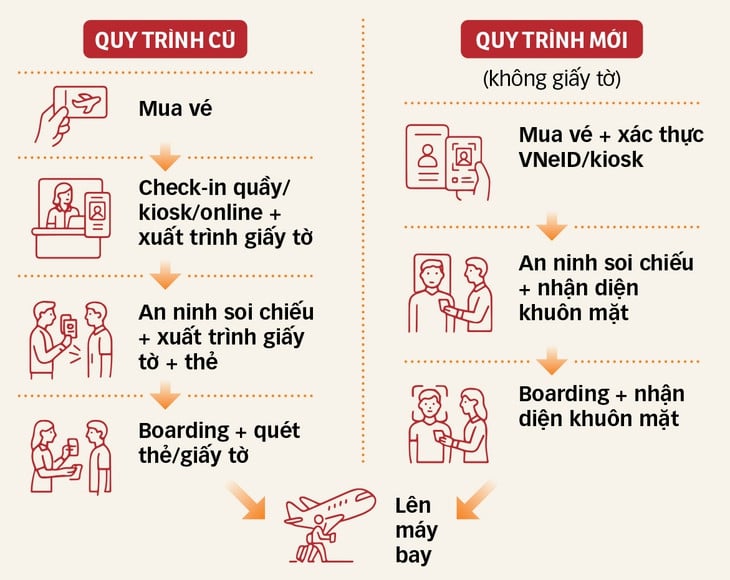
One airline company likened the old process to a road full of "toll booths." After buying a ticket, passengers had to check in at a counter or kiosk and present their documents, go through security and present their documents and card again, and then at the boarding gate, scan their card or have their documents checked again.
Each "checkpoint" takes several tens of seconds, and passengers have to wait in long lines. But with the new procedure, most of these "fee collection points" have been eliminated. Passengers don't need to check in luggage; they just need to check in through the checkout line. VNeID Or a kiosk, face scan at security, face scan at boarding, and then straight onto the plane.
Passengers with checked baggage simply stop at the drop-off counter and then enter the automated system as usual. The difference isn't just about discarding a piece of paper; it's a shift in roles from staff to system, from paperwork to data, from human observation to algorithms.
Previously, the full-time online check-in service using biometrics via VneID, a platform developed by the Ministry of Public Security , was piloted from mid-April 2025 at Terminal 3 of Tan Son Nhat Airport (Ho Chi Minh City) and Noi Bai Airport (Hanoi). Subsequently, the Department of Administrative Management of Social Order (C06) expanded it to a number of other airports.
In reality, at airports, passengers using biometric services via VNeID are satisfied because it saves them considerable time. According to Tuoi Tre newspaper's observations at airports, many passengers have had a smooth experience, although some are still confused due to being accustomed to paper-based procedures.
At midday on a weekend at Terminal 3 of Tan Son Nhat Airport, the newly constructed lanes leading directly to the security area were bustling with activity. Ms. Nguyen Thu Huyen (27 years old, Ho Chi Minh City) and her group of friends, carrying only carry-on luggage, excitedly tried the "paperless lane." Opening the VNeID app linked to her Vietnam Airlines ticket, Ms. Huyen stepped into the facial recognition area. "Tick!" - the gate opened immediately.
"It's much faster than before; no need to rummage through my wallet for my ID card, no need to wait for the card to be printed. We got through the gate in just a few seconds," Ms. Huyen shared. A few steps away, Mr. Nguyen Van Bay (56 years old, from Tay Ninh ) unexpectedly forgot his VNeID password right at the gate and, out of habit, presented his ID card to receive his paper card.
An airport security officer quickly approached, guided him through the account recovery process, reminded him to remove his sunglasses, and stand straight facing the camera. The gate opened, and passengers passed through in just a few seconds. "If it weren't for their help, I would have missed my flight," Mr. Bay said with a sigh of relief.
ACV is racing to invest in a comprehensive technological system.
With less than 80 days remaining until December 1, 2025, Vietnam's domestic aviation industry faces the major challenge of a complete transition to a paperless check-in process using biometrics via VNeID, while the technological infrastructure remains unsynchronized.
According to experts, the crucial issue is ensuring the synchronization of the "gears" of automated gate technology (e-gate), facial recognition cameras, chip-based ID readers, data transmission, security screening systems, airline applications, and connection with VNeID.
At Tan Son Nhat and Noi Bai airports, pilot programs showed that passengers who didn't check in their baggage saved 10-15 minutes by skipping the paperwork and printing the check-in card. However, at smaller airports like Con Dao or Tho Xuan, efficiency depends on a stable network, good lighting, and proper camera placement. A misaligned camera, harsh lighting, or blurry signage can ruin the entire experience.
The integration system between VNeID and airlines still has discrepancies, leading to errors such as the device failing to recognize the passenger or requiring maintenance. "Just one unsuccessful experience can easily discourage passengers and cause them to revert to traditional procedures," said one business owner.
Speaking to Tuoi Tre newspaper, a leader of the Vietnam Airports Corporation (ACV) said that the unit is directly operating ground services at 17 airports. The rate of passengers using VNeID has recorded strong growth, ranging from 30% to 50%. In August 2025 alone, Con Dao and Can Tho reached 50% of passengers checking in via VNeID, a fairly high rate.
Following the Prime Minister's new directive, ACV stated that it and its units are focusing all their efforts to meet the deadline. However, the import and installation of high-tech systems such as e-gate, facial recognition cameras, and dual backup transmission lines cannot be completed overnight. "We are racing against time to finish on schedule," an ACV leader emphasized.
Although the exact cost wasn't disclosed, this source stated that the investment was certainly substantial. The entire system includes automated gates, AI cameras, integrated software, and training for a team of "digital assistants" at the airport. In return, the long-term benefits are quite clear: reduced need for temporary staff, increased gate speed, improved on-time boarding rates, and lower processing costs per passenger.
"For ACV, synchronized infrastructure is the launching pad for many new digital services, elevating the position of Vietnamese aviation in the digital era. The biometric system will become the foundation for developing smart services, from passenger management to optimizing the entire airport operation," this person affirmed.
How are the airlines preparing?
Speaking to Tuoi Tre newspaper, Mr. Dang Anh Tuan, Deputy General Director of Vietnam Airlines, said that the airline had coordinated with C06 and ACV to successfully test the system at Terminal 1 of Noi Bai Airport and Terminal 3 of Tan Son Nhat Airport from April 19th, before expanding it to Da Nang, Cam Ranh, Cat Bi, Phu Quoc, and Phu Bai.
The technical infrastructure, personnel, and security coordination mechanisms are ready for large-scale deployment. According to Mr. Tuan, the airline has established multi-channel support via check-in counters, website, social media, hotline, detailed instructions for registering for VNeID level 2, ticket linking, and biometrics. Pilot results show that the system fully meets security and safety requirements.
Vietjet also stated that it has prepared resources in terms of equipment and personnel to guide passengers through the flight check-in process via VNeID, reducing the need for check-in at counters. However, to date, only Vietnam Airlines and Vietjet support online check-in via VNeID (Vietjet has not yet implemented it at Terminal 1 of Tan Son Nhat Airport due to a lack of automatic gates), while passengers still have to go through traditional check-in procedures with other airlines.
A representative from an airline stated that initially, the number of passengers using "paperless" services was limited because many had not yet upgraded their VNeID to level 2 (requiring facial recognition). Some passengers were unfamiliar with the three-step process: check-in (online or at the counter), passing through security using facial recognition, and boarding the plane, also using facial recognition.
Therefore, according to many experts, ACV and airlines need to strengthen guidance, install automatic arrow signs indicating designated standing positions, and use loudspeakers to remind people to remove masks and sunglasses. "Technology first aid" desks should be placed right before security to quickly handle common issues such as forgotten passwords, unlinked tickets, and incorrect identification posture.
In particular, according to aviation experts, support is needed for elderly passengers, migrant workers, or passengers who do not use smartphones to complete online procedures through the new system normally. ACV needs to invest in and implement airport signage that is large, clear, and consistent across all airports, avoiding a situation where "each place has its own style."
This preparation aims to help passengers familiarize themselves with the process in an instant, avoiding congestion. "In addition, airlines need to proactively guide passengers by sending personalized SMS and email messages for each flight segment, along with clear instructions. Passengers who 'try out' VNeID should be rewarded with better seats or priority boarding, encouraging them to experience it...", a specialist suggested.
Source: https://baoquangninh.vn/bay-noi-dia-cung-vneid-bot-lo-chen-lan-3376204.html
![[Photo] Standing Committee member of the Party Central Committee Tran Cam Tu working with the Central Inspection Committee](https://vphoto.vietnam.vn/thumb/1200x675/vietnam/resource/IMAGE/2026/05/28/1779969579668_ndo_br_bnd-2495-jpg.webp)









































































































Comment (0)