

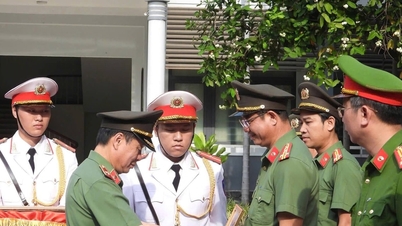
1. The Le Thanh International Border Gate Border Guard Station is located in Ia Dom commune. In addition to controlling the entry and exit of people and vehicles and protecting the assigned border line, the unit also establishes mobile and fixed teams and checkpoints to combat crime and commercial fraud.
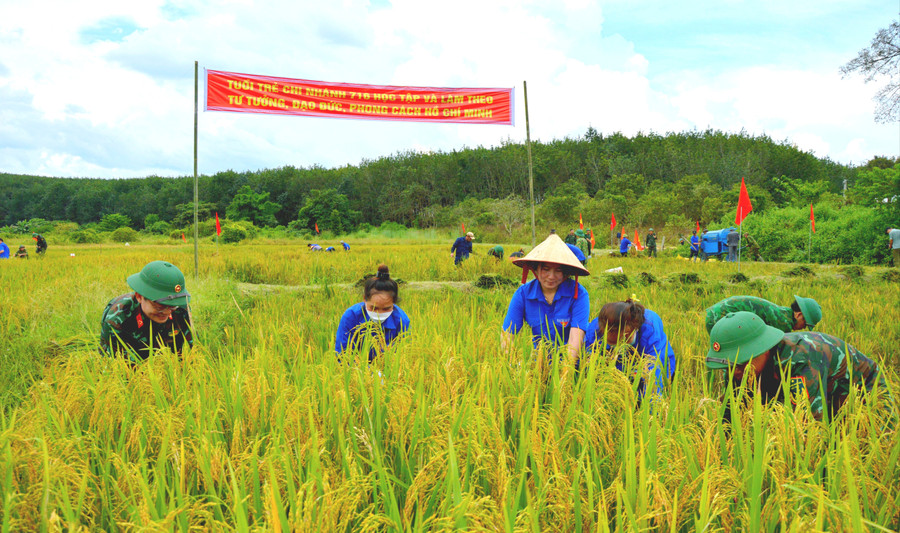
During our time at the unit, we witnessed the vibrant atmosphere of emulation among the officers and soldiers. Lieutenant Colonel Tran Manh Ha, Secretary of the Party Committee and Political Commissar of the Le Thanh International Border Gate Border Guard Station, said: The unit is intensifying the "Determined to Win" emulation movement, aiming for the highest achievements to welcome the Party congresses at all levels. Specifically, this involves building a strong unit in terms of politics, ideology, organization, and ethics; excellently fulfilling political tasks; ensuring logistics and technical support; improving the material and spiritual lives of officers and soldiers; and simultaneously enhancing the quality of training and combat readiness.
The "Determined to Win" emulation movement was implemented seriously, combining regular emulation with peak periods, creating a vibrant atmosphere throughout the unit. As a result, 100% of officers and soldiers clearly understood the ideology, upheld a high sense of responsibility, and were ready to accept and excellently complete all tasks.
Currently, in the border areas of the province, there are 49 village-level security and order self-management teams; 11 border and boundary marker self-management teams; and 2 self-management teams in areas inhabited by religious communities. These forces, along with the local people, have become "living boundary markers" along the border.
Elder Rơ Chăm Tích (Mook Đen 1 village, Ia Dom commune) shared: “Despite my advanced age, I still participate with the self-governing group in patrolling and visiting border markers to affirm that the sovereignty of our Fatherland is inviolable. Only when the border is peaceful can the people feel secure in developing the economy. Therefore, everyone has a responsibility to protect the border and border markers; if the elderly are enthusiastic, the young will soon follow suit and continue the work.”
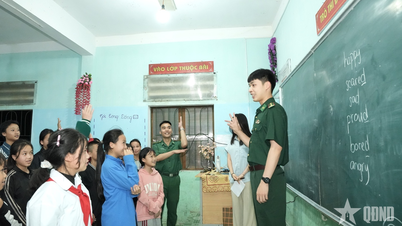
2. In a conversation with us, Major General Hoang Van Sy, Commander of the 15th Army Corps, shared: Most of the Army Corps' units are stationed in border areas, therefore, in addition to recruiting thousands of local ethnic minority workers, the units also promote twinning programs.
To date, companies and units have established fraternal ties with 33 communes; production teams have formed fraternal ties with 271 villages; and over 4,300 Kinh worker households have linked up with 4,300 ethnic minority households. Many innovative models such as "Rice Jar of Solidarity," "Vegetable Garden of Solidarity," "Shining Star of the Village," and "Breakfast of Solidarity" have proven effective.
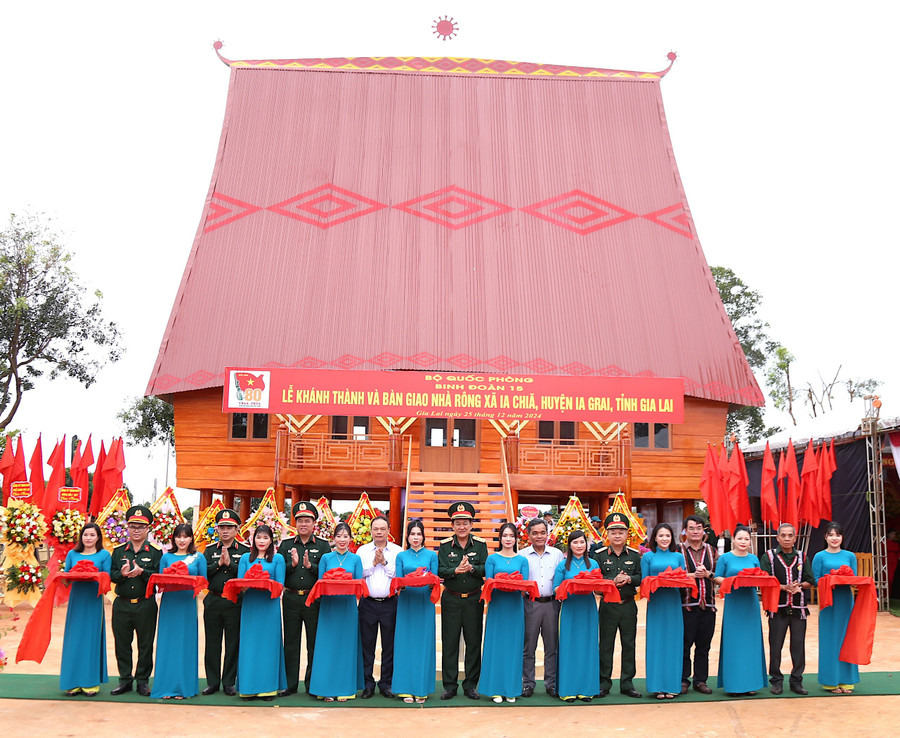
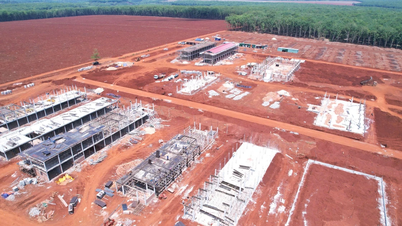
In recent years, the 15th Army Corps has built 8 primary and secondary schools for local authorities, and 11 kindergartens with 132 school and nursery locations at various companies.
In addition, Military Hospital 15 and 11 military-civilian medical clinics, with their team of doctors and nurses at the production units, regularly provide health education, care, and disease prevention and control for soldiers, workers, and civilians. Every year, tens of thousands of people receive free medical examinations and medication, costing tens of billions of dong.
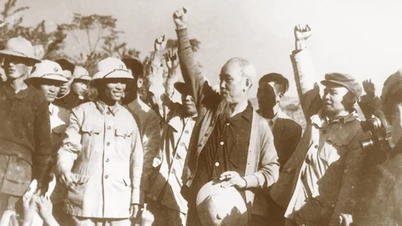
Responding to the "Army joins hands to eliminate temporary and dilapidated houses" movement, the 15th Army Corps supported the construction and repair of 357 houses with a total cost of nearly 17 billion VND, mobilizing more than 15,500 man-days, thousands of officers, soldiers, and workers, along with hundreds of vehicles to directly assist people in building houses. Through this, the image of "Uncle Ho's soldiers" continues to spread widely, strengthening the people's trust in the Party, the State, and the Army.
3. More than seven years have passed since Son village (Ia Nan commune) was recognized as meeting the standards of a new rural area, but many people still clearly remember the challenging period of effort and construction.
When construction began, the village only met 5 criteria, and life was difficult. However, once the people understood the meaning of the program, and that "the Party's will aligned with the people's aspirations," all difficulties were gradually overcome.
Village elder Siu Binh affirmed: "Building new rural areas is so that our children and grandchildren can have spacious schools, football fields, and paved roads that are no longer muddy. Making our village beautiful also contributes to building a prosperous and beautiful border region."
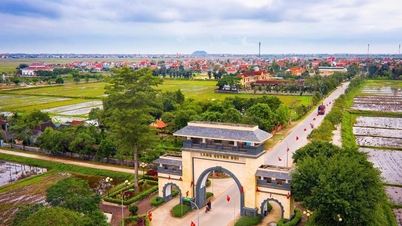
Thanks to that determination, the people of Son village donated nearly 1,000 m² of land, contributed 300 million VND and hundreds of man-days of labor to jointly build a new rural area. At the end of 2018, Son village became the first new rural village on the western border of the province.
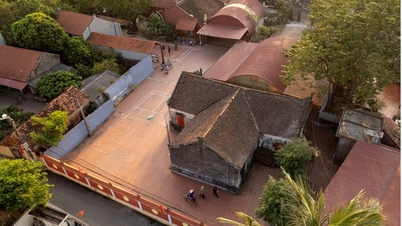
From this "opening shot," the new rural development movement has spread strongly along the border. According to statistics, to build 21 new rural villages in the border ethnic minority areas, people have contributed more than 7 billion VND and thousands of man-days to repair and upgrade roads, village gates, communal houses, and many other supporting facilities.
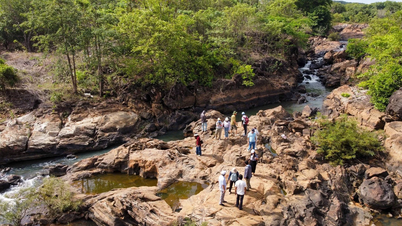
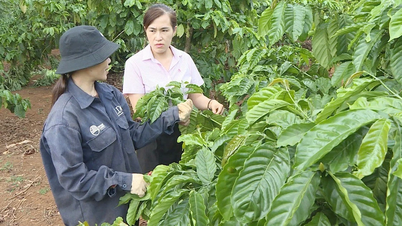
In these last days of August, traveling along the western border of the province, from patrol posts and production teams to villages, one can see the enthusiastic spirit of labor and production competition everywhere. New tiled houses are springing up, coffee and rubber plantations are lush green, and the lives of the people are improving day by day.
Source: https://baogialai.com.vn/bien-cuong-dat-am-tinh-nguoi-post565370.html


![[Photo] General Secretary and President To Lam receives Amazon's Senior Vice President David Zapolsky](https://vphoto.vietnam.vn/thumb/1200x675/vietnam/resource/IMAGE/2026/05/22/1779466547770_a1-bnd-3513-6601-jpg.webp)











![[Infographic] 8 key tasks to implement Resolution No. 2 of the 14th Central Committee on preventing and combating corruption, waste, and negative phenomena in the new period.](https://vphoto.vietnam.vn/thumb/402x226/vietnam/resource/IMAGE/2026/05/23/1779494812705_2_sua_ae609sss_1.jpeg)



























































Comment (0)