

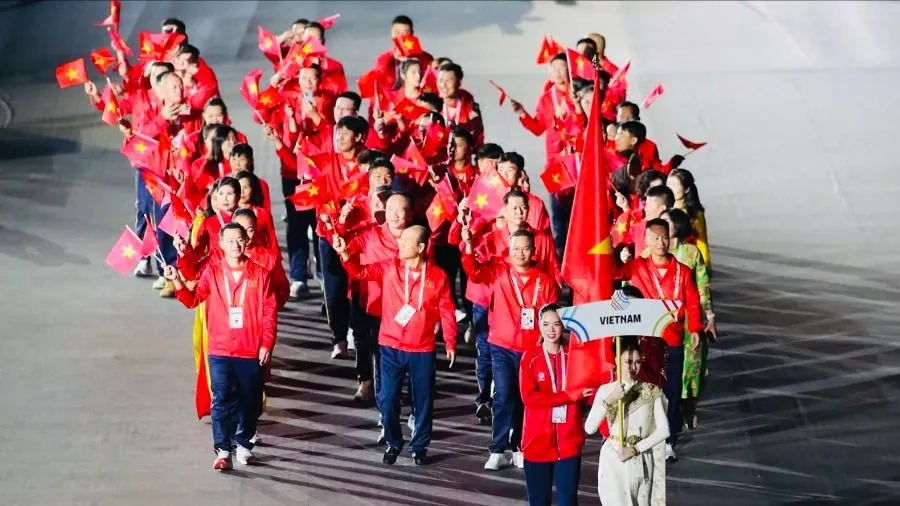
The program not only provides impetus for the growth of high-performance sports but also contributes to solving long-standing problems that have hindered sustainable development for many years.
Looking back at Vietnam's journey at the Asian Games, it's easy to see a worrying lack of consistency. At the 2018 Asian Games in Indonesia, the Vietnamese delegation peaked with 5 gold medals. But by the 2023 Asian Games in Hangzhou (China), that number had dropped to just 3 gold medals, barely meeting the minimum target in shooting, karate, and sepak takraw – sports with relatively limited mass popularity, making it difficult to increase the number of medals in the future.
Overall, at the Asian Games (ASIAD) from 2002 to the present, Vietnam's number of gold medals has fluctuated between 3 and 5 per edition, neither increasing nor decreasing significantly. Its position in the overall medal table compared to other Southeast Asian countries has also remained almost unchanged, with Thailand, Indonesia, and Malaysia still ahead. At the Olympic Games, from the silver medal won by taekwondo fighter Tran Hieu Ngan in 2000 to the remarkable gold medal in shooting by shooter Hoang Xuan Vinh, there were 16 years between the two, interspersed with a silver medal by weightlifter Hoang Anh Tuan in 2008. However, since 2016, almost a decade has passed without any further medals.
The reality is warning us: replicating past achievements is becoming increasingly difficult, and the time between generations is getting longer. This poses a significant challenge when considering the goals of reaching the top 15 in Asia or the top 50 in the world , as outlined in the "Program for the Development of Key Sports in Preparation for Participation in the ASIAD and Olympic Games 2030-2045".
In 2026, Vietnam aims for double-digit growth, creating momentum for a new era of national development. Sustainable economic growth is expected for decades. Per capita income will increase many times over. Urban infrastructure is transforming daily. We are building stadiums that meet World Cup hosting standards, and modern sports facilities on par with the region. The lives of the people, including those involved in elite sports, are significantly improving. In this context, achievements in the Olympic and Asian Games must undergo a strong transformation in both quantity and quality, while maintaining progress with each subsequent Games.
To achieve this, Vietnamese sports must shift from a mindset of "waiting for talent" to a mindset of "creating achievements" through a system-based approach. Stability in performance cannot be built on the backs of a few exceptional individuals; it must be ensured by the power of technology, modern management processes, and targeted investment.
That is why the key investment program not only sets performance targets but also emphasizes building a systematic system for selecting and training athletes; improving facilities and training equipment; applying science and technology, sports medicine; and most importantly, mobilizing financial resources outside the state budget.
From the perspective of many experts, once a clear plan for key sports is in place, it will provide a solid foundation for businesses and sponsors to confidently participate. A public-private partnership model can be expected, in which the State plays a facilitating role, creating the legal framework and investing in infrastructure and technology, while the private sector participates in sponsoring tournaments, providing benefits, and promoting the image of athletes.
The launch of the "Program for the Development of Key Sports in Preparation for Participation in the ASIAD and Olympic Games 2030-2045" is a long-term visionary decision that fundamentally addresses bottlenecks related to instability, confusion in socialization, and ineffective management from federations. The challenges ahead are immense, especially the problem of using resources efficiently. However, this pressure is significant enough to truly propel the sports sector forward, creating breakthroughs and writing new chapters in history at the ASIAD and Olympic Games in the coming decades.
Source: https://www.sggp.org.vn/chien-luoc-san-vang-cua-the-thao-viet-nam-post854001.html

![[Image] Hanoi's urban life under the challenge of a "scorching hot" environment](https://vphoto.vietnam.vn/thumb/1200x675/vietnam/resource/IMAGE/2026/05/25/1779706979265_nang-nong-t5-2026-minh-duy-7-4636-jpg.webp)



![[Image] Close-up view of the interchange connecting the two expressways and Long Thanh Airport.](https://vphoto.vietnam.vn/thumb/1200x675/vietnam/resource/IMAGE/2026/05/25/1779703378210_ndo_br_z7863716673926-224453a31600126cce10622af6290afd-4549-jpg.webp)












































































Comment (0)