

The transition from a pilot mechanism to a specialized law is an institutional leverage, creating a solid legal framework to maximize resources and meet the governance requirements of an integrated, coastal megacity like Ho Chi Minh City. For decades, the central government has always given Ho Chi Minh City special attention. This stems from its unique position: the largest city in the country, a center of economy , finance, science and technology, a hub for international exchange, and a location with strong influence.
This attention is reflected in Resolutions 20, 16, and 31 of the Politburo ; along with the system of special mechanisms in Resolutions 54, 98, and 260 of the National Assembly. After more than 3 years of implementing Resolution 31-NQ/TW, Ho Chi Minh City has achieved many important results.
However, the results achieved have not been commensurate with the potential. Institutionalization has been inconsistent; pilot mechanisms have yielded initial results but are limited in scale, short-term, and dependent on multiple levels of authority. The current context is very different. After the administrative boundary merger, Ho Chi Minh City now contributes 23.1% of GDP and nearly 30.2% of national budget revenue.
A massive, maritime-oriented economic entity cannot operate under an outdated system. A megacity needs a superior legal framework to remove all administrative barriers that are stifling innovation.
The core spirit of the new resolution is to realize the philosophy: The city for the whole country, and the whole country for the city. The enactment of a separate law with the principle of thorough decentralization and delegation of power represents a strategic investment in one of the nation's largest growth poles with significant spillover effects.
When freed from constraints by necessary autonomy and equipped with policy testing mechanisms, megacities will have the full legal tools to definitively resolve stalled projects and unlock frozen land resources. These freed resources will not only address the city's internal problems but also generate significant revenue that will be reinvested in the central government budget.
In response to the expectations of the Party and the State, Ho Chi Minh City is committed to action with a strong set of performance indicators. The city aims to maintain a minimum GRDP growth rate of 10% per year; and to have the digital economy account for 40% of GRDP by 2030. To achieve this, the megacity must be a pioneer in shifting its growth model to a knowledge-based economy, mastering semiconductor microchip technology, artificial intelligence, and operating a new generation international financial center.
The ultimate measure of a constructive institution lies not in dry growth indicators, but in touching upon the genuine happiness of the people. The overarching welfare axis of the new resolution is directed straight at addressing urgent social security projects: allocating budget to complete 200km of TOD urban railway before 2030, fundamentally resolving the flooding problem, and building social housing. A humanistic value of the city has been and is being implemented: free periodic health check-ups for all citizens and the creation of lifelong electronic health records.
The Party Committee, military, and people of Ho Chi Minh City have always carried within them a tradition of creativity and resilience in overcoming difficulties, always ready to lead the way. With a new and important resolution officially issued, the city named after the beloved President Ho Chi Minh is ready to embark on a new historical journey, striving for breakthroughs to develop to the level expected in the new era.
Source: https://www.sggp.org.vn/the-che-vuot-troi-de-sieu-do-thi-but-pha-post854413.html







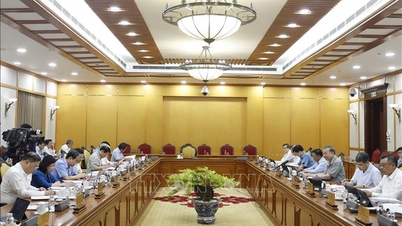

















![[Photo] General Secretary and President To Lam presides over the meeting to approve the draft report on the results of the second inspection by the Politburo of the Standing Committee of the Hanoi City Party Committee.](https://vphoto.vietnam.vn/thumb/1200x675/vietnam/resource/IMAGE/2026/05/26/1779789811432_a2-bnd-4430-9620-jpg.webp)






















































Comment (0)