

On the afternoon of May 26, Le Ngoc Linh, Deputy Director of the Ho Chi Minh City Department of Construction, announced that the department had submitted a report to the Ho Chi Minh City People's Committee on the results of implementing the Flood Control and Wastewater Treatment Project for the period 2020-2045, as stipulated in Decision 299/QD-UBND (Project 299).
The Department also proposed the development of a flood control and wastewater treatment plan for Ho Chi Minh City for the period 2026-2060, as directed by the Ho Chi Minh City Party Committee.
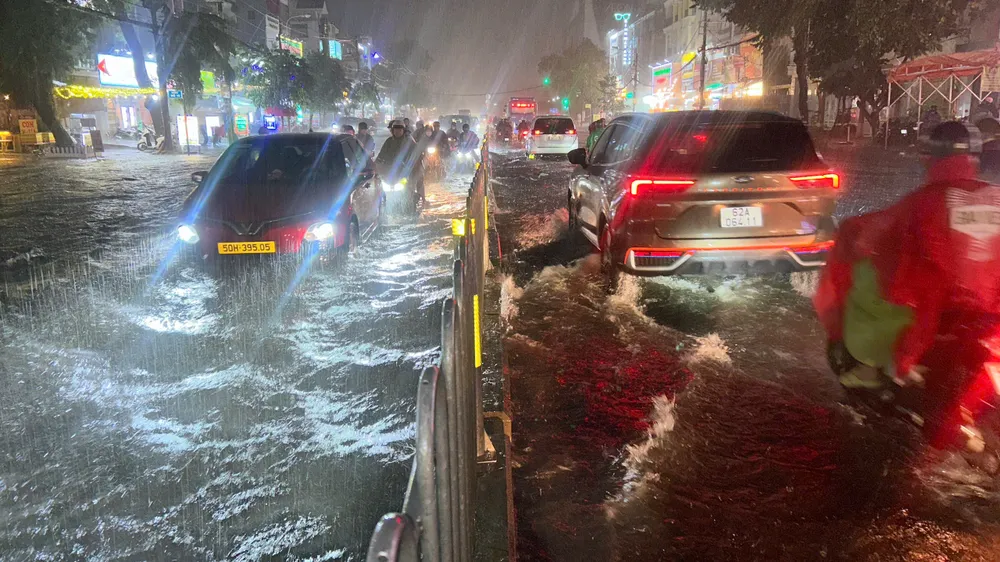
According to the Ho Chi Minh City Department of Construction, after nearly 5 years of implementation, Project 299 has achieved many positive results in flood reduction, tidal control, and wastewater treatment.
In the field of flood control due to rain, the city continues to maintain the trend of reducing the number of flooded roads. From 126 flooded roads in 2008, by the period 2021-2025, the city addressed an additional 5 roads including Tan Quy, Truong Cong Dinh, Ba Van, Bau Cat and Nguyen Huu Canh.
Regarding tidal flooding, the first phase of the Ho Chi Minh City flood control project, taking into account climate change, has reached approximately 93.33% of its construction volume. The project includes a system of river embankments and six large tidal control gates such as Ben Nghe, Tan Thuan, Phu Xuan, Muong Chuoi, Cay Kho, and Nha Be.
Upon completion, the project is expected to fundamentally address tidal flooding on 5 out of 7 main arterial roads in the southern and southwestern areas of the city.
In the field of wastewater treatment, the Binh Hung Wastewater Treatment Plant Phase 2 has been completed, increasing its capacity from 141,000 m³/day to 469,000 m³/day. Construction of the Nhieu Loc - Thi Nghe Wastewater Treatment Plant Phase 2 is also progressing rapidly.
The city has gradually applied digital technology in flood management. The FEDS online flood reporting platform, funded by the World Bank, has been put into operation, allowing for real-time updates of rainfall, tides, and flooding data. Simultaneously, a GIS drainage project funded by the British Consulate has begun to establish a spatial database to support the management of drainage infrastructure.
However, the implementation of Project 299 also revealed many limitations and was strongly affected by objective factors. Accordingly, climate change is becoming increasingly extreme with many rainfall events far exceeding the design capacity of the existing drainage system; tidal surges are constantly reaching new peaks; and serious land subsidence is occurring in many areas.
In addition, rapid urbanization, concrete construction, filling in ponds and lakes, and narrowing canals reduce the natural water infiltration and storage capacity, increasing the risk of flooding.
Notably, after Ho Chi Minh City merged with Binh Duong and Ba Ria - Vung Tau, the flood control problem shifted to a regional scale with many different characteristics, rendering the scope and objectives of Project 299 no longer appropriate.
The Ho Chi Minh City Department of Construction also acknowledged some subjective limitations such as an approach heavily focused on "eliminating flood hotspots," a lack of integrated risk management based on river basins; inconsistent investment between main infrastructure projects and collection systems; and insufficient attention paid to green infrastructure solutions, sponge cities, and flood adaptation.
Currently, the department is coordinating with relevant agencies and Dutch partners to finalize the Ho Chi Minh City Flood Control and Wastewater Treatment Project for the period 2026-2060, along with the implementation plan for the period 2026-2036.
At the same time, it is urgent to finalize the plan to address flooding in the period 2026-2030 and submit it to the Ho Chi Minh City People's Committee for promulgation in May 2026.
Source: https://www.sggp.org.vn/tphcm-xay-dung-de-an-chong-ngap-moi-post854514.html
![[Photo] General Secretary and President To Lam presides over the meeting to approve the draft report on the results of the second inspection by the Politburo of the Standing Committee of the Hanoi City Party Committee.](https://vphoto.vietnam.vn/thumb/1200x675/vietnam/resource/IMAGE/2026/05/26/1779789811432_a2-bnd-4430-9620-jpg.webp)














































































Comment (0)