

While many believe this approach could help reduce exam pressure and provide a more comprehensive assessment of the learning process, numerous concerns have also been raised regarding fairness, the risk of "beautifying" academic records, and the requirements for data management systems when changing the admission method.
A specific roadmap is needed.
This proposal quickly generated mixed opinions, especially given that the entrance exam for 10th grade has long been considered one of the most stressful milestones for students and their families.
According to many parents, in major cities like Hanoi and Ho Chi Minh City, the entrance exam for 10th grade in public high schools has consistently had a high competition rate over the years, becoming one of the exams that creates significant pressure on students and their families.
Accompanying his child in this year's 10th grade entrance exam, Mr. Pham Anh Tu (Cua Nam ward, Hanoi) said that not only students face pressure before this important exam, but parents also experience many worries while supporting their children.
"Under the immense pressure of the exam, parents go through a stressful period just as much as their children. During this time, the whole family has to adjust their daily routines, paying attention to their children's studies, health, and mental well-being so that they can enter the exam in the best possible state," Mr. Tú shared.
With two children in grades 4 and 9, Mr. Tú hopes that in the future, Hanoi will have appropriate solutions to reduce exam pressure, so that students in subsequent years will not have to endure too much stress during entrance exams to higher grades.
According to Mr. Tú, expanding the admission process from an entrance exam to grade 10 could significantly reduce pressure on students, especially for families with children preparing for the grade 10 entrance exam in the coming years.
"I think implementing an admissions process based on academic records would reduce some of the pressure of exams. However, a strict management mechanism is also needed to prevent the manipulation of academic transcripts, which would make the admissions process unfair," he shared.
Not only parents, but many students also believe that if an admissions process were used instead of an entrance exam, the pressure of studying and the stress before the 10th grade entrance exam could be reduced. According to them, assessment based on the learning process could also more comprehensively reflect students' abilities instead of relying on the results of a single exam.
Regarding the proposal to expand the admission process to include selection based on academic records instead of entrance exams for 10th grade, Le Ngoc Bich Tram, an 8th-grade student at Nguyen Du Secondary School , believes that the academic pressure on students could be significantly reduced if this option is implemented.
According to the female student, the admissions process not only helps students reduce stress from a single exam but also encourages them to maintain consistent academic performance across multiple subjects throughout their studies.
"The admissions process also forces students to study all subjects equally to gain an advantage, avoiding the situation of focusing on only certain subjects or dividing their studies into main and minor subjects," Tram shared.
However, the female student also believes that this format still has points that need consideration, especially regarding students' opportunities for advancement in their final year of high school.
"Considering academic transcripts helps reduce pressure on students, but it can also deprive many of them of the opportunity to strive for better results. Some students may not have high academic results in their early years, but they can still work hard in their final year to achieve good results in the exam. If only academic transcripts are considered, this opportunity might be missed," Tram said.
According to the female student, the advantage of evaluating academic transcripts is that it assesses the entire learning process instead of just relying on the results of a single exam. However, if there are changes to the admission method, a specific roadmap is needed to allow students time to adapt and plan early on.
"I think if it's going to be implemented, it should be for students starting 6th grade this year to avoid causing confusion among middle school students who are currently following the current curriculum," the female student expressed.

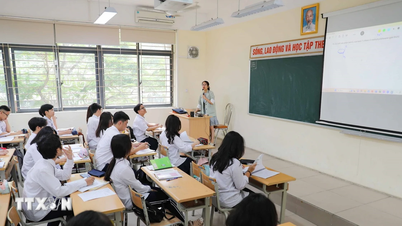
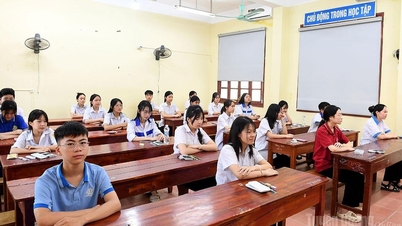
Ninth-grade students are reviewing and preparing for the entrance exam to high school.
Anti-fraud "filter"
Regarding this issue, Dr. Hoang Ngoc Vinh, former Director of the Department of Professional Education, Ministry of Education and Training , commented that abolishing the entrance exam for 10th grade in public schools is not just a mechanical change in admissions, but the most rigorous test of data management capacity and social trust.
"When the provincial-level exam is removed as a common measure, the decentralized measurement system for thousands of secondary schools poses a major challenge in ensuring fairness. The current technological infrastructure is fully capable of storing and linking data from grades 1 to 9, but the crucial issue is the integrity of that data," Dr. Vinh emphasized.
According to experts, the system must transform its governance by digitizing and locking data in real time. Scores must be entered into a common system immediately after the exam, and all edits must be tracked and accounted for, eliminating the practice of falsifying high school transcripts.
At the same time, a standardized assessment must be conducted using the Department of Education and Training's common question bank. If the score distribution of any institution's regular assessment is unusually high compared to the overall exam score, the algorithm will automatically alert the inspectors, Dr. Vinh proposed.
Regarding concerns about cheating and falsifying academic records if admissions were to replace entrance exams with a selection process, Dr. Hoang Ngoc Vinh argues that the data from the past nine years of study constitutes a multi-dimensional academic record documenting genuine skills, thinking abilities, and maturity.
"The evaluation process, spanning nine years of schooling, is the most natural and effective 'filter' against cheating. No family has the resources to manipulate records or interfere with dozens of different teachers over such a long period," he asserted.
Accordingly, the pressure from "one-time, all-or-nothing" exams will gradually be reduced, replaced by the motivation to develop genuine learning abilities. A continuous assessment mechanism involving multiple stakeholders will also help limit the impact of subjective factors or personal biases. The focus of competition will then shift back to core values: students must strive to improve themselves daily, because knowledge gaps or temporary coping mechanisms are difficult to conceal in a long-term, transparent, and verifiable assessment process.
According to him, shifting from a grading-heavy approach to a process-based assessment is a step in line with the competency-based development orientation of the 2018 General Education Program. Monitoring students over a long period not only reflects learning outcomes at a single point in time but also helps to more fully identify each student's abilities, qualities, and potential, thereby creating fairer opportunities for future career guidance.
"Abolishing the 10th-grade exam and switching to a whole-cycle competency assessment, if implemented correctly, would actually be the most sustainable tool for protecting educational equity," Dr. Vinh emphasized.
Furthermore, this approach reduces the advantages of rote learning or intensive exam preparation, shifting the focus of competition back to genuine ability and the sustained effort of students. This allows families to shift their spending away from short-term investments towards supporting their children's holistic development.
"Although opportunities to enter public schools remain competitive, the nature of the competition will change, from competition based on the results of a single exam to competition based on the accumulation of knowledge, skills, and long-term development," said Dr. Vinh.
Source: https://phunuvietnam.vn/bo-thi-vao-lop-10-cong-lap-cuoc-dua-co-thuc-su-ha-nhiet-238260521164059289.htm




![[Photo] First session of the 14th Congress of the Vietnam Trade Union](https://vphoto.vietnam.vn/thumb/1200x675/vietnam/resource/IMAGE/2026/06/03/1780465947883_ndo_br_img-3852-jpg.webp)


























































![[Video] Sunset at Lap An Lagoon – Where the sun sets over the fishing nets](https://vphoto.vietnam.vn/thumb/1200x675/vietnam/resource/IMAGE/2026/05/31/1780192137701_beach-landscape-sea-water-nature-grass-745871-pxhere-com.jpeg)








































Comment (0)