

The house is next to the school, but the system suggests studying further away.
Hanoi's pilot implementation of an online primary school enrollment system using GIS digital maps in the 2026-2027 school year is considered a significant step in the digital transformation of education , aiming to increase transparency in enrollment and facilitate students' access to education near their residences.
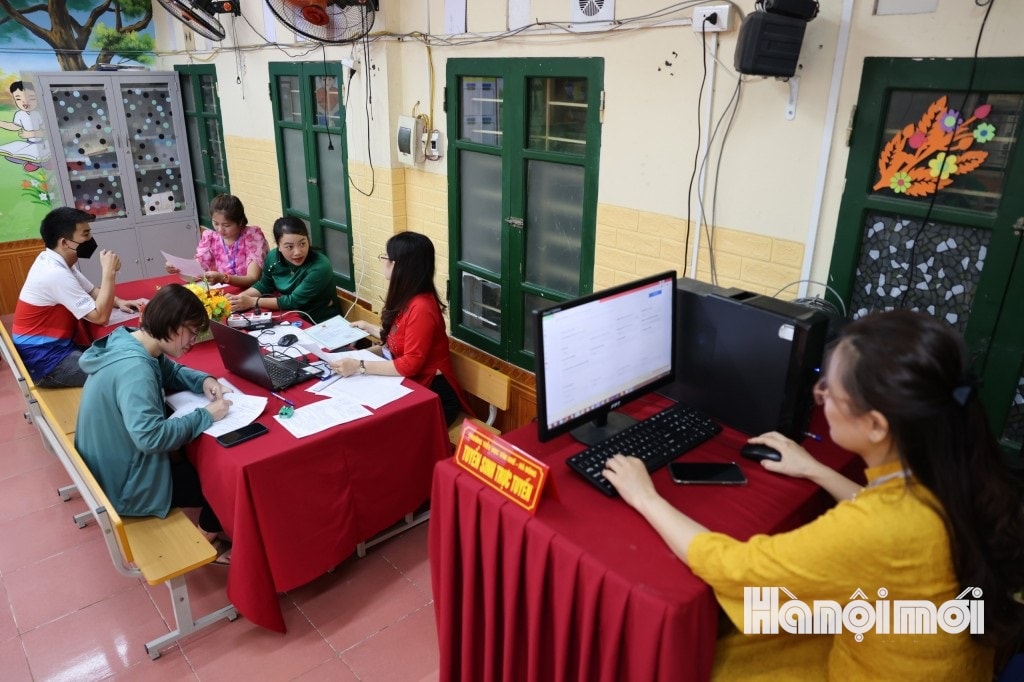
However, during the initial trial period, some parents experienced inaccurate location tracking, leading to anxiety as the school's location displayed on the system did not reflect the actual distance from their residence.
Ms. Dang Hoai Thu, whose child is about to enter 6th grade in Ha Dong ward, said that her family lives in building CT2 Xuan Mai, in residential group 1 To Hieu, right next to Ha Dong Secondary School. However, when logging into the trial enrollment system, the GIS map suggested Le Hong Phong Secondary School instead.
"I'm quite worried because it only takes a few minutes to walk from my house to Ha Dong Secondary School. Meanwhile, the school suggested by the system is much further away, requiring crossing a major road and many busy traffic routes. If my child attends that school, an adult will be required to drop him off and pick him up," Ms. Thu shared.
Not just the above case, Ms. Nguyen Thi Xuan, from Group 1, Kien Hung Ward, said that her family lives very close to Kien Hung Primary School, but when checking the GIS digital map system, her child was assigned to Phu La Primary School, which is more than 2km away. According to the reporter's investigation, a similar situation occurs with many students in residential groups 1 to 8 of Kien Hung Ward, where the system consistently shows them assigned to schools further away than their actual residences.
In areas like Duong Noi, Nghia Do, and some new urban areas in Hanoi , many parents have also reported inaccurate residential location data or incomplete address data updates on the system, leading to school suggestions that do not accurately reflect students' travel distances.
In the context of primary school enrollment in Hanoi, which always receives great public attention, even small discrepancies in data can easily cause concern among parents. For many families, having their children attend a school near home is not only convenient for drop-off and pick-up but also directly impacts daily routines, transportation costs, and traffic safety for students.
The testing phase aims to review and refine the data.
In response to feedback from parents, Mr. Nghiem Van Binh, Head of the Examination Management and Educational Quality Assurance Department of the Hanoi Department of Education and Training, affirmed that the current operation is only a trial phase aimed at helping parents familiarize themselves with the online registration process, and at the same time allowing relevant agencies to check, review, and finalize the data before officially implementing the enrollment process.
According to the instructions from the Hanoi Department of Education and Training, parents access the enrollment portal at “tsdaucap.hanoi.gov.vn”, select the appropriate grade level, and complete the steps to declare student information, check residence data, and view the school displayed on the GIS map.
Mr. Nghiem Van Binh noted that all data during the current testing period is for technical verification purposes only and does not constitute official enrollment results. After each operational phase, the system will continue to be reviewed, updated, and adjusted to ensure the highest accuracy before the official registration period.
The Hanoi Department of Education and Training also requested schools and the People's Committees of communes and wards to assign staff to support parents; receive, compile, and promptly handle errors related to residential data, school zoning, GIS maps, and online registration procedures.
According to guidelines from the Hanoi Department of Education and Training, if parents discover inaccuracies in their residential information or distance to school, they should calmly re-check all the declared data.
Specifically, parents need to verify that the residential address has been accurately synchronized with the population database and the VNeID application; double-check the house number, apartment building name, neighborhood, ward, and commune during the information entry process; and directly compare the location displayed on the GIS map.
In case of any discrepancies, parents should immediately contact the graduating school or the People's Committee of the ward or commune where they reside for assistance in updating and correcting the data.
Representatives from the Hanoi Department of Education and Training also emphasized that parents should not be overly concerned if the system experiences errors in the initial stages of operation, as the city will conduct three trial periods before the official enrollment period.
“This is just the first trial run. Any errors will be reviewed and adjusted in subsequent operations. The principle for student enrollment in the 2026-2027 school year remains to provide the most convenience for students, prioritizing schools near their actual residences, in line with the goal of bringing schools closer to students,” Mr. Nghiem Van Binh stated.
The second online registration trial period is from June 8th to June 10th; the third online registration trial period is from June 15th to June 17th.
The official enrollment period will begin on July 1, 2026, on the city's primary school enrollment portal.
Source: https://hanoimoi.vn/tuyen-sinh-dau-cap-bang-gis-o-ha-noi-phu-huynh-can-lam-gi-khi-bi-dinh-vi-sai-1142536.html


![[Photo] General Secretary and President To Lam presides over a meeting with the Central Organizing Committee.](https://vphoto.vietnam.vn/thumb/1200x675/vietnam/resource/IMAGE/2026/06/03/1780482764658_a1-bnd-4741-3342-jpg.webp)
![[Photo] Secretary of the National Assembly Party Committee, Chairman of the National Assembly presides over the meeting of the Standing Committee and Executive Committee of the National Assembly Party Committee.](https://vphoto.vietnam.vn/thumb/1200x675/vietnam/resource/IMAGE/2026/06/03/1780480353201_ndo_br_bnd-2585-jpg.webp)

![[Photo] First session of the 14th Congress of the Vietnam Trade Union](https://vphoto.vietnam.vn/thumb/1200x675/vietnam/resource/IMAGE/2026/06/03/1780465947883_ndo_br_img-3852-jpg.webp)























































![[Video] Sunset at Lap An Lagoon – Where the sun sets over the fishing nets](https://vphoto.vietnam.vn/thumb/1200x675/vietnam/resource/IMAGE/2026/05/31/1780192137701_beach-landscape-sea-water-nature-grass-745871-pxhere-com.jpeg)






































Comment (0)