


Empowering the grassroots level
When Hanoi began implementing the two-tiered local government model, many grassroots officials expressed concern about the anticipated increase in workload. This was because, along with the reorganization of administrative units, communes and wards would take on many more tasks and responsibilities that previously belonged to intermediate levels.
After the district level was abolished in the new organizational model, the commune and ward levels became the direct level for resolving many issues arising from people's lives. They have a larger administrative area, a larger population, and require faster processing of tasks, while many officials have to familiarize themselves with entirely new fields. However, this very pressure also creates the impetus for the system to transform in a more proactive direction.
In Linh Nam ward – one of the most densely populated areas in the former Hoang Mai district – the first year of operating the new model was identified as a phase of both stabilizing the organization and perfecting the management methods. Thousands of tasks arising from urban management, social welfare, administrative reform, and digital transformation were reviewed and reassigned, with clear responsibilities and increased autonomy for each department.
According to Nguyen Van Duc, Deputy Secretary of the Party Committee and Chairman of the People's Committee of Linh Nam Ward, the workload has increased significantly since the implementation of the two-tiered local government model. However, the advantage is that many issues are more strongly decentralized and empowered, allowing the locality to proactively resolve issues at the grassroots level instead of having to seek approval from multiple levels as before.
"We have determined that we must enhance the accountability of leaders, promote the application of information technology, and ensure seamless coordination between departments to guarantee that all tasks are handled promptly and without affecting the public," Mr. Nguyen Van Duc shared.
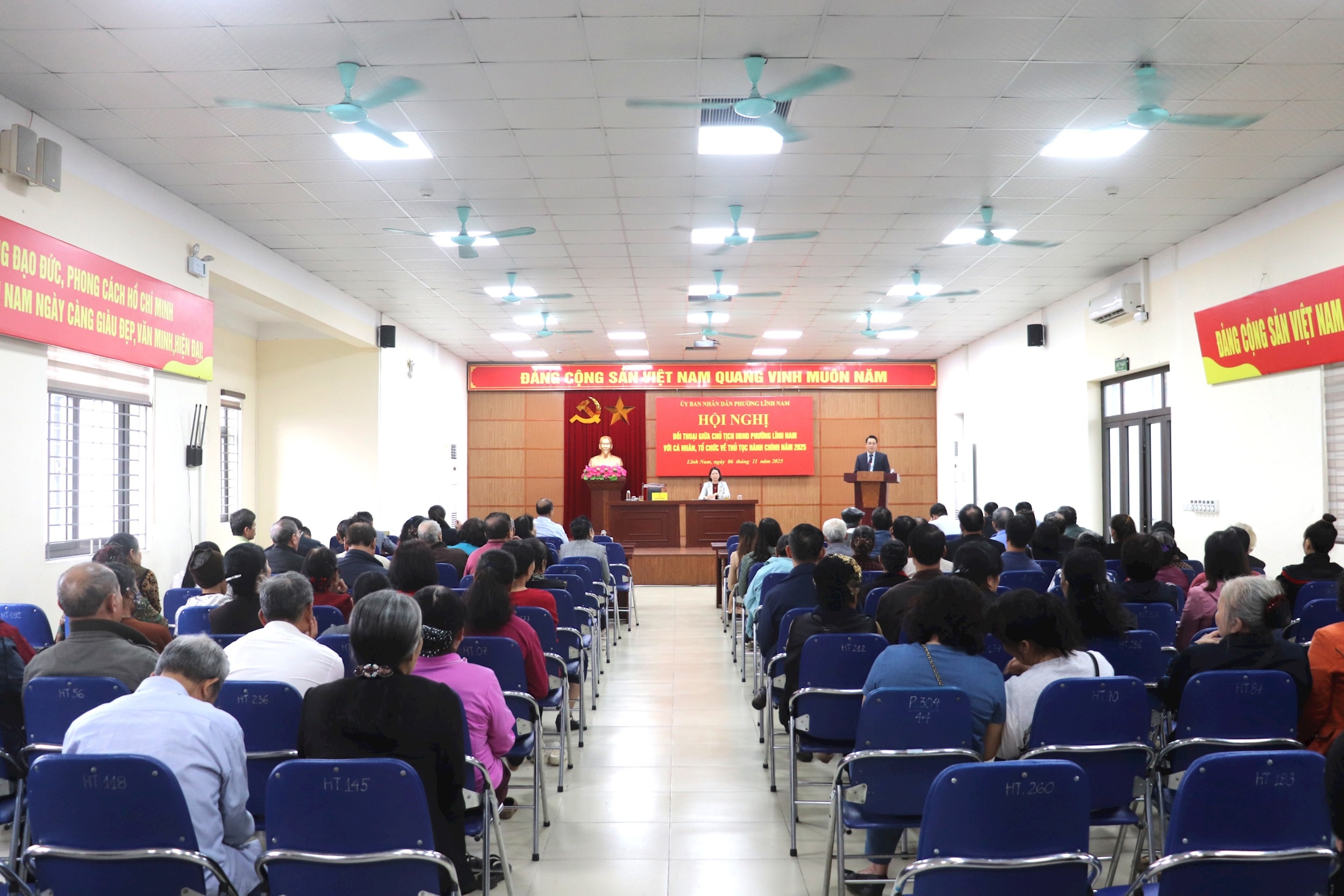
Regarding administrative procedures. Photo: Hien Chi
According to a report by the Hanoi City Public Administrative Service Center, decentralization and delegation of authority have been strongly implemented, covering 659 administrative procedures through 11 different forms of delegation. As a result, the processing time for many procedures has been shortened by 3 to 5 days, contributing to a saving of approximately 571,925 working hours, equivalent to over 63.4 billion VND.
Previously, many procedures had to be processed through multiple levels, but now most are resolved at the location closest to the people. This not only reduces waiting times but also enhances the accountability of local authorities in handling matters.
Along with decentralization, Hanoi has also undertaken a strong restructuring of administrative processes. A total of 897 restructuring plans have been implemented for 1,103 administrative procedures, focusing on the group of procedures with the largest volume of applications, accounting for approximately 81% of the total application volume citywide. The mindset of "requiring citizens to provide documents" is gradually being replaced by a mindset of "leveraging existing digital data," significantly reducing compliance costs for citizens and businesses.
Another noticeable change is the streamlining of the administrative apparatus. Instead of organizing 126 public administrative service centers in communes and wards as in the old plan, the city has switched to a centralized model with 12 branches. This helps reduce hundreds of intermediate leadership positions while improving the efficiency of human resource utilization.
The efficiency in processing applications also shows clear improvements. In 2024, when application processing was still fragmented across multiple points, the average efficiency was approximately 118 applications per person per month. By April 2026, after implementing the centralized model, this number had increased to 366 applications per person per month, more than three times higher than before.
Improve service quality
Previously, administrative procedures in Hanoi were hampered by a large amount of paper documents, a low rate of digitalization, and the need for citizens to make multiple trips for certain procedures. After a year of implementing the two-tiered local government model, coupled with synchronized digital transformation, the quality of reforms has seen many positive changes.
According to the Hanoi City Public Administration Service Center, the city currently has 2,075 administrative procedures implemented uniformly on the system, of which more than 1,120 procedures are eligible for full-process online public service delivery. All administrative procedures are publicly available on the digital environment and connected to the National Public Service Portal. In the first four months of 2026, more than 918,000 applications were processed on time or ahead of schedule, achieving an almost perfect rate.

In particular, Hanoi's index for serving citizens and businesses has seen a spectacular improvement. From 61.18 points in 2024, ranking 60th out of 63 provinces and cities, this index increased to 91.68 points in 2025 and reached 95.64 points in the first months of 2026, ranking 3rd out of 34 provinces and cities.
According to Phan Van Phuc, Director of the Hanoi City Public Administrative Service Center, the most important achievement after a year of operation is the establishment of a unified public administrative service system throughout the city. Standardized processes, digitized data, and interconnected systems help reduce processing time, lower social costs, and enhance transparency. Citizens can access public services more conveniently, while government agencies improve their management and operational efficiency.
Along with streamlining procedures, Hanoi is focused on building an ecosystem to serve citizens in the digital environment. The iHanoi platform currently has nearly 6 million accounts, recording approximately 186 million visits and receiving over 107,000 feedback and suggestions from citizens. These feedbacks are categorized and processed centrally, contributing to the formation of a direct interaction channel between the government and the people.
Ms. Le Thi Phuong (Bach Mai ward) said: "I find that compared to before, carrying out administrative procedures is much more convenient. The application process is clearly guided, the processing time is faster, and I can track the progress on my phone without having to travel as much as before."
Despite the achievements, the new model still faces difficulties and challenges that need to be addressed in order to become even more perfect.
According to assessments from various units, the biggest challenge currently is the lack of synchronization between some specialized regulations and the requirements for operating in a digital environment. Some specialized information systems of central ministries and agencies are not fully compatible with Hanoi's decentralization and delegation mechanisms. In addition, the information technology infrastructure still needs further upgrading to meet the increasing volume of transactions…
Based on practical experience, the Hanoi City Public Administrative Service Center recommends that the Government and relevant ministries and agencies promptly finalize the legal framework for the one-stop and integrated one-stop mechanisms; continue to expand decentralization and delegation of authority while maintaining control in the digital environment; improve regulations on processing non-geographical dossiers; and promote data connectivity and sharing between systems.
A year is not a long time to comprehensively assess a major reform. However, initial results show that the two-tiered local government model is gradually proving effective. Hanoi will soon evaluate the implementation results, difficulties, and obstacles encountered in operating the new model to create an administration that is increasingly closer to the people, more transparent, and more efficient in the future.
Source: https://hanoimoi.vn/hieu-qua-buoc-dau-cua-mo-hinh-moi-1157194.html

![[Photo] First session of the 14th Congress of the Vietnam Trade Union](https://vphoto.vietnam.vn/thumb/1200x675/vietnam/resource/IMAGE/2026/06/03/1780465947883_ndo_br_img-3852-jpg.webp)


![[Photo] General Secretary and President To Lam presides over a meeting with the Central Organizing Committee.](https://vphoto.vietnam.vn/thumb/1200x675/vietnam/resource/IMAGE/2026/06/03/1780482764658_a1-bnd-4741-3342-jpg.webp)
![[Photo] Secretary of the National Assembly Party Committee, Chairman of the National Assembly presides over the meeting of the Standing Committee and Executive Committee of the National Assembly Party Committee.](https://vphoto.vietnam.vn/thumb/1200x675/vietnam/resource/IMAGE/2026/06/03/1780480353201_ndo_br_bnd-2585-jpg.webp)

























































![[Video] Sunset at Lap An Lagoon – Where the sun sets over the fishing nets](https://vphoto.vietnam.vn/thumb/1200x675/vietnam/resource/IMAGE/2026/05/31/1780192137701_beach-landscape-sea-water-nature-grass-745871-pxhere-com.jpeg)







































Comment (0)