

Commander of the Campaign - General Van Tien Dung
Having been tempered in practice before the August Revolution of 1945 and the resistance war against French colonialism (1945-1954), during the resistance war against the US, Comrade Van Tien Dung was directly entrusted with leading many major campaigns. In early 1975, the Chief of Staff of the Vietnam People's Army, Van Tien Dung, was sent by the Politburo and the Central Military Commission to the battlefield to directly lead the Central Highlands Campaign, achieving resounding victories and creating a breakthrough opportunity to accelerate the liberation of the South and the reunification of the country.
In early April 1975, General Van Tien Dung was again assigned to command the Ho Chi Minh Campaign . In accordance with the strategic resolve of the Politburo and the Central Military Commission, the campaign command determined that this was the final strategic decisive blow, ending the war and achieving a swift and decisive victory. Therefore, it was necessary to concentrate forces and technical equipment, unleash combined strength, create an overwhelming advantage to quickly destroy and disperse all enemy forces, liberate Saigon, and create conditions for the complete liberation of the South. Before making the decision, General Van Tien Dung pondered over how to attack Saigon quickly and decisively, to collapse the puppet army and government, but how to attack Saigon with the least amount of casualties was a difficult problem.
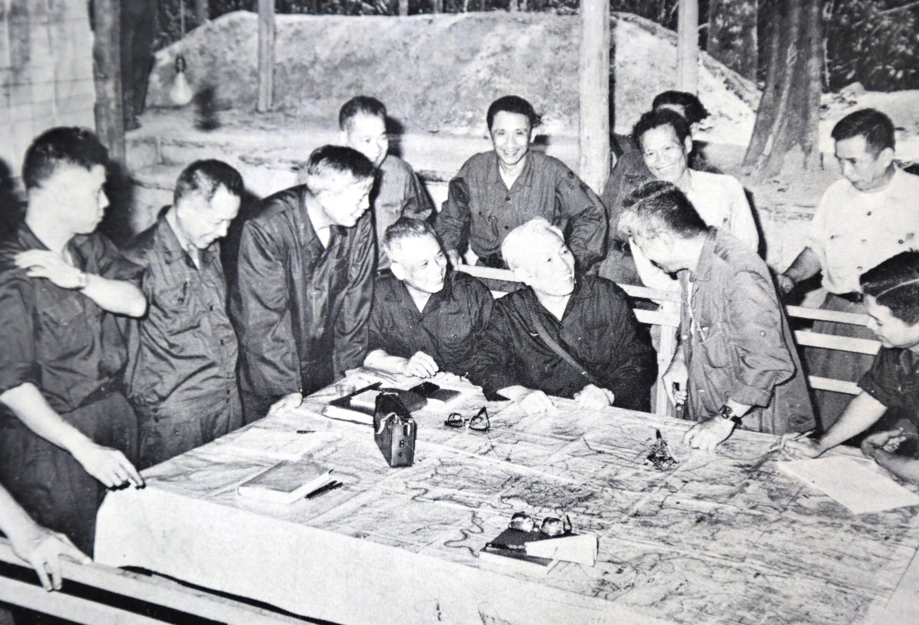 |
Party leaders and comrades in the Ho Chi Minh Campaign Command (April 1975). Archival photo. |
After careful study, discussion, and exchange of ideas, General Van Tien Dung and the campaign command found the optimal plan, selecting key enemy targets to quickly seize. The proposed strategy was: Use an appropriate portion of our forces in each direction, sufficient to encircle, divide, and block the enemy's retreat to Saigon; destroy and disperse the enemy's main infantry divisions defending the outer perimeter; and simultaneously, use the majority of our forces to quickly penetrate and seize key areas in the suburbs, paving the way for the well-organized, highly mechanized assault divisions to advance rapidly along major roads, striking directly at the five selected targets within the city: the puppet regime's General Staff Headquarters, the Independence Palace, the Capital Special Zone, the General Police Headquarters, and Tan Son Nhat Airport. Special forces, commando units, armed security forces and city self-defense forces, and mass political forces in Saigon-Gia Dinh will seize bridges across rivers first, using them as springboards for the main army to advance, guiding units, eliminating traitors, and inciting mass uprisings.
Under the leadership of Comrade Van Tien Dung, the Campaign Command developed a plan for a mass uprising to closely coordinate with the military offensive. The main attacking force formed five columns, each equivalent to a corps, commanded by talented generals. Notably, the five columns advanced from five directions to encircle the enemy's headquarters in Saigon-Gia Dinh; many units had to move rapidly from various locations, departing at different times, traveling along different routes, and handling different attack scenarios to open the way... but General Van Tien Dung, along with his comrades in the Campaign Command, calculated and directed everything in a unified manner so that all units could march to Saigon in time and successfully carry out the campaign, liberating the South.
SON BINH
--------------
Political Commissar Pham Hung - the man who kept the "lifeblood" alive on the battlefield.
On the morning of April 30, 1975, on the radio, the puppet president Duong Van Minh proposed a ceasefire for negotiations with the Liberation Army. Comrade Pham Hung, Political Commissar of the Ho Chi Minh Campaign, immediately sent an urgent telegram to units on the battlefield: The enemy is wavering and disintegrating. All units should attack strongly and advance quickly to seize their designated targets. Regroup at the Independence Palace. The enemy has nothing left to negotiate or hand over. They must surrender unconditionally. Advance! Complete victory!
The victory of the resistance war against the US, for national salvation in general, and the Spring 1975 General Offensive and Uprising in particular, owed a great deal to Comrade Pham Hung's contributions. In 1967, Pham Hung, a member of the Politburo and Deputy Prime Minister, was assigned by the Politburo to be the Secretary of the Central Bureau for the South and Political Commissar of the Southern Liberation Army. Comrade Pham Hung, together with the Central Bureau, directed the development of revolutionary forces; and intensified the three prongs of attack (political, military, and troop mobilization) throughout the South...
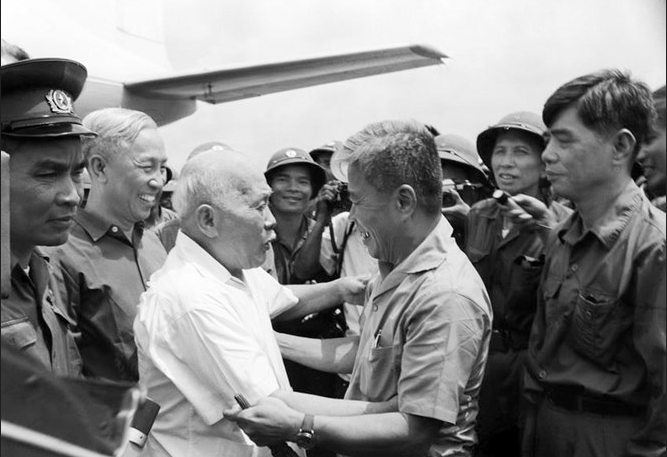 |
| Comrade Pham Hung, member of the Politburo and Secretary of the Southern Party Committee, welcomes President Ton Duc Thang at Tan Son Nhat Airport on May 13, 1975. Photo: VNA |
After the Paris Agreement was signed (January 1973), without any illusions about the enemy, firmly grasping the ideology of revolutionary violence, the ideology of offensive and continuous offensive, Secretary Pham Hung directed the forces to intensify political struggle, military mobilization, and military offensives throughout Southern Vietnam, contributing to bringing the revolution in the South into a new phase: the phase of creating momentum, strength, and opportunities for the general offensive. At the end of August 1974, Comrade Pham Hung and the Central Committee of the Southern Region, the Military Commission of the Southern Region, sent to Hanoi the operational plan for the 1974-1975 dry season, determined to achieve a decisive victory and complete the liberation of Southern Vietnam within two years, 1975-1976.
To gain momentum and strength, our forces decided to launch the Route 14-Phuoc Long Campaign. Secretary Pham Hung and Commander-in-Chief of the South Vietnam Liberation Army Tran Van Tra reported to First Secretary Le Duan and General Vo Nguyen Giap, Commander-in-Chief, that the 4th Corps should use tanks and 130mm artillery to attack Phuoc Long town. On January 6, 1975, Phuoc Long was liberated. The victory at Phuoc Long signaled the weakening of the puppet army, and the Politburo formulated a strategic plan for the liberation of South Vietnam.
On April 8, 1975, Comrade Pham Hung was assigned by the Politburo to be the Political Commissar of the Saigon-Gia Dinh Liberation Campaign. In accordance with the wishes of the cadres, soldiers, and people, Political Commissar Pham Hung, along with the Campaign Command, subsequently proposed to the Politburo that the Saigon-Gia Dinh Liberation Campaign be named the Ho Chi Minh Campaign.
To complete the task of liberating South Vietnam in April 1975, Political Commissar Pham Hung and the Campaign Command held a meeting to discuss the determination and specific operational plans, emphasizing the combination of military offensives with mass uprisings; determining the targets to be attacked and the operational methods of the campaign, with the highest requirement being the rapid liberation of Saigon and the preservation of the city intact. In his capacity as Secretary of the Central Committee of the Southern Region, Comrade Pham Hung, along with the Central Committee, directed the coordinated activities of localities throughout the region. In Saigon-Gia Dinh, Comrades Nguyen Van Linh and Vo Van Kiet were assigned to lead and direct the preparation and mobilization of mass uprisings, especially leading and commanding special forces, commando units, local armed forces, and coordinating mass organizations...; simultaneously, they directed the city's activities immediately after the liberation of Saigon-Gia Dinh.
During the Ho Chi Minh Campaign, Political Commissar Pham Hung closely monitored the battlefield to direct ideological work, build and promote the spirit of offensive action, unity and cooperation; implement policies on civilian mobilization and policies regarding prisoners of war; and prepare personnel and operational plans for the Military Governing Committee when the city was liberated. From April 26, 1975, he, along with Commander Van Tien Dung, organized and commanded the troops to launch a swift offensive into the inner city of Saigon, quickly capturing important targets. The Ho Chi Minh Campaign achieved complete victory at noon on April 30, 1975.
Major General, Associate Professor, Doctor Vu Quang Dao (former Director of the Institute of Military History)
------------
Deputy Commander of the Campaign Le Duc Anh
Comrade Le Duc Anh, a staunch communist and a seasoned general, was always present on the fierce battlefields during critical times, participating in many major battles that contributed to turning points in the national liberation struggle. During the Ho Chi Minh Campaign, Comrade Le Duc Anh served as Deputy Commander of the campaign and Commander of the Southwestern Army Corps, one of the five main attack directions in the final strategic battle for Saigon. With his courage and experience gained from practical combat, he participated in planning and directly commanded the operation, successfully completing his assigned tasks and contributing to the liberation of the South and the reunification of the country.
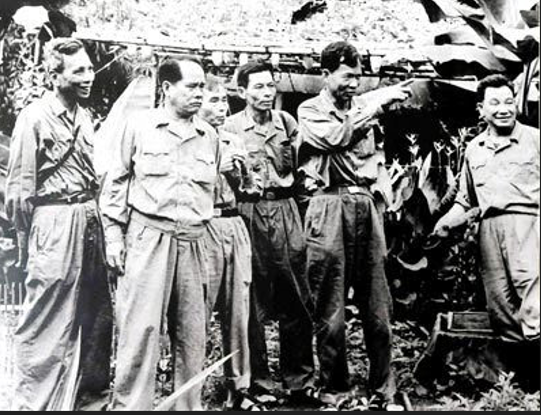 |
Comrade Le Duc Anh (second from the right) and members of the Regional Command at Ta Thiet base, Loc Ninh, Song Be. Archival photo. |
The Southwestern Wing Corps was established under the command of Lieutenant General Le Duc Anh (Six Nam), comprising: the 232nd Regiment (5th Division, 3rd Division, 16th Regiment, artillery, tank, communications, and engineering units), supplemented by the 9th Division, 271B Regiment, two main regiments of Military Region 8 (24, 88), one tank battalion, one 130mm artillery battalion, six anti-aircraft guns, and several other technical units.
Given the unique characteristics of the battlefield, primarily consisting of rivers, swamps, and a complex network of canals, making troop movements difficult and unsuitable for large-scale, concentrated attacks, the enemy concentrated a force of 10 infantry divisions, 8 commando regiments, 11 armored regiments, 33 artillery battalions, and 3 air force divisions, commanded by General Nguyen Khoa Nam, Commander of the 4th Corps and the 4th Tactical Zone of the puppet regime. Comrade Le Duc Anh advocated organizing an attack formation that included heavy units such as tanks and artillery. He instructed artillery units to dismantle parts of their cannons and load them onto boats and small boats to cross the Dong Thap Muoi River; he also ordered tank units to seal any exposed parts of their vehicles so they could march along the canal banks and down the Vam Co River to their assembly point.
On April 26, 1975, the Ho Chi Minh Campaign commenced. On the Southwest front, Commander Le Duc Anh led the Army Corps, along with local armed forces, in fighting to block and cut off National Highway 4, attacking Hau Nghia, Duc Hoa, Duc Hue, Tan An, and Thu Thua districts. On April 28, 1975, units of the Southwest Army Corps attacked the direct defense line of Saigon, capturing several targets, cutting off all water and land transportation routes, and completely isolating Saigon. On April 30, the Southwest Army Corps launched a general offensive into the inner city. At 11:00 AM that same day, units of the Army Corps planted the liberation flag on the roofs of the Capital Special Zone, the General Police Headquarters, the Long An Provincial Governor's Residence, and other bases. Several of the Army Corps' deep penetration units advanced and converged with other units at the Independence Palace.
Under the command of Lieutenant General Le Duc Anh, the Southwestern Army Corps successfully completed its mission in the Ho Chi Minh Campaign, not only successfully carrying out the strategic task of cutting off Saigon from the Southwestern region but also launching a decisive attack from the rear into the Saigon puppet army's defense system, which was the final blow that thwarted the Saigon regime's plan to "fight to the death".
NGUYEN NGOC TOAN
--------------
Deputy Commander of the campaign Le Trong Tan
Comrade Le Trong Tan is considered one of Vietnam's most skilled military commanders; he was the first division commander at the young age of 36, having led numerous campaigns in the resistance wars against French colonialism and American imperialism. In particular, in 1972, as Commander of the Tri Thien Campaign, Comrade Le Trong Tan and the campaign command successfully completed their mission, liberating Quang Tri province and several localities in Thua Thien Hue province, creating a new strategic advantage for the revolution and contributing to forcing the US imperialists to sign the Paris Agreement on ending the war and restoring peace in Vietnam. In the Hue-Da Nang Campaign (March 1975), Commander Le Trong Tan led the forces to a resounding victory, crushing the enemy's strategic consolidation plan and creating favorable conditions for our army and people to concentrate their forces for the final strategic offensive to liberate the South.
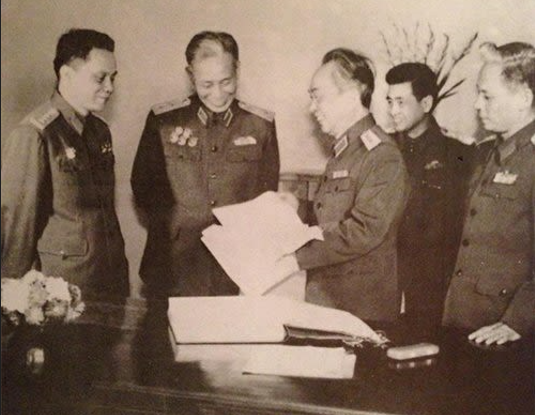 |
| Comrade Le Trong Tan (second from the left) and General Vo Nguyen Giap, along with several other officials, discuss work matters. (Archival photo) |
During the Ho Chi Minh Campaign, Comrade Le Trong Tan was the Deputy Commander of the campaign, directly commanding the eastern and southeastern flanks, comprising the 2nd and 4th Corps... On the southeastern flank of the campaign, the 2nd Corps was attached to the 3rd Division (Military Region 5), coordinating with special forces and the armed forces of Vung Tau town to destroy enemy forces, capture the Nuoc Trong base, Long Binh sub-district, Long Binh base, Nhon Trach sub-district, Tuy Ha citadel - Cat Lai ferry terminal, capture Duc Thanh sub-district, Ba Ria town; position artillery in Nhon Trach to fire at Tan Son Nhat, coordinate with friendly forces to capture the Independence Palace... From April 9 to 21, 1975, the 4th Corps completed the task of liberating Xuan Loc, opening the eastern gateway, creating favorable conditions for the 2nd Corps to quickly mobilize and deploy forces to carry out its mission on the southeastern flank.
Implementing the campaign plan, under the command of Comrade Le Trong Tan, on the southeastern front, on the night of April 26, 1975, the artillery of the 2nd Army Corps relentlessly bombarded selected targets, creating favorable conditions for infantry and tanks to quickly move and occupy bridgeheads in preparation for the assault. On the attack fronts, units of the 2nd Army Corps quickly captured the armored training school, the intersection of Highway 15, the Long Thanh, Duc Thanh, and Ba Ria sub-districts... On the afternoon of April 29, the 2nd Army Corps' deep penetration force was ordered to depart, and by midnight established contact with the special forces, preparing to break through into the inner city of Saigon.
Over the five days of the Ho Chi Minh Campaign, the eastern and southeastern flanks of the army successfully completed their mission. As a result, we eliminated, captured, or forced to surrender over 20,000 enemy soldiers; destroyed or disbanded four tank and armored vehicle regiments and four riverine combat fleets; shot down or destroyed 23 aircraft; and seized or destroyed hundreds of artillery pieces of various types, along with numerous enemy warehouses and other war equipment. The attacking force on the southeastern flank had the honor of capturing the Independence Palace – the nerve center of the Saigon puppet regime.
From a platoon-level commander, Comrade Le Trong Tan rose through the ranks to become a Division Commander, Chief of the General Staff of the Vietnam People's Army, and Deputy Minister of National Defense. From the Dien Bien Phu battlefield (1954), then Saigon-Gia Dinh (1975), to the Southwestern and Northern borders, Comrade Le Trong Tan left a strong mark.
QUOC HUNG
-------------
The strategies of General Tran Van Tra
To prepare for the second Politburo meeting to discuss the plan for liberating South Vietnam, on December 3, 1974, the Standing Committee of the Central Military Commission listened to reports from comrades Tran Van Tra and Pham Hung on the situation in the B2 battlefield. At the meeting, comrade Tran Van Tra proposed maintaining the plan to attack Dong Xoai because "Dong Xoai is a key point of the entire Highway 14," and "if we capture Dong Xoai, the enemy will be in dire straits in Phuoc Long, creating conditions for us to liberate the entire province," thereby opening a corridor to the east of Saigon. The result: The Highway 14-Phuoc Long campaign (December 13, 1974 to January 6, 1975) was victorious, serving as an important "strategic reconnaissance" for the Politburo to affirm its determination to liberate South Vietnam and predict: "If the opportunity arises at the beginning or end of 1975, we will immediately liberate South Vietnam in 1975." Following the conference, on January 24, 1975, Comrade Tran Van Tra returned to the B2 battlefield to work with the South Vietnamese Liberation Army in implementing the operational plan.
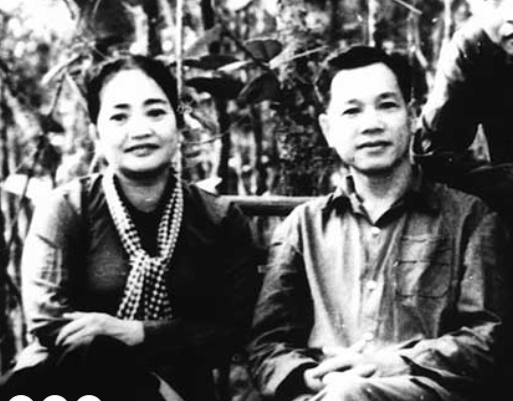 |
| Comrades Tran Van Tra and Nguyen Thi Dinh were officers in the Command Headquarters of the Southern Liberation Army. (Archival photo) |
Following successive defeats in the Central Highlands, Hue, and Da Nang, the enemy fell into even greater crisis, with defeated troops retreating towards Saigon. To hold Saigon, they organized a defensive line stretching from Phan Rang through Xuan Loc to Tay Ninh, with Xuan Loc being "a crucial link that must be held," the "steel gate" east of Saigon; losing Xuan Loc meant losing Saigon. Due to the importance of Xuan Loc, Comrade Tran Van Tra personally went to the forward command post to assign the 4th Corps the task of launching an offensive to break through the Xuan Loc defensive line.
On April 9, 1975, the Xuan Loc Campaign began, and we successively captured several important targets. From April 11 to 14, the enemy mobilized forces and firepower, inflicting heavy losses on us. Some suggested that we should withdraw all forces from Xuan Loc town, then organize attacks to destroy enemy units outside, eliminating them piecemeal. General Tran Van Tra proposed: "Let me go there myself, understand the specific situation on the ground, and together with the troops, study how to achieve victory."
On the afternoon of April 11th, General Tran Van Tra traveled from Loc Ninh to the 4th Army Corps Command to direct and urge the 4th Army Corps to implement a new tactic: Deploying the 4th Army Corps to occupy the Dau Giay intersection, annihilating enemy units that were attempting a counterattack but lacked secure fortifications; cutting Highway 1, isolating Xuan Loc from Bien Hoa; cutting Highway 2 leading to Ba Ria; and using long-range artillery to control Bien Hoa airport.
Thanks to that tactic, on April 21, the Xuan Loc defense line—the "steel gate" protecting the eastern part of Saigon—was shattered, and Xuan Loc town and Long Khanh province were liberated. The victory at Xuan Loc-Long Khanh created favorable conditions for the army and people in the East and Northeast to prepare their forces and battle formations to advance towards Saigon along with the army and people in other directions.
During the Ho Chi Minh Campaign, Comrade Tran Van Tra was assigned as Deputy Commander of the campaign. On April 22, 1975, the Party Committee and the Campaign Command met to approve the plan to attack Saigon-Gia Dinh. General Tran Van Tra and the Campaign Command agreed on the campaign's operational plan. Adhering to the ideology of "speed, boldness, surprise, and certain victory," and implementing General Vo Nguyen Giap's order of "speed, even greater speed, boldness, even greater boldness," from April 26 to 30, 1975, with overwhelming force, our five valiant army columns simultaneously advanced towards the last stronghold of the Saigon puppet regime.
In his capacity as Commander of the South Vietnam Liberation Army and Deputy Commander of the Ho Chi Minh Campaign, Comrade Tran Van Tra, along with the Military Committee, the Regional Command, and the Campaign Command, contributed their intellect and dedication to advising, planning, and strategically deciding on the liberation of South Vietnam, and successfully organizing its implementation.
NGUYEN TOAN
-------------------
Deputy Commander of the campaign, Dinh Duc Thien
In 1974, the Ministry of National Defense separated the technical equipment and ordnance sector to establish the General Department of Engineering in preparation for the general offensive to liberate South Vietnam. Comrade Dinh Duc Thien was appointed Deputy Minister of National Defense, Deputy Chairman of the State Planning Committee, and concurrently Head of the General Department of Logistics and the General Department of Engineering. In April 1975, he was entrusted by the Central Military Commission with the important responsibility of Deputy Commander of the Ho Chi Minh Campaign.
Preparing the logistical and technical support for the general offensive to liberate South Vietnam was a very difficult and complex task. Following the Central Highlands Campaign and the Hue-Da Nang Liberation Campaign, the Politburo and the Central Committee of the Party decided to concentrate forces, weapons, technical equipment, materials, and logistics to liberate Saigon before the rainy season. The campaign's technical force was established based on the forward technical force of the Ministry of National Defense and the technical force of the Southern Region. Technical support was assigned as follows: The campaign's logistical and technical support agency provided support to the 1st, 2nd, and 3rd Corps and technical branches. The Southern Region's logistical and technical support agency provided support to the 4th Corps and units along Route 20. The logistical and technical support agencies of Military Regions 7, 8, and 9 provided support to the main divisions of the Southern Region and military regions in My Tho, Can Tho, and Southwest Saigon.
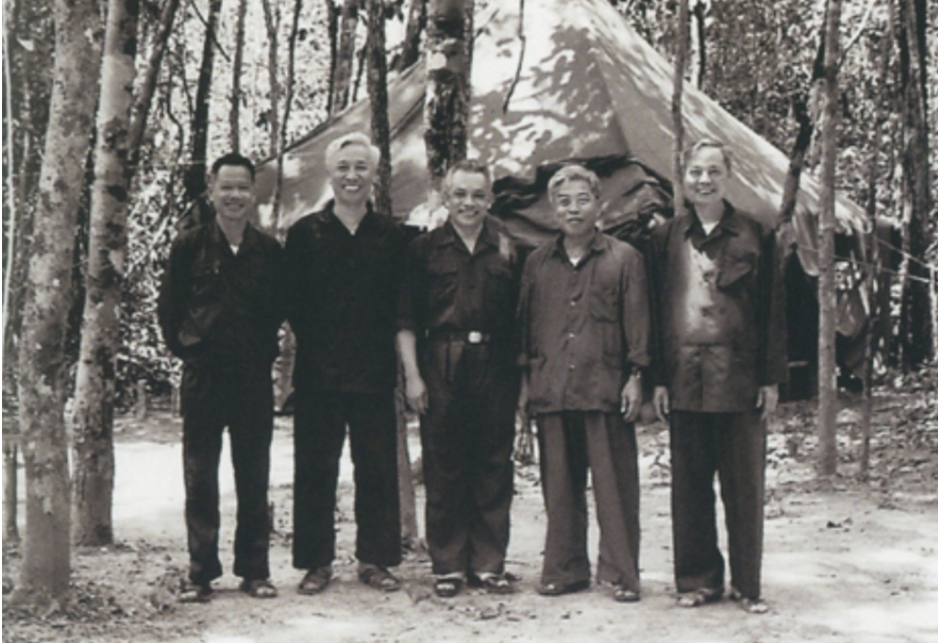 |
| Comrade Dinh Duc Thien (far right) with several comrades in the Ho Chi Minh Campaign Command (April 1975). Archival photo. |
Acting on the orders and operational plans of the General Staff, under the direction of Comrade Dinh Duc Thien, the General Department of Engineering concentrated all efforts and mobilized its capabilities to the highest degree to ensure the provision of technical equipment for the forces participating in the campaign; prioritizing the full and synchronized supply of weapons and technical equipment to the main units, mobile corps, and engineering units. It directed the technical branches and engineering branches of the military regions, corps, and branches to strengthen their forces and effectively carry out technical work to support the campaign. From the beginning of January to the end of April 1975, the General Department of Engineering mobilized more than 2,000 technical officers and personnel, nearly 3,000 military vehicles, and organized the transportation of tens of thousands of tons of weapons and technical equipment, and thousands of people participating in the Spring 1975 General Offensive and Uprising.
With the guiding principle of "speed, boldness, surprise, and certain victory," the Party and Government directed the mobilization of all forces nationwide and the entire army to serve in logistics. The need for material reserves for the Ho Chi Minh Campaign was enormous, while the time for direct logistical preparation for the campaign was very short (20 days, from April 5 to 25, 1975). To solve this problem, in addition to mobilizing various support measures as directly directed by the Battlefield Support Council, under the leadership of Comrade Dinh Duc Thien, the General Department of Logistics coordinated with units to concentrate all forces and means to fully prepare materials and logistics for the campaign. Due to our rapid offensive with overwhelming force, and moreover, the enemy was quickly annihilated and disintegrated, the campaign ended early and the amount of material and technical supplies consumed was not significant. The entire campaign used nearly 14,000 tons of various materials, equivalent to 21.6% of the reserve...
In January 1997, during the commemoration ceremony marking the 10th anniversary of the death of General Dinh Duc Thien, General Vo Nguyen Giap emotionally stated: "Comrade Dinh Duc Thien made great contributions to the construction of the Truong Son Road, building a large transportation system from the rear areas of the North to the battlefields, including the oil pipeline, to ensure support for the South, creating infrastructure for the movement of forces and large-scale transportation, effectively serving the strategic opportunity, especially for the General Offensive and Uprising of Spring 1975."
CHI PHAN
-----------------
Deputy Political Commissar and Head of Political Affairs of the Campaign, Le Quang Hoa
On April 5, 1975, the Politburo and the Central Military Commission decided to organize the Eastern Front, with Comrade Le Trong Tan appointed Commander and Comrade Le Quang Hoa as Political Commissar. The Eastern Front units advanced along Highway 1 and the central coast, simultaneously marching and fighting to destroy enemy forces, shattering the Saigon regime's defensive lines in Phan Rang, Phan Thiet, and Ham Tan, and liberating the provinces of Ninh Thuan, Binh Thuan, and Binh Tuy – the distant defensive areas of the US-puppet regime against Saigon in the East...
Comrade Le Quang Hoa, along with the Eastern Front Command, thoroughly understood the Central Committee's strategic resolve to march swiftly to strike quickly and forcefully, crushing all of the enemy's strategic consolidation plans. The Command discussed that, in addition to support from higher levels and strategic transport units, it was necessary to utilize existing transport means to move large quantities of materials, weapons, and technical equipment to the front lines, enlist the help of local authorities, and mobilize additional transport vehicles to ensure that all branches of the armed forces could be mobilized by motorized means.
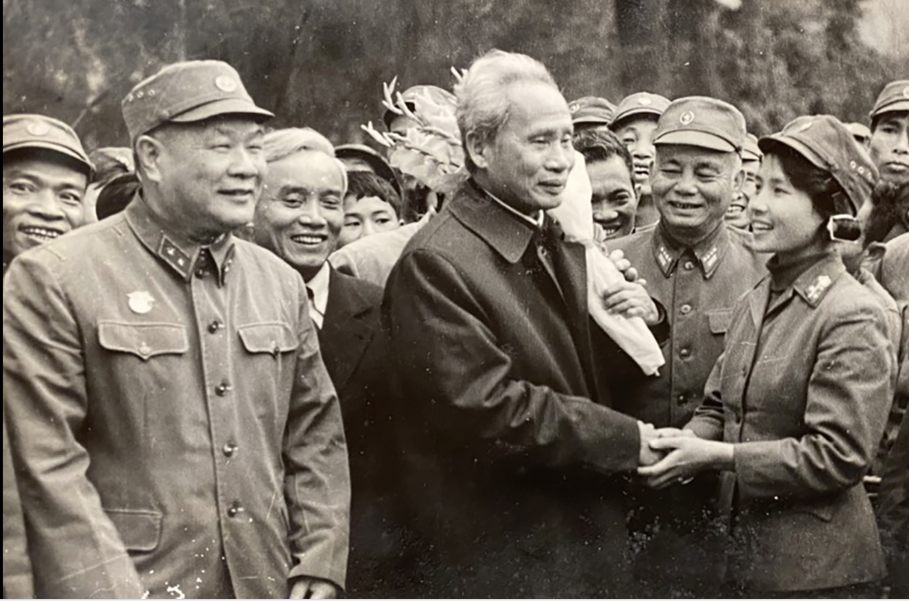 |
| Comrade Le Quang Hoa (on the left) during a visit by Prime Minister Pham Van Dong to the unit. (Archival photo) |
Along the march, the eastern flank received a telegram from the General Staff: “Ironclad determination to completely liberate the South before the rainy season… We must penetrate deep, launch strong attacks, be extremely proactive, highly mobile, and highly flexible… Seize every hour, every minute, fight decisively, and achieve total victory…”. This telegram spurred officers and soldiers on all fronts to overcome all difficulties and strive to complete their mission. The continuous loss of control over a vast area from the Central Highlands to the southernmost part of Central Vietnam and the South pushed the enemy into a state of confusion and despair. On April 8, 1975, the Politburo and the Central Military Commission decided to establish the Saigon-Gia Dinh Campaign Command (Ho Chi Minh Campaign). Subsequently, Comrade Le Quang Hoa was appointed by the Politburo as Deputy Political Commissar and Head of Political Affairs of the campaign.
On April 16, 1975, the Saigon regime's "steel shield" of Phan Rang fell. This victory was a guarantee of the determination of the entire Party, people, and army to liberate the South in April 1975. This victory honored the Eastern Front, in which Comrade Le Quang Hoa made a significant contribution. After being forced to retreat to Phan Rang for defense, the Saigon regime was in disarray but remained stubborn. However, after the enemy lost Phan Rang, the Xuan Loc base also could not hold out.
From April 26th, the Liberation Army besieged Saigon from five directions, launching breakthroughs in the outskirts and penetrating deep into the city center. The Ho Chi Minh Campaign Command, including Comrade Le Quang Hoa, united and creatively organized the breakthrough and offensive forces, achieving victory, liberating Saigon, and unifying the country.
PHAN TRAC THANH DONG
* Please visit the section commemorating the 50th anniversary of the great victory of Spring 1975 to view related news and articles.
Source: https://baodaknong.vn/bo-tu-lenh-chien-dich-ho-chi-minh-251128.html
![[Photo] Prime Minister Pham Minh Chinh receives the Chinese Ambassador to Vietnam](https://vphoto.vietnam.vn/thumb/1200x675/vietnam/resource/IMAGE/2026/04/05/1775397481797_ndo_br_dsc-5512-jpg.webp)











































![[INFOGRAPHICS] Exploiting children's personal images for profit can result in fines of up to 50 million VND.](https://vphoto.vietnam.vn/thumb/402x226/vietnam/resource/IMAGE/2026/04/06/1775442200854_1775442148.webp)











Comment (0)