

According to Euronews, Estonia, France, Germany, and Spain are urging the European Commission (EC) to reconsider parts of the European Union's (EU) carbon market reform plan, warning that stricter emissions regulations between 2026 and 2030 could undermine the competitiveness of many industries.
Controversy surrounding ETS
At the heart of the debate is the Emissions Trading System (ETS) – the EU's key climate tool that requires large-scale emitters to pay for the carbon emissions they produce. The EC plans to revise this mechanism amid concerns from many member states and businesses that the ETS is contributing to higher electricity prices and causing European industry to lose its competitive edge compared to the US and China.
In the joint document, the four countries argued that the new method proposed by the EC for calculating emission-free quotas could force businesses to cut emissions at a rate exceeding the practical adaptability of many industries.
This move comes after the EC expressed its intention to cut the amount of free emissions quotas available to businesses. This mechanism was designed to protect European producers from competition from countries with lower environmental standards.
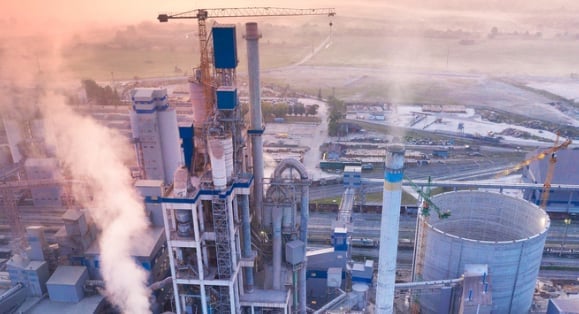
EU countries argue that tightening ETS regulations is reducing the competitiveness of the bloc's industries. Photo: Centre for European Reform.
Speaking at a meeting of EU industry ministers in Brussels last week, French Industry Minister Sébastien Martin warned that tightening the free quota allocation mechanism could accelerate the trend of production shifting out of Europe. According to him, the chemical industry alone could face an additional €3 billion in costs arising from the new standards.
Meanwhile, the EC argues that revenue from ETS will be reimbursed to governments for investment in industrial emission reduction. However, Martin points out that the agency has not yet provided a specific roadmap or a clear legal assessment of the reimbursement mechanism.
"We can't just rely on promises. We need concrete commitments," Martin emphasized.
Estonian Industry Minister Erkki Keldo also argued that funds supporting industrial decarbonization need to be allocated more equitably across sectors and pay more attention to the needs of smaller economies .
Climate goals and the challenge of competition.
The debate over ETS continues to reflect a major challenge to the EU's green transition strategy: How to accelerate the pace of emissions reduction without undermining the bloc's industrial base.
According to the document, many industries heavily reliant on thermal energy and fossil fuels still lack commercially viable low-emission technologies or cost-effective alternatives. Therefore, the rate of emissions reductions set by Brussels may exceed the adaptability of businesses.
Although they did not propose abolishing the ETS, all four countries warned that industries are facing high energy costs and increasing competitive pressure. They believe that the outcome of negotiations on a new free quota allocation mechanism will significantly impact investment decisions and production costs for businesses over the next decade.
The document also warns that if implemented as currently planned, the free quotas allocated to certain sectors may not be sufficient to prevent "carbon leakage"—when businesses shift production to countries with lower environmental standards to reduce costs.
The four countries requested that the EC clarify the new method for calculating free quotas as soon as possible, and also determine whether this mechanism can be flexibly adapted to the specific characteristics of each industry.
In addition, governments have requested that the EC submit a separate bill on default values to be used when data is lacking, instead of waiting for the comprehensive revision of ETS scheduled for July 15th.
Countries also requested a legal assessment of the feasibility of retroactively applying the new calculation method to the free emissions quota system from January 2026.
The coordinated move by Estonia, France, Germany, and Spain is increasing pressure on the EC ahead of upcoming high-level meetings to decide on new regulations related to the allocation of emission-free quotas for businesses.
Source: https://nongnghiepmoitruong.vn/bon-nuoc-eu-de-xuat-noi-long-quy-dinh-phat-thai-d814572.html
![[Photo] First session of the 14th Congress of the Vietnam Trade Union](https://vphoto.vietnam.vn/thumb/1200x675/vietnam/resource/IMAGE/2026/06/03/1780465947883_ndo_br_img-3852-jpg.webp)

![[Photo] Secretary of the National Assembly Party Committee, Chairman of the National Assembly presides over the meeting of the Standing Committee and Executive Committee of the National Assembly Party Committee.](https://vphoto.vietnam.vn/thumb/1200x675/vietnam/resource/IMAGE/2026/06/03/1780480353201_ndo_br_bnd-2585-jpg.webp)
![[Photo] General Secretary and President To Lam presides over a meeting with the Central Organizing Committee.](https://vphoto.vietnam.vn/thumb/1200x675/vietnam/resource/IMAGE/2026/06/03/1780482764658_a1-bnd-4741-3342-jpg.webp)








































![[Video] Sunset at Lap An Lagoon – Where the sun sets over the fishing nets](https://vphoto.vietnam.vn/thumb/1200x675/vietnam/resource/IMAGE/2026/05/31/1780192137701_beach-landscape-sea-water-nature-grass-745871-pxhere-com.jpeg)






























Comment (0)