

Speaking about the history of the Catinat Police Station at the scientific conference on the historical site of the Catinat Police Station (organized by the Ho Chi Minh City Department of Culture and Sports last weekend), researcher Vo Nguyen Phong shared: "The Catinat Police Station, located at 164 Catinat Street (now the Ho Chi Minh City Department of Culture and Sports - 164 Dong Khoi Street, Saigon Ward), was originally a colonial administrative office, later becoming a notorious police and secret police headquarters. From early on, the French organized the planning of Saigon city with the explanatory document 'Note à l'appui d'un projet de la Ville de Saigon' (roughly translated as 'Document on the Saigon City Project') and a planning drawing titled 'Projet de ville de 500,000 âmes à Saigon' (Project for the city of Saigon with 500,000 inhabitants)."
According to documents by MSc - Architect Nguyen Ngoc Son and PhD - Architect Pham Phu Cuong (Ho Chi Minh City University of Architecture): "The map compiled by Colonel Lucien Florent Paul Coffyn of the engineering corps shows the location of the 164 Dong Khoi complex at the corner of a block in the southeastern area of Phung Citadel, with administrative functions, adjacent to Road No. 21 and a square with a central cathedral."
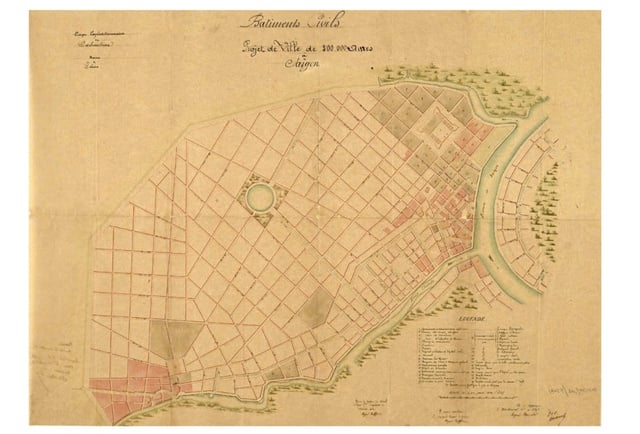
Planning drawing for a city of 500,000 ames in Saigon
Source: Archives Nationales d'Outre-Mer
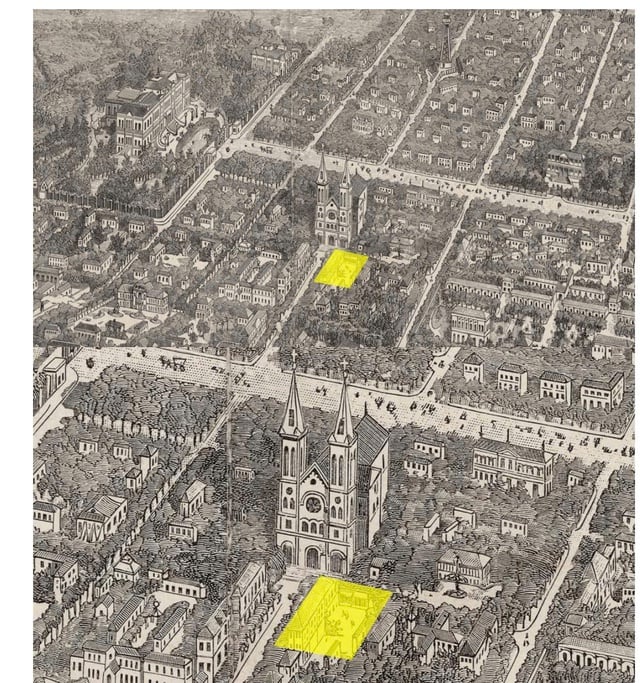
The location of the 164 Dong Khoi complex (yellow area), with the presence of the Post Office and Mailbox (Poste aux Lettres), is shown in a section of the 1881 Saigon city skyline rendering by French naval captain M. Favre.
Source: Bibliothèque Nationale de France
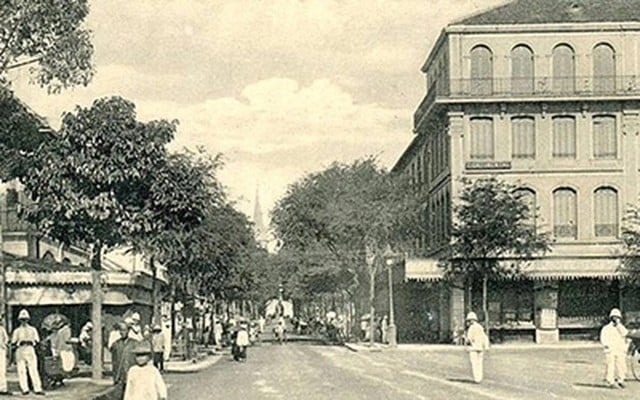
The late 19th-century scene, with its streets, shops, daily life, and colonial architecture, shows the layout of Catinat Street before the Catinat Police Station was established.
Photo: TL. NGUYEN MY HANH
According to Mr. Vo Nguyen Phong: "The central square was formed in 1862 (also known as Clock Square or Government Square) because it was located in the heart of Saigon. Besides its central location, its name was also based on surrounding structures such as the original Governor's Palace (Tran Dai Nghia Specialized High School) and the Clock Tower (the current Department of Culture and Sports). Later, due to urban development and work needs, the Treasury (Trésor) was built in 1864 in the same location (The Metropolitan building) at a cost of 5,415.48 dong. Later in 1865, the Post Office (Hôtel des Postes) was built next to the Treasury, completed in 1866. The construction was undertaken by contractor Jean Baptiste Lambert. This also marked the beginning of the construction of permanent government offices in the central square area of the city."
According to the Plan de la ville de Saigon (1893) map, the area around the old central square included the following buildings: to the west were the Treasury, the Registry and Public Property Office; to the east were the Local Tax Office, the Land Office, the Education Office and the Direct Tax Control Office; the remaining area up to the corner of Catinat-de la Grandière was an unidentified building located outside the area that later became the Catinat Police Station. The conversion of these units was carried out by the decree of the Governor of Cochinchina on November 29, 1892.
Researcher Nguyen Hoang Thai (War Remnants Museum) added: "During the French colonial period, Catinat Street was planned and built to become the backbone and heart of the European-style urban area. Extending seven blocks, the street started from the bustling Saigon port, where ships from the mother country docked, and majestically ended at the square in front of Notre Dame Cathedral, creating a perfect landscape axis and serving as a central boulevard for the European commercial district. This strategic location transformed Catinat into the center of power, commerce, and social life for the colonialists and Western expatriates. Along the street, the most important buildings of the colonial government successively sprang up: the Governor's Palace of Cochinchina, government offices, the Central Post Office, and even the first US Consulate."
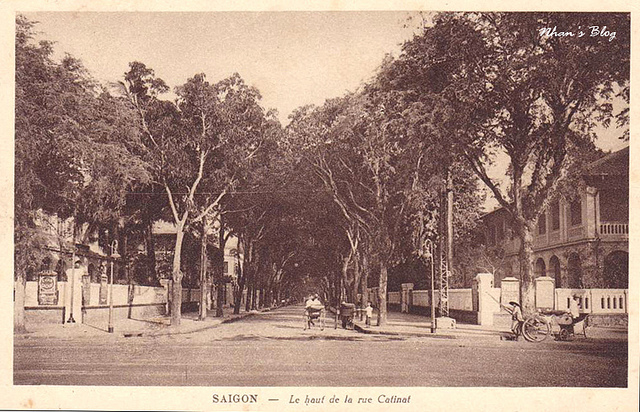
When the new Treasury building was constructed on Charner Avenue (Nguyen Hue), the French allocated the building to serve as the Southern Vietnam Secret Police Headquarters. Because it was located on Catinat Street, the locals commonly referred to it as the Catinat Police Station.
Photo: ARCHIVE
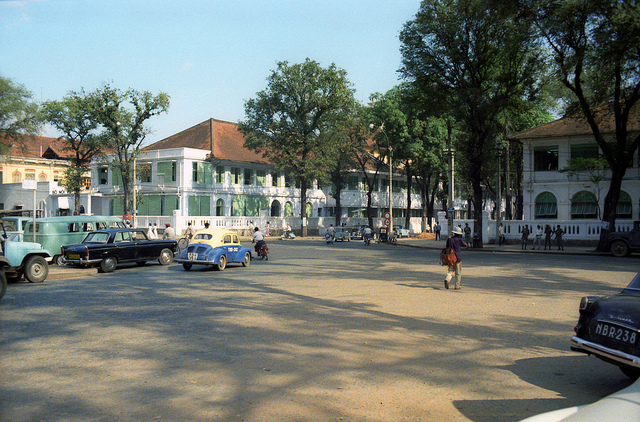
After 1954, Catinat Police Station was used by the Saigon government as the headquarters of the Ministry of Interior.
Source: Ken, manhhai flickr
Researcher Vo Nguyen Phong noted: "The locations of the Secret Police offices stretched along Catinat Street, starting from the building adjacent to the Church Square (Place Pigneau de Béhaine) and extending to the Catinat building (now building number 26 Ly Tu Trong Street). It was commonly known as Catinat Police Station, but it should correctly be called the Southern Vietnam Police and Secret Police Department, or more simply, the Secret Police Department."
"Catinat is like a piece of France subtly placed in the Far East."
The infamous Catinat Police Station, known as "hell on earth," is located on Catinat Street – a symbol of the luxurious French lifestyle, like a "miniature Paris" in the heart of Asia.
With a love for Saigon and a passion for history, drawing from documents about old Saigon, researcher Nguyen Hoang Thai sketched a picture of Catinat Street (now Dong Khoi Street) in those days: "Large tamarind trees provided shade for sidewalk cafes, where officials, businessmen, and Western travelers enjoyed a cup of Parisian-style coffee while observing the passersby. Luxurious shops displayed imported luxury goods from France and Europe, from fashionable clothing and perfumes to fine wines. Large and magnificent hotels, most notably the Continental Hotel, became familiar stops for tourists and international writers and journalists. It was this coffee culture and vibrant urban atmosphere that led early 20th-century American travelers like Clifford to write that, looking out of his hotel room window on Rue Catinat, he had to 'rub his eyes and force himself to remember that this was truly Asia.' Catinat was like a piece of France subtly placed in the Far East." Winter".
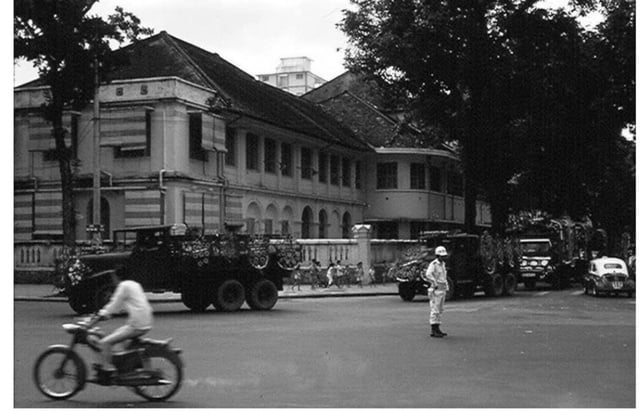
The building that served as the headquarters of the South Vietnamese Ministry of Interior at 164 Tu Do Street (photo taken in 1965).
Photo: ARCHIVE
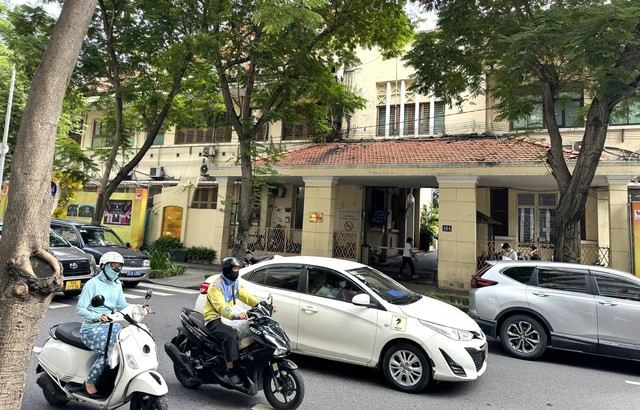
The former Catinat Police Station is now the headquarters of the Department of Culture and Sports of Ho Chi Minh City.
Photo: QUYNH TRAN
Later, in 1933, the complex of buildings No. 162-164-166 Catinat underwent major restoration and repair to house the Police and Security Department. According to Master's student Le Doan Thanh Tai (Ho Chi Minh City Development Research Institute): "In terms of form, this architectural complex abandoned the Beaux-Arts style with its many elaborate decorative details characteristic of the early colonial period, shifting towards a modern and functional trend, emphasizing straight lines, clear volumes, and restraint in detail."
"During the August Revolution, from August 26th to September 23rd, 1945, the Viet Minh flag was hoisted on top of the Catinat Police Station; the building temporarily became the headquarters of the Saigon-Chợ Lớn National Self-Defense Force before the French reoccupied the central area. During the Republic of Vietnam period, the building continued to serve security and administrative functions within the Ministry of Interior system, while the street was named Tu Do (Freedom) Street," said Master's student Le Doan Thanh Tai.
After the liberation, Tu Do Street was renamed Dong Khoi Street, and the Catianat Police Station has been used as the headquarters of the Ho Chi Minh City Department of Culture and Sports until today.
Source: https://thanhnien.vn/bot-catinat-dia-nguc-ke-ben-thien-dang-185250922110541804.htm

![[Photo] Standing Committee member of the Party Central Committee Tran Cam Tu working with the Central Inspection Committee](https://vphoto.vietnam.vn/thumb/1200x675/vietnam/resource/IMAGE/2026/05/28/1779969579668_ndo_br_bnd-2495-jpg.webp)






































































Comment (0)