

- E-commerce is spreading to rural markets.
- Enhancing e-commerce capabilities for ethnic minority communities.
- E-commerce applications - Safe and sustainable consumption.
- Amazon will support Vietnam in becoming a Southeast Asian e-commerce export hub.
Leveraging the advantages of the digital space.
With advantages such as not being limited by time or location, saving operating costs, and being able to reach customers everywhere, e- commerce is increasingly being chosen by businesses, cooperatives, and production and trading establishments in Ca Mau .
The Vietnam Agricultural Products Facility (Phong Hiep commune) was established in 2013 and to date has 13 OCOP products that have achieved 4-star standard and 2 products that have achieved 3-star standard, including typical products such as shrimp crackers, vegetable crackers, and dried shrimp.
Ms. Ta Tuyet Thu, the owner of the business, said: “To promote our products, in addition to participating in direct trade promotion activities, we are boosting our advertising and sales on e-commerce platforms, websites, TikTok, Facebook, Zalo, etc. If we only sold through traditional methods, our products would struggle to reach beyond the local area. Thanks to doing business through e-commerce platforms and online sales, our business has been able to reach a large number of customers both within and outside the province.”
After joining e-commerce platforms and social media channels, Thanh Thuy dried seafood production facility (Long Dien commune) has a stable customer base, with orders increasing significantly during holidays and Tet (Lunar New Year).
Ms. Nguyen Thanh Thuy, owner of Thanh Thuy Dried Seafood Production Facility, said: “Previously, my family only sold through traditional methods. Since receiving support from the Department of Industry and Trade, I have brought my products to e-commerce platforms and sold them through TikTok, Zalo, etc., and the brand has become more well-known. In addition to our main products, which are various types of dried shrimp and fish, the facility also produces fermented shrimp, shrimp paste, shrimp cakes, and shrimp floss to meet the diverse culinary needs of consumers, from budget-friendly to high-end.”
The application of e-commerce is not only suitable for manufacturing facilities but is also particularly effective for retail stores. Ms. Tran Bich Phuong's Phuong Sua system, with four stores in Vinh Phuoc and Phuoc Long communes, has experienced significant growth thanks to a combination of in-store and online sales. “I regularly post promotional information for diapers and milk products on social media. When customers place orders, we deliver them to their doorstep, which has significantly increased sales. All stores have QR codes for payment and issue electronic invoices, making it very convenient for customers,” Ms. Phuong shared.
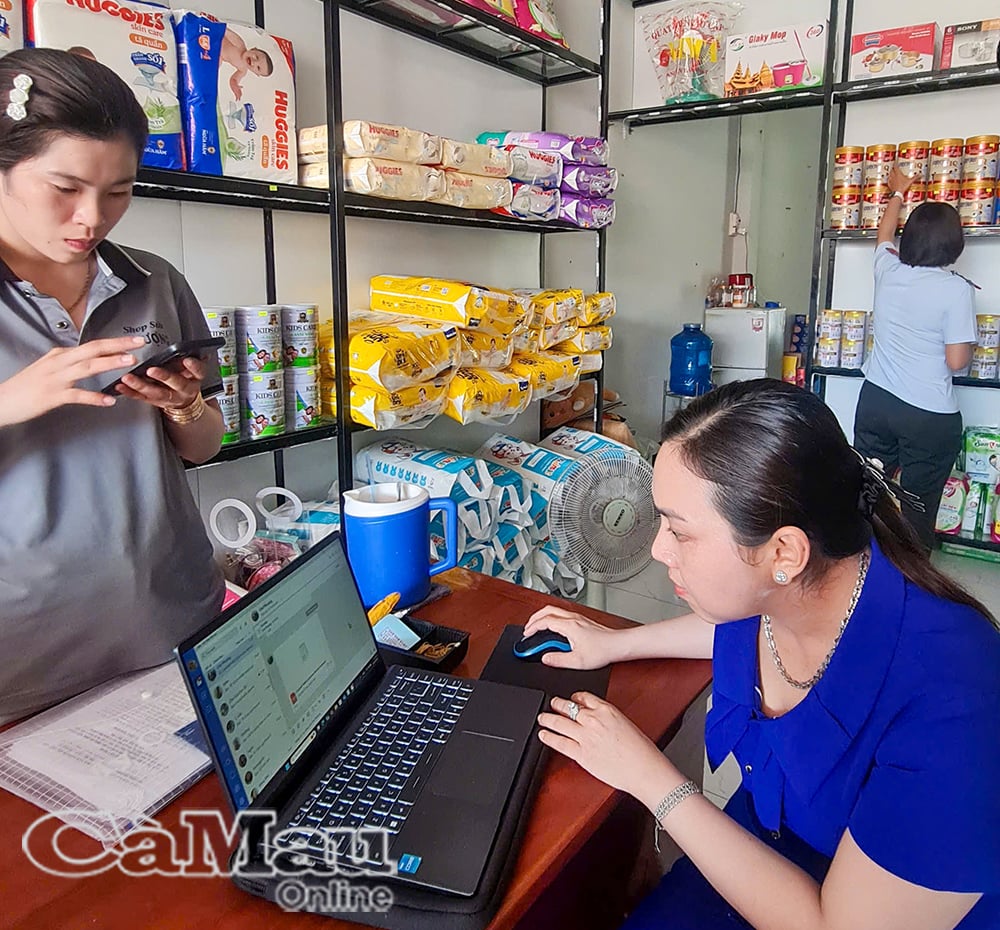 Ms. Tran Bich Phuong, owner of Phuong Sua shop, issues electronic invoices to customers who place orders via Facebook.
One of the major advantages of e-commerce is the reduction in operating costs. Instead of spending money on premises, warehousing, labor, or product displays, businesses only need to invest in content such as images, videos , and livestreaming to reach customers. Consumers can also easily compare prices, choose products, and place orders anytime without having to travel.
Ms. Nhu Hao, from Vinh Phuoc commune, said: "Even though I live in the countryside, I can buy everything, from food, clothes, cosmetics, to household goods... with just a click."
Goods are delivered quickly to your door. Most stores have QR codes, so cash is almost unnecessary. Online shopping has become familiar and very convenient.”
Thanks to increasingly convenient shopping experiences, e-commerce is no longer a secondary option but has become a habit for the majority of people, including the elderly, children, and especially those in rural areas; creating opportunities for manufacturers and businesses to expand their markets.
Promoting the development of e-commerce.
To support businesses, cooperatives, establishments, and household businesses in keeping pace with the digitalization trend , the Department of Industry and Trade has recently coordinated with other departments, agencies, and localities to implement many solutions. The focus is on improving the effectiveness of state management, promoting cross-border transactions, and expanding domestic and international markets through e-commerce platforms. Numerous training courses have been organized to provide skills training for managers, businesses, and cooperatives; support has been given in building websites and online brands; and businesses have been guided on how to list their products on major e-commerce platforms such as Shopee, Lazada, Tiki, and Sendo. In addition, these entities have been equipped with skills to utilize social media platforms like Facebook, Zalo, YouTube, and TikTok for more effective product promotion.
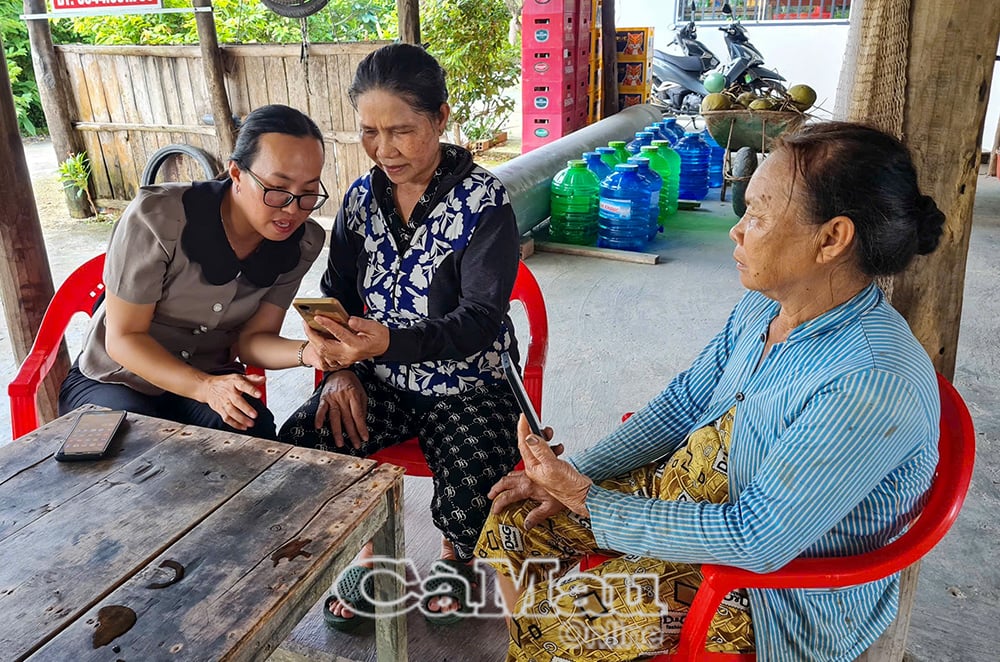 Officials in Dinh Thanh commune are guiding residents on how to use their phones to shop for goods on e-commerce platforms and online marketplaces.
According to the Department of Industry and Trade, e-commerce sales between businesses and consumers currently account for approximately 10% of the total retail sales and consumer service revenue in the province.
Specifically, cashless payments in e-commerce reached 50%; 50% of purchases on e-commerce websites/applications had electronic invoices; 60% of e-commerce websites integrated online ordering functions; 40% of small and medium-sized enterprises conducted business on e-commerce platforms; and 30% of businesses participated in e-commerce activities on mobile applications.
To date, Ca Mau has 112 e-commerce websites, 4 sales applications, 1 service application, and 5 e-commerce trading platforms registered with the Ministry of Industry and Trade. The Ca Mau provincial e-commerce trading platform currently has over 400 members, including businesses, cooperatives, rural industrial establishments, and OCOP (One Commune One Product) entities.
The platform regularly collaborates with provinces and cities nationwide to expand market reach and bring Ca Mau products to customers across the country.
Alongside traditional trade promotion, e-commerce is becoming a key distribution channel, helping businesses, cooperatives, establishments, and households in Ca Mau enhance their competitiveness. From local specialties to consumer goods, products have the opportunity to access larger markets through digital platforms. Most businesses in the province have flexibly combined direct and online sales, saving costs, expanding their customer base, and adapting quickly to market fluctuations.
Thanks to this strong transformation, Ca Mau is asserting itself as a pioneering locality in innovation and digital transformation, gradually rising to the leading group in the region in digital commerce.
Thuy Lam
Source: https://baocamau.vn/buoc-chuyen-cua-thuong-mai-so-a124539.html



![[Photo] Standing Committee member of the Party Central Committee Tran Cam Tu working with the Central Inspection Committee](https://vphoto.vietnam.vn/thumb/1200x675/vietnam/resource/IMAGE/2026/05/28/1779969579668_ndo_br_bnd-2495-jpg.webp)







































































































Comment (0)