

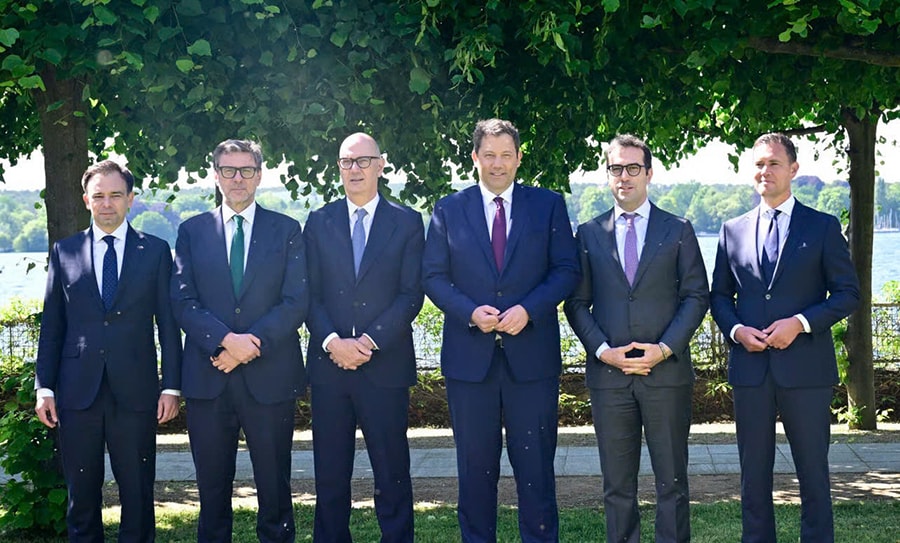
According to an agreement reached between the finance ministers of Germany, France, Italy, Poland, Spain, and the Netherlands (known as the E6 group), supervision of critical financial market infrastructure will gradually be transferred to ESMA – the EU financial market regulator based in Paris, France. This means that supervisory power will no longer be entirely within the purview of national agencies as before. Instead, the EU aims to build a more centralized and coordinated supervisory mechanism capable of effectively responding to cross-border risks.
German Finance Minister Lars Klingbeil stressed that the willingness of the six largest EU economies to "set aside national interests" to jointly push for reforms is an important signal for the entire bloc.
In fact, since 2015, the EU has launched the CMU initiative with the goal of creating a unified financial market across the bloc. Through this, businesses, especially small and medium-sized enterprises (SMEs), can access capital more easily, while investors have expanded opportunities for cross-border investment. However, the implementation of the CMU has faced many obstacles due to differences in laws, supervisory mechanisms, and national interests among member states. Therefore, the EU's financial system remains highly fragmented, with most supervisory activities carried out by national regulatory bodies. This fragmentation puts Europe at a significant disadvantage in global competition.
Meanwhile, the US continues to attract global capital flows thanks to its robust financial markets and large-scale industrial support policies. Many EU technology companies still have to turn to the US market for funding due to the limited size and liquidity of the European market. China is also continuously expanding its economic influence through technology and financial investments.
In this context, the European Commission's (EC) new proposal to grant more power to ESMA is seen as a crucial part of a strategy to restructure the region's financial system, aiming to create a more modern, integrated, and globally competitive financial market to maintain Europe's economic position in the future.
The E6 finance ministers also agreed that the ESMA's governance structure must be designed effectively, based on expertise, market supervision experience, and ensuring geographical balance among member states. This addresses concerns from many countries that excessive concentration of power in a single EU-level body could undermine the role of national regulators or create an imbalance of interests within the bloc.
Another notable point in the E6 agreement is the increased authority of EU supervisory bodies in the field of cryptocurrency trading. In recent years, the cryptocurrency market has grown rapidly in Europe, but this has also brought with it many risks related to speculation, fraud, and money laundering. The EU has issued the MiCA legal framework to regulate this sector, but enforcement remains a major challenge. Increased authority for EU supervisory bodies is expected to help better control cross-border trading activities and reduce the risk of businesses exploiting legal differences between member states.
Furthermore, the E6 group also agreed on the need to reduce barriers to cross-border investment funds to facilitate capital mobilization for businesses. According to economic experts, this is a key factor for Europe to boost investment in strategic sectors such as: green transformation, high technology, artificial intelligence, and defense.
Despite reaching consensus within the E6 group, the reform proposal still needs the support of the remaining 21 member states before it can be formally adopted. The negotiation process is expected to be challenging, as many smaller countries fear losing control over their national financial systems. If this hurdle is overcome, the EU will achieve a significant breakthrough in regional financial integration, strengthening its global economic position and creating new growth momentum for decades to come.
Source: https://hanoimoi.vn/buoc-dot-pha-nham-tang-suc-canh-tranh-toan-cau-cua-eu-976397.html

![[Image] A brilliant symphony and explosive power in the skies of Da Nang.](https://vphoto.vietnam.vn/thumb/1200x675/vietnam/resource/IMAGE/2026/05/31/1780193150738_anh-bia-copy-jpg.webp)
![[Video] Sunset at Lap An Lagoon – Where the sun sets over the fishing nets](https://vphoto.vietnam.vn/thumb/1200x675/vietnam/resource/IMAGE/2026/05/31/1780192137701_beach-landscape-sea-water-nature-grass-745871-pxhere-com.jpeg)











![[Video] Sunset at Lap An Lagoon – Where the sun sets over the fishing nets](https://vphoto.vietnam.vn/thumb/800x450/vietnam/resource/IMAGE/2026/05/31/1780192137701_beach-landscape-sea-water-nature-grass-745871-pxhere-com.jpeg)



































![[Video] Sunset at Lap An Lagoon – Where the sun sets over the fishing nets](https://vphoto.vietnam.vn/thumb/402x226/vietnam/resource/IMAGE/2026/05/31/1780192137701_beach-landscape-sea-water-nature-grass-745871-pxhere-com.jpeg)
























Comment (0)