

(CLO) Indonesia has become the first Southeast Asian country to join BRICS as a full member, marking a significant milestone in the history of regional international relations.
This decision not only reflects Indonesia's growing stature on the international stage but also demonstrates the increasing power of Southeast Asia in shaping global supply chains, particularly in strategic industries such as renewable energy and clean technology.
Indonesia is the world's largest producer of nickel – a crucial metal in the production of electric vehicle batteries, playing a vital role in the global energy revolution. Indonesia's participation in BRICS benefits not only the country but also the entire bloc, as its vital mineral resources help strengthen the BRICS commodity value chain.
Along with Indonesia, Malaysia and Thailand – two ASEAN countries that are partners of BRICS – possess distinct strategic resources. Malaysia is a leading exporter of natural gas and a major tin producer. Meanwhile, Thailand is one of the world's largest producers of rare earth metals.
The joining of these countries to BRICS not only helps expand the supply of strategic goods but also creates a strong alliance in key industries, from energy and agriculture to high-tech manufacturing.
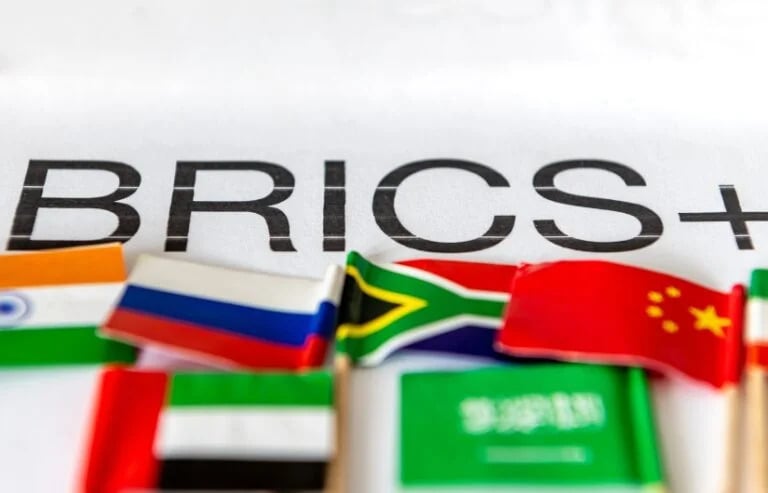
Illustration: GI/iStock
BRICS, originally comprising only Brazil, Russia, India, China, and South Africa, has become a significant economic and political bloc with the addition of new members such as Egypt, Ethiopia, Iran, and the UAE last year. The inclusion of Indonesia and other Southeast Asian nations further strengthens BRICS's position as a diverse alliance representing the interests of Southern Hemisphere nations.
Thanks to the addition of members from Southeast Asia – a region rich in mineral and natural resources – BRICS now controls a large portion of the global supply of essential commodities such as oil, natural gas, and critical minerals.
This creates a strong counterweight to Western-dominated supply chains, especially as G7 nations are reorienting their supply chains.
Advantages for Southeast Asian countries when joining BRICS
BRICS is a platform where member states have equal standing and make decisions based on consensus. This is a stark contrast to Western-led institutions, which are often dominated by major powers.
The BRICS bloc is focused on promoting economic development, trade reforms, and combating climate change. These policies align with the interests of Indonesia and other Southeast Asian nations, helping to ensure that initiatives such as clean energy production and carbon emission reduction are strongly supported.
BRICS has also agreed to oppose discriminatory economic sanctions and carbon border regulation mechanisms. For Indonesia and other ASEAN countries, this is an opportunity to protect national interests against pressure from Western-imposed trade and environmental policies.
ASEAN countries, including Indonesia, strongly oppose the idea of an Asian NATO and are concerned about initiatives such as the US-led Mineral Security Partnership (MSP). Having representation in BRICS would strengthen ASEAN's voice on regional issues, ensuring that the region's interests are respected.
BRICS also plays a crucial role in supporting sustainable development initiatives and ensuring regional peace. The bloc has advocated for the establishment of nuclear-weapon-free zones and promoted disarmament. Indonesia, which has proposed a Southeast Asia Nuclear-Weapon-Free Zone Treaty, could leverage BRICS support to make this initiative a reality.
Furthermore, BRICS supports countries in the Southern Hemisphere in addressing the consequences of climate change. The bloc's agreement to establish a Compensation Fund at COP27 was a significant step forward, particularly for Southeast Asian countries vulnerable to natural disasters and rising sea levels.
A turning point for the Southern Hemisphere
Indonesia's accession to BRICS reflects a new trend in international relations, where Southern Hemisphere nations are increasingly having a greater voice.
Against the backdrop of increasingly apparent limitations in Western-led institutions – from failing to prevent armed conflicts to biases in foreign policy – BRICS emerges as a reliable platform for small and medium-sized nations to protect their interests.
Indonesia, as a pioneer in ASEAN, is helping the region integrate more deeply into global alliances, thereby not only promoting economic development but also creating a multipolar world where power is distributed more equitably.
Ngoc Anh (according to SCMP, Diplomat, Nikkei Asia)
Source: https://www.congluan.vn/indonesia-gia-nhap-brics-buoc-ngoat-cho-dong-nam-a-va-nam-ban-cau-post330066.html

![[Photo] Delegation attending the 14th Congress of the Vietnam Trade Union visits the Mausoleum of President Ho Chi Minh.](https://vphoto.vietnam.vn/thumb/1200x675/vietnam/resource/IMAGE/2026/06/03/1780451842301_ndo_br_img-3824-jpg.webp)
























































































Comment (0)