

Singapore's StraitTimes commented: China is striving to position itself as the global center of the next phase of artificial intelligence (AI) development, with a series of robotics companies preparing to go public to gauge investor interest.
Unitree Robotics, one of the industry's most prominent names, was approved for listing in Shanghai on June 1st. The company's IPO is seen as the first test of a potential wave of initial public offerings in the sector.
According to a report, at least 46 robotics-related companies in Hong Kong (China) alone are preparing for IPOs, accounting for more than 10% of the total number of listing applications. Among the companies that have filed for IPOs are Leju Robotics and Deep Robotics.

Unitree Robotics' Shaolin martial arts robot
"Chinese humanoid robotics companies are taking another step toward IPOs, sparking market interest in the humanoid robotics sector in the second half of 2026," said Sheng Zhong, head of China industrial research at Morgan Stanley.
He stated that the majority of the capital raised from the IPOs of Chinese humanoid robot companies will be allocated to research and development (R&D), particularly the development of robot models.
The wave of IPOs in the robotics sector reflects the rapid development of China's AI ecosystem. Over the past six months, a series of AI-related listings have contributed to an investment frenzy in the market.
This trend also aligns with Beijing's strategy to encourage high-tech industries to move from the innovation phase to large-scale deployment.
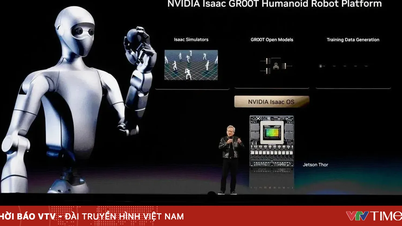
China is accelerating its race to raise capital, industrialize, and ultimately gain a leading position in what Nvidia CEO Jensen Huang calls "physical AI."
Morgan Stanley: Humanoid robots will be China's new strategic export asset.
According to a report published in May by Morgan Stanley, leveraging China's advantages in the race to develop humanoid robots and robotics is similar to its rise to leadership in the electric vehicle (EV) industry over the past decade.
"In the future, humanoid robots and robotics will become the next major driver, boosting China's export machine over the next 5 to 10 years," Morgan Stanley analysts said.
"We see many similarities between the development of robotics and humanoid robots and the electric vehicle industry a decade ago," the report added.
Over the past year, humanoid robots and AI agent models have continuously attracted the attention of users in China and globally. Examples include the humanoid robot's Shaolin martial arts performance at the Lunar New Year Gala, a robot half-marathon race, and the viral video of a robot dog on social media.
Behind the growing wave of interest lies China's rapidly expanding artificial intelligence industry. In February 2026, China's Ministry of Industry and Information Technology announced a standards system for humanoid robots and AI agents, further promoting standardization and development in the industry.
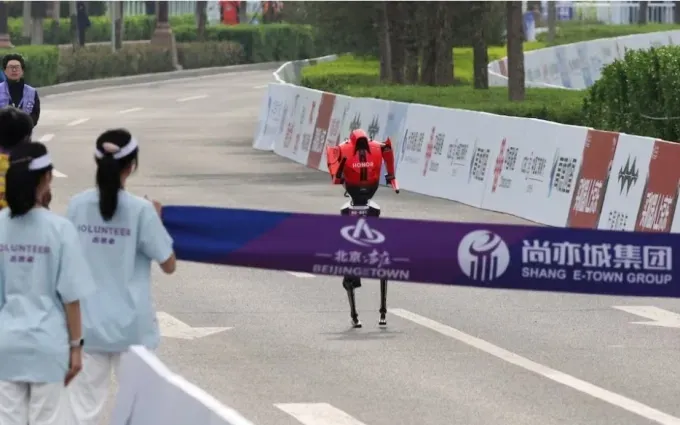
Robots participate in marathon competition.
Meanwhile, cities like Beijing, Shenzhen, and Shanghai have also implemented various support policies to accelerate the construction of robotics industrial parks, expand testing scenarios, and increase financial support for future industries.
Wang Peng, an associate research fellow at the Beijing Academy of Social Sciences , told the Global Times that Unitree's new transforming robot is not just the success of a single product, but a "focused breakthrough built on years of accumulated industrial chain experience."
According to Wang, Unitree's ability to quickly launch such products is backed by China's high-density manufacturing ecosystem and rapid responsiveness. From high-performance motors and batteries to carbon fiber materials, China's comprehensive supply chain network allows companies to quickly source components, accelerate product upgrades, and reduce development costs.
"Such ecological advantages will be very difficult for foreign manufacturers to replicate in the short term," he said.
According to the International Federation of Robotics (IFR), China has consistently held the position of the world's largest industrial robot market for many years. As of April 16, 2026, China has 964 enterprises involved in humanoid robots, while the number of patent applications in this field reached 1,174 in 2025, an 89.7% increase year-on-year and the highest level in five years.
Source: https://vtv.vn/cac-cong-ty-robot-hinh-nguoi-trung-quoc-xep-hang-cho-ipo-100260602100543868.htm
































































































Comment (0)