

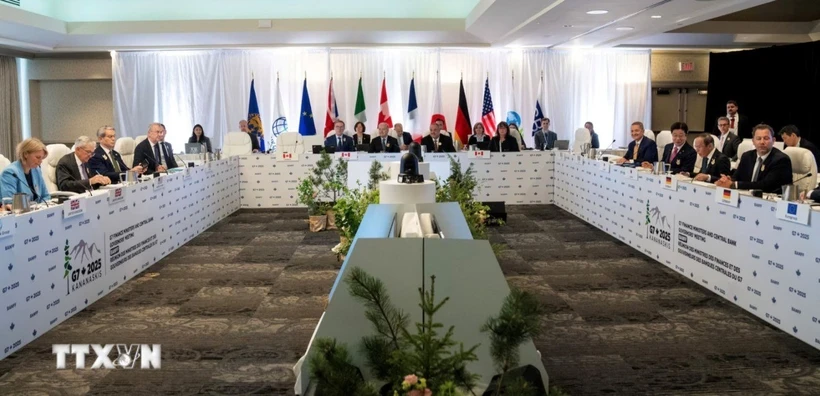
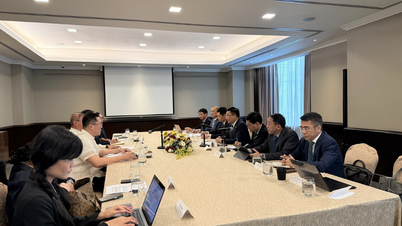
A general view of the meeting of Finance Ministers and Central Bank Governors of the Group of 7 industrialized nations (G7) in Banff, Alberta, Canada on May 21, 2025. (Source: Reuters/VNA)
According to the Vietnam News Agency correspondent in the US, the UK is currently leading the race to reach an agreement with the US, after the two countries had previously reached a preliminary agreement.
In the latest development, on June 16th, President Trump signed a decision to reduce some tariffs on goods imported from the UK, such as bringing tariffs on aerospace products to zero from the end of this month, and lowering tariffs on cars to 10% for the first 100,000 imported vehicles, significantly lower than the previously announced 27.5% tariff.
However, the steel tariff was not lowered to zero as agreed by the leaders of the two countries in May, but remains at 25%. In addition, the new regulations will allow the two countries reciprocal access to 13,000 tons of each other's beef.
Meanwhile, with the European Union (EU), the United States' largest trading partner, trade negotiations are ongoing but no agreement has been reached.
EU spokesperson Paula Pinho said the bloc is not yet ready to accept the US's 10% global tariffs and that both sides are currently engaged in technical and political negotiations to resolve points of disagreement.
Prior to this G7 summit, the President of the European Commission and the President of the European Council had also urged President Trump to end the trade war.
The EU has repeatedly urged Washington to accept a "zero-sum" agreement on industrial goods, but the Trump administration has not agreed due to concerns about obstacles from Congress .
With Canada, a neighboring country of the United States, Prime Minister Mark Carney announced on June 16th that an agreement had been reached with President Trump to finalize a new economic and security deal within 30 days. Officials from both countries will have much work to do in the coming period to make this a reality.
Previously, Trump had said a new deal with Canada was possible, but tariffs would still play a key role.
Also on June 16, Japanese Prime Minister Shigeru Ishiba met with President Trump on the sidelines of the G7 summit. A statement from the Japanese government said the meeting lasted 30 minutes but provided no further details.
Reportedly, Prime Minister Ishiba wants President Trump to eliminate the 25% tariff on Japanese cars and the 24% retaliatory tariff on other Japanese goods.
In recent days, Japan's Economy Minister has met with U.S. trade officials several times, but no progress has been made. Economists warn that U.S. tariffs could reduce Japan's GDP by nearly 1%.
According to VNA
Source: https://baothanhhoa.vn/cac-nuoc-dong-minh-no-luc-dat-thoa-thuan-thuong-mai-voi-my-252422.htm


![[Photo] General Secretary and President To Lam presides over a meeting on preparations for the review of one year of operation of the three-tiered government system.](https://vphoto.vietnam.vn/thumb/1200x675/vietnam/resource/IMAGE/2026/06/02/1780391821195_a1-bnd-4595-9717-jpg.webp)






![[Podcast] World News June 2nd: Trump affirms US-Iran negotiations continue](https://vphoto.vietnam.vn/thumb/402x226/vietnam/resource/IMAGE/2026/06/02/1780385234127_khung-thumbnail-tham-khao-tu-mau-cu-500-x-500-px-900-x-600-px-7.jpeg)



































































Comment (0)