


Thanks to a bumper rice harvest, even with falling rice prices, farmers in the rice-shrimp farming area still achieved profits of 4-6 million VND per hectare.
Double effect
In early December 2025, the rice-shrimp farming area of U Minh Thuong, An Giang province, began harvesting its only rice crop of the year. The results were very positive: rice yield was 8-10 tons/ha, and the price of ST24 and ST25 rice (the two main varieties) ranged from 9,500-10,000 VND/kg (fresh rice). With this yield and price, according to Mr. Huynh Chi Phuong, Director of the Rice and Shrimp Company in An Giang province, farmers achieved a profit of 6 million VND/hectare (large plot) or more, which is almost equal to the profit from three rice crops in the upstream Mekong Delta.
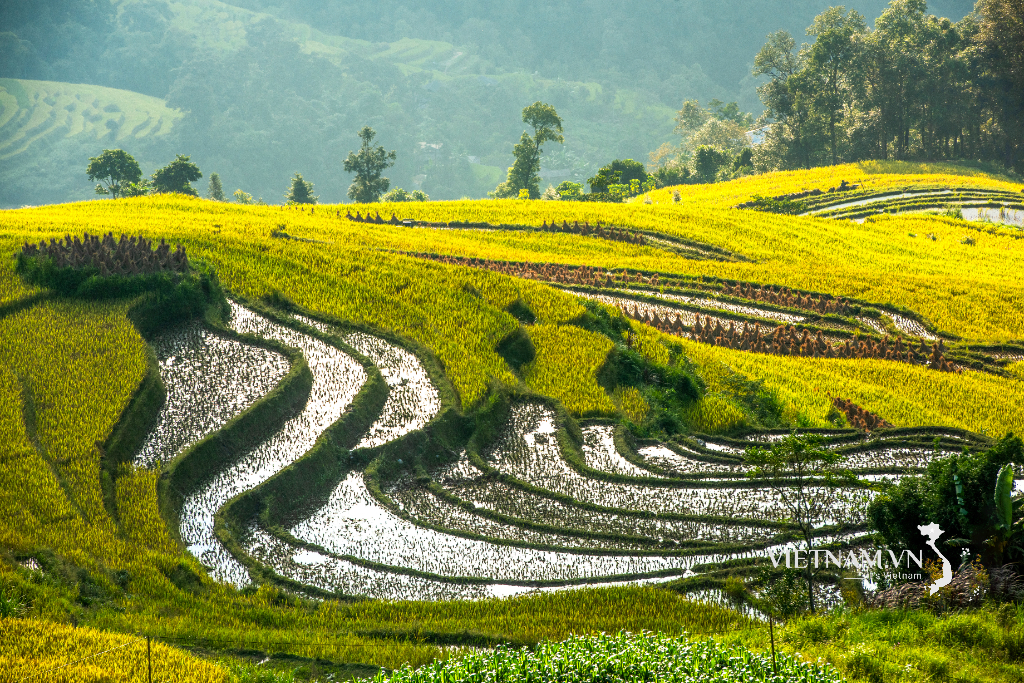
In mid-December, we arrived in Tay Yen commune, the earliest rice-growing area in the U Minh Thuong region. Following the paved roads along the canal banks, we saw vast fields of ripe, golden ST rice, its stalks heavy with grain, awaiting harvest. According to Mr. Nguyen Van Muc, although the price of rice this year is about 2,000 VND/kg lower than last year, the yield is higher. Mr. Muc shared: “On average, the rice yield this season here is around 800-900 kg/hectare. In some cases, people have achieved 1 ton/hectare.”
However, the early harvest joy of shrimp-rice farmers was not complete as rice prices tended to decline as the harvest season progressed. Mr. Tran Tap from Vinh Hoa commune, An Giang province, said: “Due to the impact of several unseasonal rains and fluctuations in the export market, the price of ST rice has gradually decreased. From over 9,000 to 10,000 VND/kg, the price of ST24 and ST25 rice is only 8,200-8,500 VND/kg. At this price, farmers still make a profit of 4-5 million VND/hectare.” According to Mr. Nguyen Van Cua from Phuoc Long commune, Ca Mau province, with an average ST25 rice yield of 800-900 kg/hectare, those who harvested early sold at 8,700-8,900 VND/kg, making a profit of 5-6 million VND/hectare, while currently the price is only 8,200-8,400 VND/kg, with a profit of about 4 million VND/hectare.”

Farmers in the U Minh Thuong rice-shrimp farming region rejoice at the high prices of freshwater prawns.
Giant freshwater prawns are expensive.
Before the start of this rice crop, farmers in the U Minh Thuong region also received good news regarding the high prices of freshwater prawns raised alongside rice. Mr. Tran Tap from Vinh Hoa commune, An Giang province, happily said: “This freshwater prawn crop is both bountiful and profitable. Last year, at this time, the price of freshwater prawns (20 prawns/kg) was only about sixty or seventy thousand dong, but this year the price is consistently 120,000-130,000 dong/kg. For larger freshwater prawns (10 prawns/kg and up), the price reaches 200,000 dong/kg, while those (12-15 prawns/kg) fetch 150,000 dong/kg.”
According to Ms. Trang Thi Tu Nga, one of the households with a long history of intercropping giant freshwater prawns in Vinh Binh commune, the yield is comparable to previous years' harvests, but thanks to a price increase of 30,000-50,000 VND/kg compared to the same period last year, profits have increased. Ms. Nga added: “Enzymed giant freshwater prawns sell for 150,000-160,000 VND/kg, while dead prawns sell for 90,000 VND/kg. This year, not only my family but most prawn farmers in the U Minh Thuong region have made high profits.” Ms. Nga also said that after the giant freshwater prawn and rice harvests, farmers will renovate their ponds, waiting for the water to reach sufficient salinity before filling them to start a new prawn season.
For the 2025-2026 rice-shrimp farming season, An Giang province has approximately 107,000 hectares; of which, 40,000 hectares are used by farmers to raise freshwater prawns in combination with rice-shrimp farming. Due to the very low stocking density, the average yield is around 350-650 kg/ha. Even so, with this area, the An Giang Department of Agriculture estimates a prawn production of nearly 20,000 tons. Ca Mau province, with the second largest rice-shrimp farming area, also has about 90,000 hectares, mainly concentrated in the areas north and south of National Highway 1A. In other provinces and cities, such as Can Tho and Vinh Long, although the rice-shrimp model still exists, the area is generally not large.
According to Mr. Pham Van Muoi, Deputy Director of the Ca Mau Department of Agriculture and Environment, the rotation of rice and shrimp farming not only helps farmers increase their income per unit of cultivated land but also creates clean, environmentally friendly agricultural products. Because this farming method uses fewer chemicals, farmers are producing rice that meets organic, VietGAP, and Global GAP standards, and shrimp that meets ASC standards, thus satisfying the stringent requirements of foreign export markets.
Text and photos: HOANG NHA
Source: https://baocantho.com.vn/lua-trung-mua-tom-trung-gia-a196728.html


Comment (0)